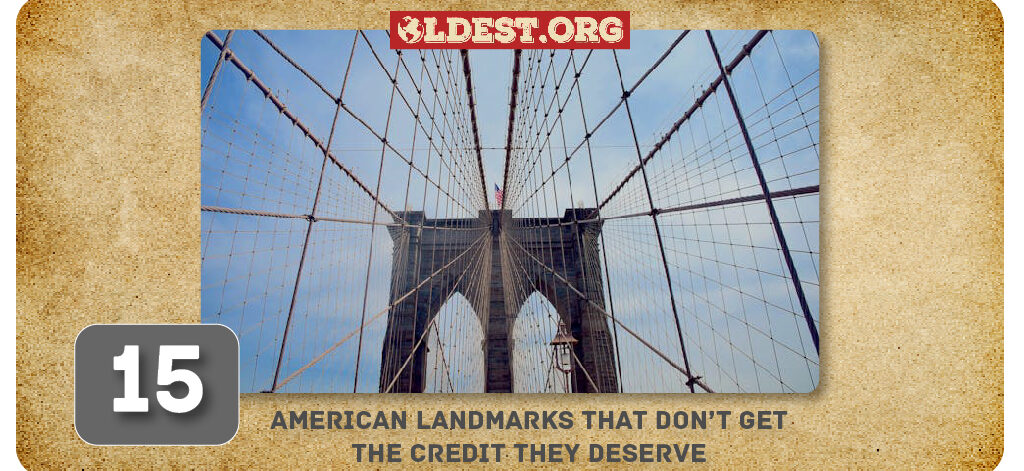
When people think of American landmarks, the same names tend to dominate the conversation. The Statue of Liberty. Mount Rushmore. The Golden Gate Bridge. They are iconic, yes. They also have great PR.
Scattered across the country are landmarks that shaped history, culture, and entire ways of life yet barely make it into school textbooks or travel bucket lists. Most of which we aren’t aware of, or have not been made aware of.
So slow down. Take the exit you usually skip. Here are 15 American landmarks that deserve far more credit than they get.
1. Cahokia Mounds, Illinois
CC BY 4.0, Link
Long before New York, long before Washington, there was Cahokia. At its peak around 1100 CE, Cahokia was the largest city north of Mexico, home to an estimated 20,000 people. That makes it larger than London at the same time. And yet, most Americans have never heard of it. The Cahokia Mounds are the remains of this vast Indigenous city, built by the Mississippian culture. Monks Mound, the largest earthen structure in the Americas, still rises dramatically from the Illinois landscape. It is reportedly bigger at its base than the Great Pyramid of Giza.
2. Angel Island Immigration Station, California
Public Domain, Link
From 1910 to 1940, Angel Island served as the primary immigration station for the West Coast. But unlike Ellis Island, which processed immigrants quickly, Angel Island was designed to exclude. Primarily targeting Asian immigrants, detainees were held for weeks, months, sometimes years, subjected to invasive interrogations. The poems carved into the wooden walls by detained immigrants is one of the main attractions there.
3. Fort Mose, Florida
CC BY-SA 4.0, Link
Fort Mose should be taught in every American history class. It was established in 1738 near present-day St. Augustine and was the first legally sanctioned free Black settlement in what is now the United States. It offered freedom to formerly enslaved people who escaped British colonies and converted to Catholicism under Spanish rule. It was a functioning community with families, farmland, and a militia that helped defend Spanish Florida.
4. The Serpent Mound, Ohio
CC BY-SA 3.0, Link
Stretching over 1,300 feet, the Serpent Mount is a massive effigy mound depicts a serpent swallowing an egg or possibly the sun. It was built by Indigenous peoples over a thousand years ago, it aligns with astronomical events like solstices and equinoxes. What’s striking is that the Serpent Mound serves no obvious practical purpose. It is not a burial site. It is not defensive. It seems to exist purely as symbolic or spiritual architecture.
Some overlooked landmarks have also endured neglect and damage—explore U.S. landmarks that have struggled with vandalism and the efforts to preserve them today.
5. The Pullman National Historical Park, Illinois
CC0, Link
Before labor laws were debated in Congress, they were fought for in places like Pullman. The Pullman neighborhood was built in the 1880s as a planned company town for workers who manufactured luxury railroad cars. The Pullman Strike of 1894 became one of the most significant labor uprisings in U.S. history. It forced the nation to reckon with workers’ rights, corporate power, and government intervention, making it one of the most iconic yet overlooked monuments in American history.
6. Chaco Culture National Historical Park, New Mexico
Public Domain, Link
Between 850 and 1250 CE, the Ancestral Puebloans built massive stone complexes here, some rising four or five stories high. These structures were connected by an extensive road system stretching for miles across the desert. The engineering precise of this place is astonishing. Buildings are aligned with lunar cycles. Stones were transported from far distances without pack animals or wheeled vehicles. The planning suggests a sophisticated understanding of astronomy, geometry, and social organization.
7. The Mississippi River Delta
Source: Canva
This region shaped American music in ways that still echo worldwide. Blues, jazz, rock and roll, gospel, and hip-hop all trace roots back to the Delta. It also played a central role in agriculture, trade, and the brutal realities of slavery and sharecropping. Its levees, towns, and floodplains tell stories of survival, creativity, and systemic injustice. So, when talking about iconic American landmarks, this one deserves a shoutout.
8. Castillo de San Marcos, Florida
Source: Canva
While wooden forts burned and collapsed, Castillo de San Marcos endured. This was built by the Spanish in the late 1600s and is the oldest masonry fort in the continental United States. It is made entirely out of coquina stone, which absorbed cannon fire instead of shattering. Over centuries, it changed flags multiple times, serving Spanish, British, and American interests and has housed prisoners, protected trade routes, and witnessed shifting empires.
9. The National Mall, Washington, D.C.
CC BY-SA 4.0, Link
Most people walk the National Mall with a checklist. Lincoln. Washington. Jefferson. Then they leave. But the Mall itself is one of America’s most important civic spaces. It has hosted protests, celebrations, marches, and moments of national reckoning. From the March on Washington to anti-war demonstrations, it has been the physical stage for democratic expression.
Many landmarks have also faced nature’s fury—learn about America’s deadliest earthquake and how it reshaped cities, history, and the built environment.
10. The Tenement Museum, New York City
CC BY 2.0, Link
The Tenement Museum is located on the Lower East Side and preserves the lived experiences of immigrant families who crowded into small apartments while building new lives in America. Each room tells a story of adaptation, sacrifice, and resilience. You will find cramped kitchens, shared bathrooms, and the quiet courage of ordinary people.
11. The Oregon Trail Ruts, Wyoming
CC BY-SA 3.0, Link
In places like Wyoming, you can still see deep ruts carved into stone by wagon wheels. These marks were made by thousands of settlers heading west in the 1800s. More than symbolism, they are physical evidence of movement, desperation, optimism, and endurance. The idea of westward expansion that you had somehow turns real when you stand beside these trail ruts.
12. Manzanar, California
Source: Reddit
Manzanar was one of ten internment camps where Japanese Americans were forcibly relocated during World War II. Families lost homes, businesses, and dignity. Many were U.S. citizens. The camp now stands as a stark reminder of how fear can override constitutional rights. So, remembering it matters.
13. The Great Kiva at Aztec Ruins, New Mexico
Source: Reddit
The Great Kiva was a massive ceremonial structure used for gatherings, rituals, and decision-making. Its scale suggests a society deeply invested in collective life. This was not architecture for elites. It was architecture for community. A visit down to this place almost feels radical and charged but not many Americans know of it or visit it as frequently.
14. Route 66
Source: Canva
Often (if not most of the times), we treat Route 66 as a kitsch. Neon signs. Diners. Nostalgia. But it was also a lifeline. It carried Dust Bowl refugees, postwar families, and generations searching for opportunity. Towns rose and fell along its path. It has a subtle attachment to history that not a lot of Americans talk about in the present day.
15. The Appalachian Trail
CC BY-SA 3.0, Link
A “different kind of landmark,” but the Appalachian Trail isn’t a structure, but a landmark worth exploring. Stretching over 2,000 miles, it connects forests, communities, and people. Built by volunteers, maintained by hikers, it represents cooperation across states and generations. It is one of the longest continuously protected footpaths in the world, yet one of the least-travelled spots in the U.S.
To see how these stories are preserved, explore some of the most amazing American museums that keep the nation’s overlooked history alive.
Final Words
The places on this list remind us that American history is layered, complicated, and often uncomfortable. It is built not only by presidents and generals, but by immigrants, laborers, Indigenous engineers, artists, and everyday people whose names rarely make headlines. Sometimes, the most meaningful places are the ones without crowds, gift shops, or blockbuster status. So, the next time you are setting out to explore American landmarks, consider these ones less talked about.
The post 15 American Landmarks That Don’t Get the Credit They Deserve appeared first on Oldest.org.