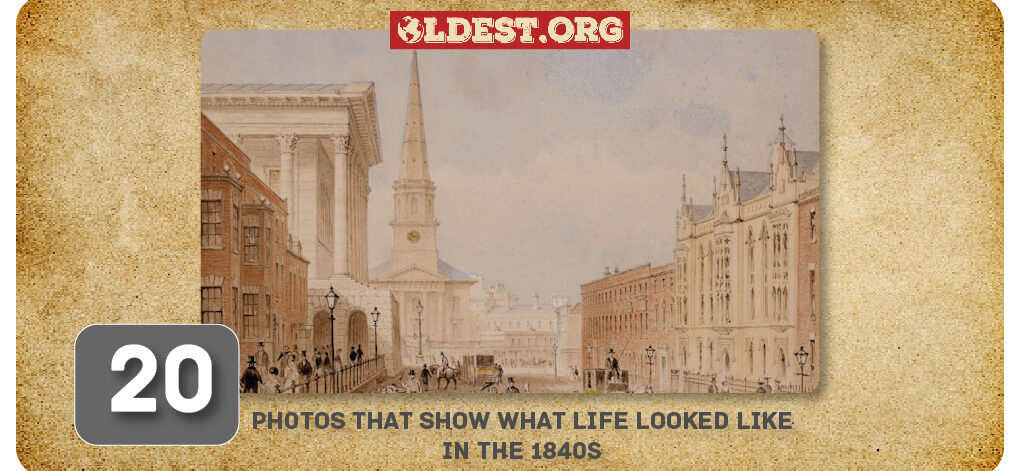
The 1840’s were a time of great change and transition. We were entering a new era of industrialization, while photography was still in its infancy, and people’s lives were completely different from those of today.
The first photographs taken during this period were rare opportunities for us to see how people lived, worked, dressed, travelled, and interacted with one another, as well as what social status things were at the time. These photographs have historical significance and can be seen as time machines, allowing us to experience what it was like to be alive at that time.
1. Early Daguerreotype Portraits of Everyday People
Source: Reddit
Early daguerreotype portraits from the 1840s capture ordinary men and women with striking seriousness. Because exposure times were long, subjects had to sit perfectly still, resulting in stiff postures and solemn expressions. These images are relevant because they mark the first time non-elite individuals could preserve their likeness. Unlike painted portraits reserved for the wealthy, daguerreotypes democratized memory and identity during the 1840s.
2. Factory Workers During the Industrial Revolution
Source: Reddit
Photos of factory workers from the 1840s reveal crowded interiors filled with machinery, smoke, and laborers of all ages. Men, women, and even children worked long hours in harsh conditions. These images are relevant because they visually document the human cost of early industrialization. They show how factories reshaped daily life, moving work from homes and farms into dangerous, tightly controlled industrial spaces.
3. Street Scenes in Growing Industrial Cities
Public Domain, Link
Street photographs from the 1840s show narrow roads packed with horse-drawn carts, pedestrians, and early storefronts. Cities were expanding rapidly, often without proper infrastructure.
These images matter because they capture the birth of modern urban life which was crowded, noisy, and chaotic. They also show stark class divides, with wealthy districts and working-class neighborhoods often separated by just a few streets.
4. Women’s Fashion in the 1840s
Source: Reddit
Photographs of women in the 1840s highlight high-waisted dresses, fitted bodices, and full skirts supported by layers of fabric. Hair was neatly parted and styled, reflecting strict social norms. These images are relevant because fashion symbolized morality, class, and femininity.
Clothing was not just decorative, but it also communicated respectability and social standing in a time when appearances carried enormous social weight.
Step back in time with some of the oldest photos of London, capturing early urban life and historic streets.
5. Men’s Formal and Working-Class Clothing
Source: Reddit
Men’s fashion photos from the 1840s show a clear divide between formal and working-class attire. Middle- and upper-class men wore tailored coats and waistcoats, while laborers appeared in worn shirts and trousers.
These images are relevant because they visually represent economic inequality. Clothing immediately signaled a man’s profession and social position, making class distinctions unavoidable in daily interactions.
6. Rural Farm Life in the 1840s
Source: Reddit
Images of rural farms show families working fields by hand, using basic tools and animal labor. Life revolved around seasons, weather, and survival. These photos are relevant because they remind us that despite industrial growth, most people still lived agrarian lives. Farming demanded constant physical labor, and these images capture the simplicity and hardship of rural existence in the 1840s.
7. Early Railroads and Steam Trains
Public Domain, Link
Photographs of steam locomotives from the 1840s showcase massive engines surrounded by curious crowds. Railways were revolutionary, shrinking travel times and connecting distant regions. These images are relevant because they represent technological optimism and economic change. Trains transformed trade, migration, and communication, making the 1840s a turning point in how people experienced distance and mobility.
8. Family Portraits and Domestic Life
Source: Reddit
Family portraits from the 1840s often feature parents and children posed formally inside modest homes. The seriousness reflects both photographic limitations and cultural values. These images are relevant because they show family structure, gender roles, and domestic priorities. Homes were central to life, serving as workplaces, schools, and social spaces in an era before modern conveniences.
9. Child Labor in the 1840s
Source: Reddit
Photos of child laborers show young children working in factories, mines, and workshops. Their small frames were often exploited for dangerous tasks. These images are relevant because they expose a harsh reality of 1840s life, childhood was often sacrificed for family survival. They later fueled reform movements and labor laws by making exploitation visible to the public.
10. Early Medical Practices and Hospitals
Public Domain, Link
Hospital images from the 1840s depict sparse rooms, minimal equipment, and patients treated without modern anesthesia or sanitation. These photos are relevant because they show how limited medical knowledge was at the time. Illness and injury were common and often fatal, making health a constant concern. The images highlight how far modern medicine has evolved since this era.
To explore lives full of unrealized potential, discover historical figures who could have been the greatest, but were shaped by circumstance and fate.
11. Immigrant Communities and Arrival Ports
Source: Reddit
Photos of immigrant arrivals show crowded docks filled with families carrying belongings. Many were fleeing famine, poverty, or political unrest. These images are relevant because they capture the beginning of mass migration that reshaped nations. The 1840s marked a period of hope and uncertainty, as immigrants sought opportunity while facing discrimination and hardship.
12. Religious Gatherings and Churches
Source: Canva
Church photographs from the 1840s show large congregations gathered in simple buildings. Religion played a central role in community life and moral guidance. These images are relevant because they illustrate how faith structured weekly routines and social norms. Churches were not just spiritual centers but also hubs for education, charity, and social connection.
13. Markets and Street Vendors
Public Domain, Link
Images of street markets show vendors selling produce, meat, and handmade goods in open-air settings. These markets were essential for daily survival. The photos are relevant because they demonstrate how commerce functioned before supermarkets and refrigeration. Shopping was a social activity, and markets reflected local economies, seasonal food availability, and class interactions.
14. Military Life and Uniforms
Public Domain, Link
Military photographs from the 1840s show soldiers in formal uniforms, often posed with weapons. These images are relevant because the decade was marked by political unrest and conflict in many regions. Military service was a significant part of national identity, and uniforms symbolized discipline, authority, and loyalty during a time of expanding empires and revolutions.
15. Cemeteries and Mourning Traditions
Public Domain, Link
Photos related to mourning show families dressed in black, often posed near graves or in mourning attire. Death was a frequent presence due to disease and limited medicine. These images are relevant because they reveal how openly society confronted mortality. Mourning rituals were structured and prolonged, reflecting the emotional and cultural weight of loss in the 1840s.
Learn how modern living spaces evolved by exploring the history of mobile homes and their impact on flexible lifestyles.
Conclusion
The 1840s were a tumultuous decade shaped by many forces, including technology, tradition, and labor; these 15 photos illustrate these changes by providing ample examples of people affected by them.
Factory workers, farmers, family members, and pedestrians all faced similar challenges as they tried to cope with the ever-evolving pace of civilization. Together, these 15 images represent a unique and priceless archival collection documenting the successes, struggles, and daily lives of people living in the 1840’s.
The post 15 Photos That Show What Life Looked Like In The 1840s appeared first on Oldest.org.