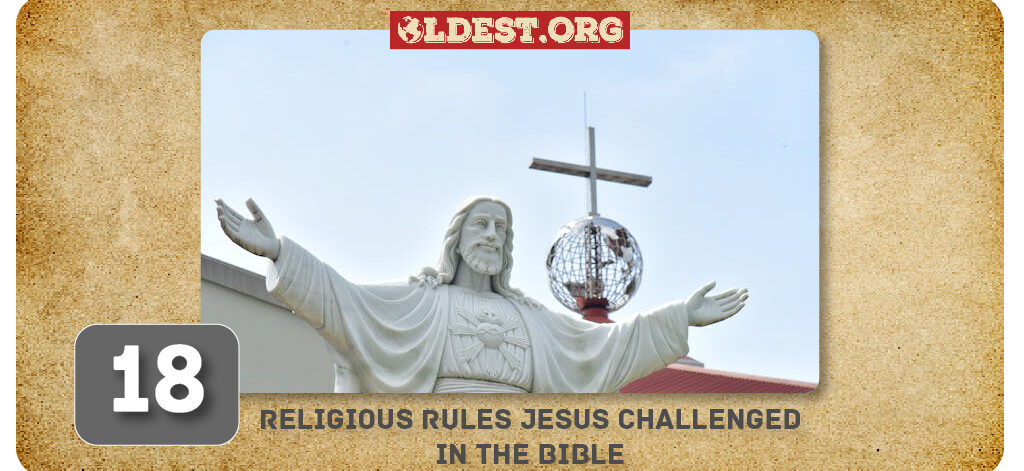
Often remembered as gentle, compassionate and deeply spiritual, Jesus was also the most radical rule breaker of all time. Instead of simply preaching about faith and religion, he questioned, confronted and outright challenged a lot of the rules.
What we fail to understand often is that Jesus didn’t challenge them to be a rebellion but challenged rules when they became tools of control, exclusion, or hypocrisy. He pushed back when laws meant to bring people closer to God were instead pushing them away.
Below are 18 religious rules that Jesus challenged in the Bible that deserve to be discussed, highlighted and talked about.
1. Sabbath Work Restrictions
Source: Canva
One of the most frequent clashes Jesus had with religious leaders revolved around the Sabbath. According to Jewish law, no work was permitted on this sacred day of rest. Jesus healed people on the Sabbath. He allowed his disciples to pick grain. When confronted, his response was strikingly simple. The Sabbath was made for people, not people for the Sabbath.
2. Ritual Handwashing Before Meals
Source: Canva
Religious leaders criticized Jesus’ disciples for eating without performing ceremonial handwashing. This wasn’t about hygiene but more so about ritual purity. Jesus challenged the obsession with external cleanliness. He argued that what comes out of a person’s heart matters far more than what goes into their mouth.
3. Dietary Purity Laws
Source: Canva
Jewish dietary laws were extensive and strictly enforced. Certain foods were considered unclean and forbidden. Jesus disrupted this framework by declaring that no food could spiritually defile a person. This was revolutionary. For early Christians, this teaching reshaped how diverse communities could gather and worship together without cultural barriers.
4. Strict Interpretation of Divorce Laws
Source: Canva
Religious law allowed men to divorce their wives with relative ease. Many used this rule to justify abandonment and exploitation. Jesus challenged this interpretation by focusing on responsibility and faithfulness. He taught that divorce wasn’t meant to be casual or self-serving. His concern was less about legal loopholes and more about the human cost of broken commitments.
Many traditions are built on stories passed down for centuries, but when you compare religious beliefs with historical reality, the differences can be surprising and sometimes uncomfortable.
5. Exclusion of “Sinners” from Religious Life
Source: Canva
Tax collectors, prostitutes, and others labeled as sinners were routinely excluded from respectable religious society. Jesus did the opposite. He ate with them. He spoke to them publicly. He welcomed them into his circle. It was intentional defiance of a religious culture that treated moral failure as a permanent stain.
6. Temple-Centered Worship as the Only Path to God
Source: Canva
The Temple in Jerusalem was considered the exclusive dwelling place of God’s presence. Jesus challenged this idea when he told the Samaritan woman that true worship wasn’t about location. It was about spirit and truth. Jesus made worship accessible to everyone, regardless of geography or status.
7. Religious Authority Based on Status and Titles
Source: Canva
Jesus repeatedly confronted religious leaders who loved public recognition, honorific titles, and visible authority. He warned his followers not to seek power in the same way. Leadership, he said, was about service, not status. The greatest among you should be the servant of all, is what he believed and preached.
8. The Rule of Retaliation
Source: Canva
“An eye for an eye” was a legal principle meant to limit revenge. Over time, it became a justification for retaliation. Jesus took it further. He taught nonviolence, forgiveness, and radical restraint. Turn the other cheek. Love your enemies.
9. Oaths and Religious Swearing
Source: Canva
People often used religious oaths to signal honesty. Swearing by heaven or by God’s name was common practice. Jesus rejected this entirely. He taught that integrity should be so consistent that oaths were unnecessary. Let your yes be yes, and your no be no. According to Him, truthfulness was a way of life and not a performative streak.
10. Gender-Based Religious Limitations
Photo by Ivan S
Women in Jesus’ time were largely excluded from formal religious education and leadership. Jesus broke these norms repeatedly. He taught women publicly, defended them against public shaming, and included them among his followers. Women were also the first witnesses to his resurrection, a detail that would have seemed culturally implausible if invented.
11. Punitive Interpretation of the Law
Photo by Pixabay
Religious leaders often emphasized punishment over restoration. Jesus shifted the focus. When a woman caught in adultery was brought before him, he refused to participate in her execution. Instead, he exposed the hypocrisy of her accusers and offered her a path forward.
Many people are surprised to learn how misunderstood religious laws can be, much like the common misconceptions about the Ten Commandments that have developed over centuries.
12. Public Displays of Religious Piety
Source: Canva
Prayer, fasting, and charity were often performed publicly to demonstrate righteousness. Jesus criticized this sharply. He warned against turning spiritual practices into performances. True devotion, he said, happens in private, away from applause. The focus was to reward sincerity over visibility.
13. Rigid Interpretation of the Law Over Human Need
Photo by Grzegorz Sękulski
Time and again, Jesus prioritized people over procedures. When confronted with suffering, he refused to delay compassion for the sake of compliance. Whether healing on the Sabbath or touching those deemed unclean, he consistently chose human need over rigid rule enforcement. It was all about moral clarity.
14. Purity Laws That Isolated the Sick
Source: Canva
Those with leprosy and other illnesses were considered ritually unclean and socially untouchable. Jesus touched them anyway. By doing so, he reversed the logic of contamination. Instead of impurity spreading, healing did. Instead of exclusion, restoration followed. Such acts of Him challenged deeply ingrained fears embedded in religious law.
15. The Belief That Wealth Signified Divine Favor
Source: Canva
Many believed material prosperity was a sign of God’s blessing. Jesus disrupted this belief by warning that wealth could become a spiritual obstacle. He emphasized generosity, detachment, and care for the poor. This challenged a comfortable theology that equated success with righteousness.
16. Legalism Over Love
Photo by Andreas Schnabl
At the heart of many religious disputes was legalism. Rule-following had become the goal. Jesus summarized the entire law in two commandments: love God and love your neighbor. Everything else, he said, flowed from that. It was primarily a recalibration of people’s priorities.
17. Religious Boundaries Between Ethnic Groups
Photo by Huy Nguyễn
Jews and Samaritans avoided one another due to deep religious and ethnic divisions. Jesus crossed these boundaries deliberately. He spoke with Samaritans, healed them, and made them heroes in his parables. In doing so, he challenged the idea that God belonged to one group alone. His actions established a message of inclusion, love, and salvation that transcended ethnic, cultural, and social divisions.
18. The Idea That Righteousness Is Earned
Source: Canva
Perhaps the most profound challenge Jesus issued was to the belief that righteousness could be earned through rule compliance. Instead, he taught grace and forgiveness. Transformation that begins with humility rather than achievement. Faith, in his message, was relational, not transactional.
Jesus’ willingness to challenge rigid traditions is closely tied to the powerful life lessons from Jesus that still resonate far beyond religious boundaries today.
Final Words
Jesus didn’t abolish faith. He rescued it from becoming a system that valued rules more than people. Every rule he challenged had one thing in common. It had drifted away from compassion, justice, or humility. Jesus’ message remains unsettling because it asks uncomfortable questions. Are our rules serving love, or replacing it? Are they opening doors, or quietly closing them? Two thousand years later, his rule-breaking still invites us to rethink what faith is really for. And maybe that’s the point.
The post 18 Religious Rules Jesus Challenged in the Bible appeared first on Oldest.org.