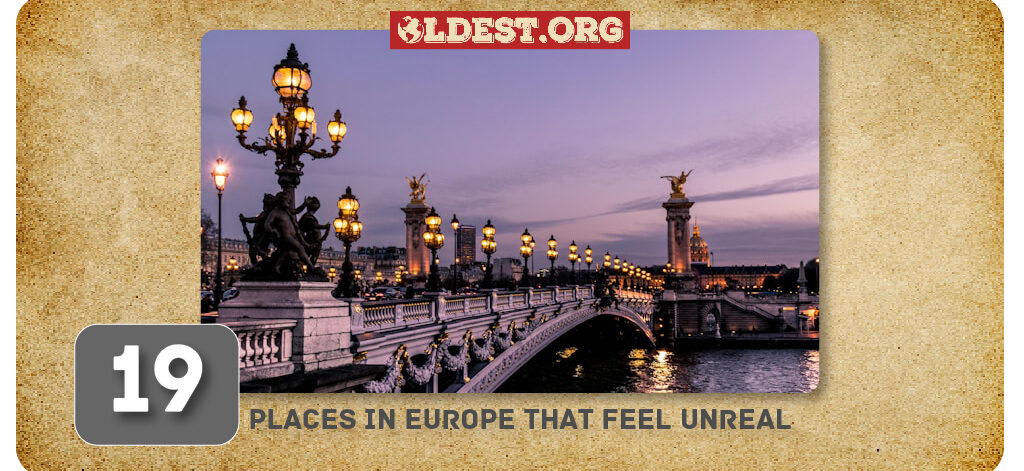
Europe hides corners so dreamlike they challenge reality. These dreamlike places transcend ordinary travel, offering experiences that blur the line between the possible and the imagined. Here are 19 European escapes that show the world still holds real magic.
19. Hallstatt, Austria
Source: Canva
This alpine village clings to a crystalline lake beneath soaring peaks, its pastel chalets stacked like a painter’s fantasy. Salt mines burrowed into the mountains have been harvested for over 3,000 years, adding ancient mystique to the already enchanting scenery. Plan your visit between May and June when wildflowers blanket the hillsides and temperatures hover around a pleasant 15-25°C, letting you explore without the crushing summer tourist waves.
18. Lake Bled, Slovenia
Source: Canva
An emerald lake cradles a tiny island crowned by a baroque church, while a medieval castle watches from dramatic cliffs above. Locals say rowing to the island and ringing the church bell grants wishes—a tradition that draws romantics year-round. April through May or September to October delivers ideal hiking weather around 20-25°C and thinner crowds, perfect for capturing that iconic shot without a hundred strangers in frame.
17. Český Krumlov, Czech Republic
Source: Canva
A UNESCO-listed medieval core spirals around a meandering river, dominated by a Renaissance castle that seems lifted from a fairy tale. Summer brings whitewater rafters splashing through town, adding energy to cobbled streets lined with centuries-old buildings. Visit in May, early June, or September for comfortable weather and autumn’s golden hues without battling peak-season congestion.
16. Colmar, France
Source: Canva
Half-timbered houses in candy colors line canal-laced streets in this Alsatian gem, often called “Little Venice” for its waterway charm. The town anchors famous wine routes that wind through vine-covered hills, offering tastings of crisp Rieslings and aromatic Gewürztraminers. Late spring or fall transforms the region into a tapestry of blooms or harvest colors, with local festivals celebrating the grape bounty.
If you’re fascinated by Europe’s diversity, explore some of the most remarkable cities in Europe, where history, culture, and modern life blend seamlessly across the continent.
15. Meteora, Greece
Source: Canva
Eastern Orthodox monasteries hover atop 400-meter sandstone pillars that shoot skyward like natural skyscrapers. Monks once ascended via rope baskets and retractable ladders; today’s visitors hike winding paths to discover centuries-old frescoes glowing in candlelit chambers. Target late spring (March through May) or fall (September to November) when clear skies and lighter crowds make the climbs manageable and the views breathtaking.
14. Lauterbrunnen, Switzerland
Source: Canva
Seventy-two waterfalls thunder down sheer cliffs into this impossibly green valley, a landscape so otherworldly it inspired Tolkien’s Rivendell. Traditional Swiss chalets dot meadows where paragliders launch into alpine skies, seeking the ultimate aerial perspective. May through June unleashes peak waterfall flow as snowmelt cascades down, with temperatures maxing around 18°C—perfect for trail exploration without sweltering.
13. High Tatras, Slovakia
Source: Canva
Jagged granite peaks pierce the sky above glacial tarns in this compact alpine paradise where brown bears still roam wild. Unlike the overcrowded Alps, these mountains offer solitude along rugged trails threading through pristine wilderness. June through September guarantees snow-free paths and meadows exploding with wildflowers, ideal for trekking without the Alpine price tags or tourist hordes.
12. Sagrada Família, Barcelona
Source: Canva
Gaudí’s unfinished basilica defies architectural conventions with tree-like columns branching toward heaven and stained glass that bathes interiors in kaleidoscopic light. After 140 years of construction, this living artwork continues evolving, each visit revealing new completed sections. Spring or fall sidesteps Barcelona’s scorching heat and endless queues, letting you absorb the intricate biomimicry in relative peace.
11. Pena Palace, Sintra
Source: Canva
A Romanticist fever dream in eye-popping yellows and reds crowns misty hilltops just outside Lisbon. This 19th-century palace hides secret tunnels and exotic gardens where ferns grow prehistoric-sized in the Atlantic humidity. Spring amplifies the magic with blooming camellias and rhododendrons, all accessible via a 40-minute train ride from Portugal’s capital.
For more natural beauty, explore the world’s most stunning botanical gardens, where rare plants, scenic landscapes, and centuries of horticultural history come together.
10. Budapest Ruin Bars
Source: Canva
Abandoned factories in the Jewish Quarter have been transformed into surreal nightlife spaces dripping with graffiti art, mismatched furniture, and installations made from reclaimed junk. Each bar creates its own bizarre universe—one features a car suspended from the ceiling, another a bathtub filled with ice and drinks. Summer festivals crank up the already electric atmosphere, but any evening delivers Budapest’s signature offbeat energy.
9. The Azores, Portugal
Source: Canva
Nine volcanic islands punch through the Atlantic, offering crater lakes in shocking blues, geothermal hot springs, and colonies of comical puffins. The isolation preserves ecosystems where whales breach offshore and hydrangeas grow wild along country roads. May through October balances mild weather with optimal whale-watching, though the islands’ subtropical climate means occasional soft rains add to the mystical vibe.
8. Monsanto, Portugal
Source: Canva
Megalithic boulders didn’t just inspire this village—they dictate its architecture, with houses wedged beneath and between massive rocks that dwarf human structures. Some boulders serve as roofs or walls, creating a settlement that feels half-carved from the mountain itself. Spring or fall brings comfortable temperatures for hiking the surrounding trails, where medieval ruins emerge from wild herb-scented hillsides.
7. Vik, Iceland
Source: Canva
Black volcanic sand beaches stretch beneath dramatic sea stacks and hexagonal basalt columns being eternally pounded by the North Atlantic. Puffins nest on nearby cliffs in summer, their colorful beaks bobbing as they survey the moody coastline. June through August offers the midnight sun and nesting birds, though the stark beauty persists year-round for those who brave Iceland’s wilder seasons.
6. Theth, Albania
Source: Canva
Stone towers built for blood feuds rise from this remote valley in the Accursed Mountains, where Ottoman-era codes once governed highland life. Shepherd trails connect the village to even more isolated hamlets, threading through landscapes that remain largely untouched by modern development. Summer opens the high passes for trekking, revealing Albania’s raw beauty before winter snows seal the valleys again.
To dive deeper into Europe’s past, explore the oldest buildings in Europe, where ancient architecture and history still stand as living testaments to earlier civilizations.
5. Faroe Islands, Denmark
Source: Canva
Eighteen volcanic islands erupt from the North Atlantic between Iceland and Norway, cloaked in emerald grass that glows against dark cliffs. Turf-roofed houses blend into hillsides where sheep outnumber people, and waterfalls plunge directly into the churning sea. June through August provides the most daylight and mildest weather for exploring these windswept outposts that feel positioned at the edge of the world.
4. Rila Monastery, Bulgaria
CC BY-SA 3.0, Link
Candy-striped arches and vibrant frescoes cover this 10th-century monastery nestled in Bulgaria’s highest mountains. Founded by a hermit saint, the complex survived Ottoman rule and fires to preserve thousands of medieval manuscripts and icons. Spring through early fall allows access without snow blocking mountain roads, revealing a spiritual sanctuary that appears frozen in Byzantine splendor.
3. Civita di Bagnoregio, Italy
Source: Canva
A medieval town balances atop an eroding volcanic plateau, connected to the modern world by a single pedestrian bridge. Called “the dying city” because the surrounding rock crumbles away, it survives as a time capsule of Renaissance Italy with only a dozen permanent residents. Visit during shoulder seasons to avoid crowds while exploring the fragile stone streets before geology reclaims them.
2. Plitvice Lakes, Croatia
Source: Canva
Sixteen crystalline lakes cascade into each other via travertine barriers that shift and grow each year, creating an ever-changing water staircase. Wooden walkways weave over turquoise pools and beneath thundering waterfalls, surrounding visitors with liquid beauty in impossible shades of blue and green. Spring and fall deliver spectacular colors—whether from blooms or foliage—with fewer visitors than summer’s overwhelming peak.
1. Giethoorn, Netherlands
Source: Canva
This canal village bans cars entirely, relying instead on boats and footbridges to connect thatched-roof farmhouses. Originally settled by peat diggers whose excavations created the waterways, it earned the nickname “Venice of the North” despite its rural tranquility. Spring through summer transforms gardens into explosions of tulips and roses, best explored by renting a whisper-boat to glide through the peaceful channels.
If you’re curious about Europe’s deep cultural roots, explore the history of written languages, tracing how early scripts shaped communication and civilization.
Conclusion
These 19 destinations in Europe still harbor genuine wonders for those willing to venture beyond the usual circuits. Each location offers something photographs struggle to capture and that the human eye can’t get enough of. One thing’s for sure: these spots promise experiences that linger long after you return home.
The post 19 Places In Europe That Feel Unreal appeared first on Oldest.org.