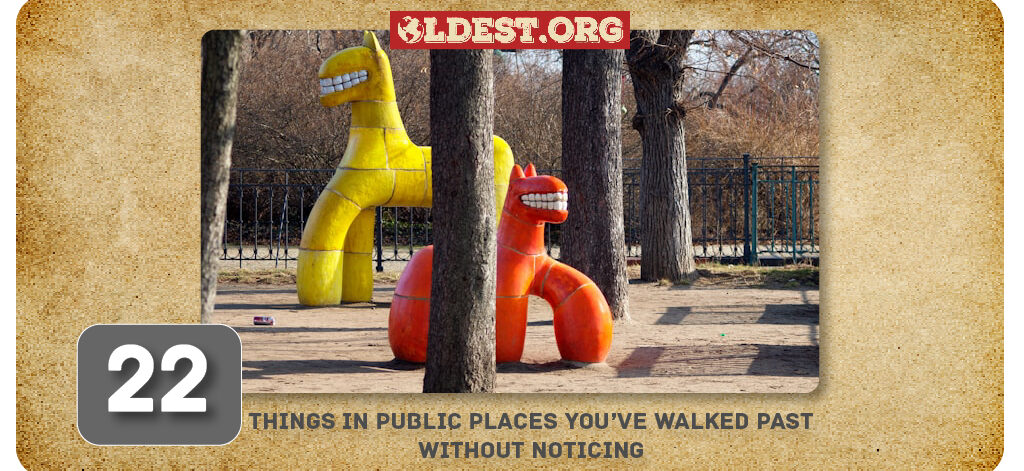
You probably think you’re observant. You notice new cafés opening on your street, potholes forming on familiar roads, and that one bench in the park that’s always occupied.
But here’s the uncomfortable truth. Most of us move through public spaces on autopilot. We walk, wait, sit, scroll, repeat. And while we’re busy getting from Point A to Point B, the world quietly carries on around us, filled with small details that exist for a reason but rarely get a second glance.
Here are 22 things in public places you’ve almost certainly walked past hundreds of times without really noticing. Fair warning. After this, your everyday walks may never feel the same again.
1. Those Small Metal Dots Embedded in Sidewalks
Source: Reddit
You’ve stepped on them countless times without thinking. Those small, raised metal dots or bumpy tiles on sidewalks are tactile paving. They exist for visually impaired pedestrians, helping them navigate crossings, stairs, and platform edges through touch.
2. The Slight Tilt of Public Benches
Photo by Sonder Quest on Unsplash
Ever wondered why some benches feel just a bit uncomfortable? That’s not bad craftsmanship. Many public benches are slightly tilted or have armrests placed at odd intervals. The idea is to discourage people from lying down for long periods.
3. Why Trash Cans Often Have Small Openings
Source: Canva
Those narrow openings on trash cans aren’t just about aesthetics. They’re designed to prevent people from stuffing large household trash inside, reduce scavenging by animals, and sometimes even discourage theft or vandalism.
4. The Extra Thick Line at Pedestrian Crossings
Photo by Jacek Dylag on Unsplash
Look closely at crosswalks and you’ll often notice a thicker line or an extra marking near the curb. This is usually a stopping guide for visually impaired pedestrians and sometimes for vehicles as well.
Explore the most crowded yet peaceful gatherings where massive crowds come together in harmony and shared purpose.
5. Why Public Bathrooms Have Gaps in the Doors
Photo by Austin on Unsplash
It’s awkward. Everyone notices it but no one talks about it. Those gaps in public restroom stalls are there for multiple reasons. They allow for easier cleaning, discourage illegal activity, and make it possible to check if someone inside needs help.
6. The Slight Curve in Park Pathways
Photo by Samu Silva on Unsplash
Straight paths would be faster, so why are park walkways often gently curved? Because curves slow people down. Designers use these curves to encourage leisurely walking, reduce cycling speeds, and make parks feel less like transit routes.
7. Why Handrails Are Often Warm to the Touch
Photo by Anthony Rae on Unsplash
In busy public spaces, handrails are designed using materials that quickly adjust to ambient temperature. Cold metal discourages use, while warmer surfaces feel more inviting. This subtle choice increases safety by encouraging people to hold on, especially on stairs and ramps.
8. The Height of Public Mirrors
Photo by Kenny Miller on Unsplash
Mirrors in public restrooms, elevators, and changing areas are often placed slightly higher than expected. This isn’t accidental. It’s meant to accommodate a wide range of heights and reduce vandalism.
9. Why There Are No Sharp Corners in Playgrounds?
Photo by Power Lai on Unsplash
Modern playgrounds avoid sharp edges wherever possible. Rounded corners, soft materials, and curved designs reduce injury risk. What you might not notice is how deeply regulated these spaces are.
10. The Unusual Placement of Public Clocks
Photo by Teodora Popa on Unsplash
Instead, public clocks positioned higher up, visible from a distance. This makes them useful reference points rather than distractions. They help people orient themselves in space, especially in large transit hubs or open plazas.
11. The Texture Change Before Stairs Begin
Source: Canva
That slight shift in floor texture before stairs or escalators is intentional. It’s another accessibility feature designed to alert people, especially those with visual impairments, that a change in elevation is coming.
Discover historic U.S. sites closed to the public and uncover the stories behind these hidden landmarks.
12. Why Public Wi-Fi Signs Are So Visible?
Photo by Ajay Lamichhane
Public Wi-Fi signs are often oversized and brightly colored. They serve two purposes. First, they let people know connectivity is available. Second, they encourage people to gather in specific areas, which helps cities manage crowd flow and usage patterns.
13. Why Public Signs Use Simple Fonts?
Photo by Erik Mclean
Public signage almost always uses clean, sans-serif fonts. These fonts are easier to read at a distance, in poor lighting, and for people with dyslexia or visual impairments.
14. Escalator Brushes That Keep You Safe
Photo by Taiki Ishikawa on Unsplash
Look along the base of an escalator and you’ll notice brush-like strips running along the sides of the steps. They’re not there to clean your shoes. They’re designed to gently guide loose clothing, shoelaces, or bags away from the dangerous gap where you could get caught.
15. Fire Hydrants with Oddly Shaped Bolts
Source: Canva
In many cities, fire hydrants have five-sided bolts. That’s not an aesthetic choice. The oddly shaped bolt heads require a special wrench that most people don’t carry, preventing unauthorized folks from opening the hydrant or tampering with it.
Explore historic libraries and uncover the timeless stories and treasures housed in these cultural landmarks.
15. Subway Platforms That Slope Towards the Tracks
Source: Reddit
Those slight angles you notice on some subway platforms aren’t sloppy construction. The tiny slope helps control water runoff, makes cleaning easier, and subtly discourages people from standing too close to the platform’s edge.
16. Bollards That Are More Than Just Ugly Posts
Photo by Marek Lumi on Unsplash
Those short posts near sidewalks aren’t just decoration or an obstacle. They protect pedestrians from errant cars, provide anchor points for lighting or temporary fencing, and often hide cables or sensors.
17. Emergency Buttons in “Quiet” Places
Source: Reddit
You might notice emergency call buttons tucked near elevator landings or stairwells. Designers place them in spots where people naturally hesitate, so they’re easier to find when needed.
18. Public Bathrooms Designed to Self-Clean
Source: Canva
In some cities, public restrooms have automatic features like timed flushes, self-rinsing floors, and motion-sensor sinks. These are there to keep sanitation high and improve access for everyone without a human attendant.
19. Hidden Accessibility Ramps Up Against Buildings
Source: Canva
Some older buildings hide accessibility ramps behind landscaping or under awnings so they don’t disrupt historical facades. These out-of-the-way ramps make spaces more inclusive.
20. The Tiny Grooves in Floors
Source: Canva
You probably think those diagonal lines on the ground are just a choice made by an architect who liked geometric patterns, but they’re actually doing a lot of heavy lifting. These grooves are the unsung heroes of public flooring, designed to funnel away water, mud, and slush so you don’t end up doing an accidental backflip on your way to work.
21. Parking Lot Lines
Source: Canva
We usually only notice these lines when someone decides to park diagonally across three of them, but they’re actually doing a lot more than just marking a spot for your car. Think of them as a silent language of cooperation. Without these yellow stripes, a grocery store parking lot would turn into a high-stakes game of bumper cars within minutes.
Discover fascinating archaeological sites that reveal ancient civilizations and the mysteries of our past.
22. The Metal Curb Ramp
Source: Reddit
At first glance, this looks like someone just forgot a piece of scrap metal on the sidewalk, but it’s actually a small piece of engineering that makes the world accessible. These ramps are the bridge between the sidewalk and the street, turning a potentially ankle-twisting drop into a smooth transition for everyone.
Final Words
Most of these things aren’t flashy. They don’t announce themselves. They just quietly do their jobs so we can move through the world a bit more safely, a bit more comfortably, and with a bit more ease. So, the next time you cross a street, wait for a bus, or stroll through a plaza, take a second to slow down and really see your surroundings.
The post 22 Things in Public Places You’ve Walked Past Without Noticing appeared first on Oldest.org.