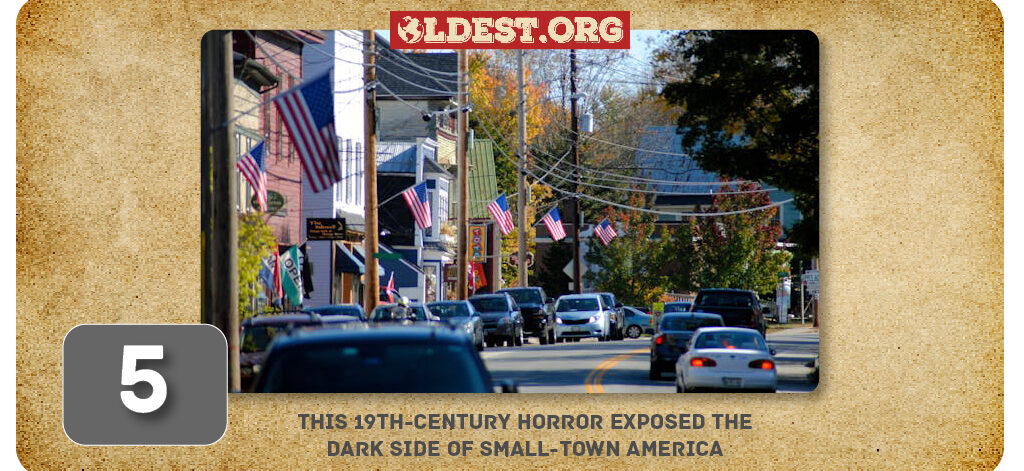
In the quiet woods of Northwood, New Hampshire, autumn 1872 brought a nightmare that would forever shatter the illusion of small-town safety. When 13-year-old Georgianna Lovering vanished after a simple errand for her great-uncle, the ensuing investigation would uncover not just a brutal murder, but the hidden darkness lurking within a seemingly respectable family man. This case marked a turning point in how America viewed both the safety of its rural communities and the monsters that could hide in plain sight.
An Innocent Girl In A Tight-Knit Community
Source: Reddit
Georgianna “Georgie” Lovering embodied the quintessential rural New England childhood. The pretty, modest 13-year-old spent her days helping with family chores and duties, fully embraced by Northwood’s close community. On September 24, 1872 (some sources cite October 25), she left home on what should have been a routine task—checking bird snares in the woods at her great-uncle’s request. She never returned. In a town where everyone knew everyone, Georgie’s disappearance sent shockwaves through the community, igniting fears no one had previously dared imagine.
When Georgianna failed to come home, neighbors stumbled upon chilling clues: her broken comb, a torn apron, and unmistakable signs of a violent struggle near the forest edge. Over 100 residents grabbed lanterns and flooded into the darkening woods, their search illuminating both the terrain and growing suspicions. Eyes turned toward Franklin B. Evans—Georgie’s own great-uncle. His stories kept shifting, his behavior during the search struck others as disturbingly odd, and whispers surfaced about prior improper advances toward the girl. Sheriff Henry Drew confronted Evans, employing a controversial tactic: plying him with liquor until his defenses crumbled and the horrifying truth spilled out.
The Confession That Revealed A Monster
Source: Canva
Evans finally broke, confessing to the unthinkable and leading searchers to Georgianna’s mut*lated body hidden in a swampy hollow. The scene devastated everyone who witnessed it—she had been strangled, violated after death, and grotesquely dismembered with organs removed. This wasn’t just murder; it was depravity that exceeded the community’s darkest fears. The man they’d trusted as family had committed an act so heinous it would echo through New England’s history for generations.
The Man Behind The Mask
Public Domain, Link
Born in 1807 in Strafford, New Hampshire, Franklin B. Evans spent 66 years perfecting a facade of respectability while living a parasitic existence. He drifted through New England and Canada, posing as a botanist and itinerant preacher while scamming relatives and strangers alike. Three failed marriages marked his trail, along with elaborate cons—including faking his own death for insurance money. Those who knew him described piercing eyes that hinted at the cunning beneath his wanderer’s charm. Evans wasn’t just a murderer; he was a predator who’d spent decades exploiting trust.
As Evans awaited execution, more horrors tumbled out. He confessed to strangling 5-year-old Mills in Derry, New Hampshire, back in 1850, claiming he wanted her body for “surgical study” but buried her intact after discovering deformities. Investigators linked him to other unsolved cases: Lura Libby in Maine (1862), the Joyce siblings in Roxbury, Massachusetts (1865), and a woman in Fitchburg (1872). Though Evans only admitted to two killings, evidence suggested many more victims. Some cases had even resulted in wrongful convictions of innocent people. Historians now recognize Franklin B. Evans as New England’s first documented serial killer—a monster who operated freely for over two decades.
Justice, 19th-Century Style
Source: Canva
Evans’ trial in Exeter during February 1873 became a spectacle, drawing massive crowds hungry for justice. He pleaded insanity, but psychiatric examination declared him perfectly sane and aware of his crimes. The jury needed just 30 minutes to convict him of first-degree murder. New Hampshire law required a year between sentencing and execution—a year Evans spent attempting suicide in his cell and eventually signing a partial confession. On February 17, 1874, at New Hampshire State Prison, Franklin B. Evans was hanged. The execution went awry; he strangled slowly over 20 agonizing minutes. His body was sent to Dartmouth College for dissection, a final request he’d made himself.
If you’re intrigued by the darker side of history, don’t miss our list of famous people who did evil things and left a lasting, controversial impact.
The Ripple Effect
Source: Canva
Newspapers across New England sensationalized every gruesome detail, transforming the tragedy into a cultural phenomenon. Poets like Byron DeWolfe published broadsides such as “Georgianna Lovering or The Northwood Tragedy,” ensuring the story would survive in public memory. The case ignited fierce debates about capital punishment, child safety, and the limitations of 19th-century forensic science—an era with no DNA testing, relying almost entirely on confessions and circumstantial evidence. Most profoundly, Northwood’s communal trust evaporated. The town that once left doors unlocked and children unsupervised learned a brutal lesson: evil doesn’t always come from strangers. Sometimes it sits at your family table.
Conclusion
The murder of Georgianna Lovering remains a haunting reminder that the pastoral innocence of 19th-century small-town America masked darker realities. Franklin B. Evans didn’t just take a young girl’s life—he exposed how vulnerable communities were to predators hiding behind familiarity and family ties. This case shattered the comforting myth that danger only lurked in cities. Decades later, Georgianna’s story serves as both a memorial to a life stolen too soon and a cautionary tale about the darkness that lurks in close corners.
The post This 19th-Century Horror Exposed the Dark Side of Small-Town America appeared first on Oldest.org.