YEREVAN, Armenia — The Power of
Decentralization: Promise and Peril. This is the theme that kept
busy global IT leaders at the 23rd [1]World Congress on Information
Technology[2] (WCIT 2019)
hosted by Armenia in its capital city, Yerevan.
How information and communications technology (ICT) is
transforming our lives, and how the industry is preparing for the
radical change that Artificial Intelligence[3]
is bringing to all sectors took a predominant role in the
discussion.
For Narayana Murthy[4], Founder, Chairman
Emeritus of Infosys[5], the thought of machines
rising in the future represents “a blessing for the
prepared minds and a curse for
the unprepared ones.”
During his keynote speech at WCIT, Murthy said
that “technology has the power to make life more comfortable for
human beings, as long as it is put into good use.” Speaking about
the benefits of adopting autonomous vehicles, Murthy said that
94 percent of accidents are caused by human error.
“Autonomous cars will reduce accidents, reducing deaths caused by
car accidents.”
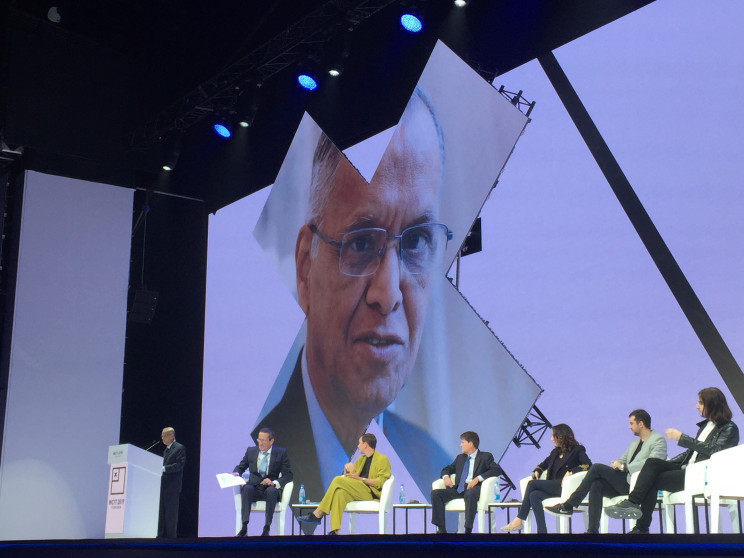 Narayana
Murthy, Founder, Chairman Emeritus of Infosys speaks at WCIT in
Yerevan/Source: Susan Fourtané for Interesting Engineering
Rise of the machines: The price of creating power
Technology has always the power to make life more comfortable for
human beings as long as it is put into good use. -Narayana Murthy,
Founder of Infosys
Big Data, Artificial Intelligence[6]
(AI), and Machine Learning[7] (ML) offer the
promise of unrevealed insight and efficiency; robotics, the promise
of freedom from physically dangerous or taxing manual labor, all in
ways never before imaginable.
However, at what price? The widespread deployment of
increasingly sophisticated Big Data, AI, and automated robotic
systems threatens to make entire categories of workers redundant by
automation.
Big Data and AI systems also threaten to distort the human decision-making process[8], subordinating the role
of human judgment.
And paramount questions arise; should the cold logic of hard
data be the master of human systems? What room will remain for
judgment, morality, and human compassion? How much authority and
decision-making are humans willing to cede to machines?
Where and when will it be necessary to draw the ethical and
practical line in the application of Big Data and AI in areas such
as medicine, where compassion and morality ought to reign over
clinical statistics?
How do we avoid being ruled by Big Data, or automated systems?
How do we control AI systems, already so complex that no single
person can understand them, and keep them from going rogue and
turning on us? These are some of the questions everyone involved in
the creation of AI and all those concerned about technology going
wrong should ponder. The topic was deeply discussed by experts on
the subject at WCIT.
AI: What is your fundamental fear?
 Members of the
panel at WCIT discuss if AI in the future should have an ON/OFF
switch/Source: Susan Fourtané for Interesting
Engineering
Richard Quest[9], Business Anchor for
CNN, moderated the panel integrated by James Bridle[10], Multidisciplinary
Artist and Journalist; Martin Ford[11], Author and Futurist;
Daniel
Hulme[12], Director of Business
Analytics MSc, University College London and CEO of Satalia;
Christopher
Markou, Ph.D[13], Leverhulme Early
Career Fellow and Affiliated Lecturer at Jesus College University
of Cambridge; and Narayana Murthy[14], Founder and Chairman
Emeritus of Infosys.
Richard Quest asked the members of the panel what their
fundamental fears about AI are. The panel established that as AI,
Machine Learning, and robotics advance, more jobs will be lost.
“That can be any job, including some white-collar jobs,” said
Martin Ford.
And although more jobs, other different jobs will be created,
are those new jobs going to be enough for everybody?, he pondered.
And, what about the transition period? What are the big potential
challenges that will be occurring in the next decade, or
two?
“Companies must make profit and create jobs,”
said Narayana Murthy. “According to research
from Oxford University, Murthy said,” 40 percent of
jobs will be automated by 2025.
“Regulation is good when it’s not telling you what to do,” said
Christopher Markou. Discussing the limits of
these machines, he added that AI should not exist in places such as
classrooms. “Where we don’t want these things is what we should be
discussing,” he said.
AI machines are predicted to be the last invention of human
beings, and this could happen in our lifetime. “Adaptable machines
can be dangerous. If the machine, say autonomous weapons, have the
capacity to adapt to their environment and learn from it, then if
the machine is in a bad environment learning from humans whose
purpose in life is to damage other humans it means that is what the
machines will learn. And that can be unstoppable. Indeed.”
In the end, Richard Quest ended the
discussion by asking the panel if every machine should have an
ON/OFF switch. Answers varied. Based on AI safety research
conducted by the University of Cambridge, “the central authority
must remain human,” Christopher Markou
concluded.
What do you think, should every machine, including AI machines,
have an ON/OFF switch?
Related Articles:
References
- ^
23rd
(wcit2019.org) - ^
World Congress on Information
Technology (wcit2019.org) - ^
Artificial Intelligence
(interestingengineering.com) - ^
Narayana Murthy
(www.infosys.com) - ^
Infosys
(www.infosys.com) - ^
Artificial Intelligence
(interestingengineering.com) - ^
Machine
Learning (interestingengineering.com) - ^
human
decision-making process
(interestingengineering.com) - ^
Richard Quest
(edition.cnn.com) - ^
James
Bridle (jamesbridle.com) - ^
Martin
Ford (mfordfuture.com) - ^
Daniel Hulme
(www.linkedin.com) - ^
Christopher Markou, Ph.D
(www.law.cam.ac.uk) - ^
Narayana Murthy
(www.infosys.com)