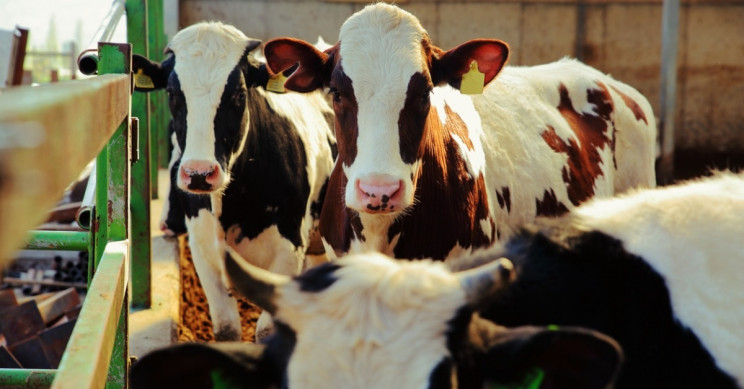
Most cows are bred to be exactly alike but with increased
demand for dairy, many of these cows are housed in large dynamic
groups, with little thought placed on how they deal with these
settings.
Sure researchers focus on the aggressive behavior of the cows,
after all, they don’t want any injuries, but they haven’t done much
work on whether they are stressed out over sharing their housing
with other cows.
With two large-scale dairies[1]
that house 3,000 to 8,000 cattle becoming the norm, researchers at
The University of Northhampton, led by postgraduate Krista Marie
McLennan, set out to see how bovine deal with their cow
counterparts.
RELATED: BLOOD SUCKING TICKS BLAMED
FOR THE DEATH OF FIVE COWS [2]
Younger cattle form stronger bonds
The researchers observed[3]
a herd of 400 Holstein-Friesian cattle in a cubicle and found
social bonds formed between individual cows. Relying on previous
trials, the scientists concluded spending 25% or more time with a
particular cow was indicative of a preferred partner.
The researchers found the strongest bonds were formed when the
cattle were younger. Between the ages of seven and eleven months,
the cows exhibited the most positive social behavior and the
strongest relationships between two of them. As the cattle got
older, the relationships between pairs were much weaker.
Cattle get stressed when separated from their preferred
partner
To gauge how strong the bond was between the preferred partners,
the scientists removed one of the cows from the herd for a period
of thirty minutes. When the cattle were separated from their
preferred partner the heart rate of the cattle dropped
significantly. When they were paired back up, they exhibited less
agitation than when they were with their non-preferred
partner.
“These results suggest that cattle were receiving social support
from their preferred partners allowing them to have a reduced
stress response to the social isolation test,”
wrote McLennan in the research report[4]. “As cattle aged and
experienced regrouping, positive social bonds tended to
disappear and cattle were more likely to have only weak
associations. During long term separation (two weeks) from
preferred partners, cattle showed significant
behavioural, physiological and milk production changes. Upon
subsequent reunion of preferred partners and consequential
regrouping of individuals, no further changes in
behaviour, biology and milk production were observed,
suggesting that separation rather than regrouping elicited a
stress response.”
References
- ^
dairies
(interestingengineering.com) - ^
RELATED:
BLOOD SUCKING TICKS BLAMED FOR THE DEATH OF FIVE COWS
(interestingengineering.com) - ^
observed
(www.researchgate.net) - ^
research report
(nectar.northampton.ac.uk)