From just about any standpoint, existence is pretty funky and
weird. But when you get right down to the fundamental physics of it
all, it gets even weirder! While many people may think that in the
realm of science, everything is clear-cut and ordered. But is that
the way things really work?
Throughout millennia, scholars and philosophers have debated
endlessly whether life and the cosmos are orderly or chaotic. The
sciences have not been immune to this debate, and many significant
discoveries have been taken up by either one school of thought or
the other.
Learning about the motions of the planets, gravity, atomic
theory, relativity, quantum mechanics, and the large-scale
structure of the Universe has sometimes been used to add weight to
ideas of both order and chaos.
At present, there’s a lot of ambiguity when it comes to this
question, and future discoveries may help to resolve it. But in the
meantime, it’s good to take stock of what we’ve learned and what it
can tell us about life as we know it.
 Panoramic
view of the Milky Way. Source: ESO/S. Brunier[1]
What is the Universe?
The word “Universe” comes from the Latin “Universum”, which was
used by Roman authors to refer to the cosmos as they knew them.
This consisted of the Earth and all life as well as the Moon, the
Sun, the planets that they knew about (Mercury, Venus, Mars,
Jupiter, Saturn) and the stars.
The term “cosmos”, on the other hand, is derived from the Greek
word kosmos, which means “order” or “the world”. Other
words commonly used to define all of known-existence include
“Nature” (from the Germanic word natur) and the English
word “everything” (self-explanatory).
Today, the word Universe is used by scientists to refer to all
existing matter and space. This includes the Solar System, the
Milky Way, all known galaxies, and superstructures. In terms of
modern science and astrophysics, it also includes all time, space,
matter, energy, and the fundamental forces that bind them.
Cosmology, on the other hand, is used to describe the study of
the Universe (or cosmos) and the forces that bind it. Thanks to
thousands of years of scholarship, what we know about the physical
Universe has grown by leaps and bounds. And yet, there is still so
much that we don’t understand.
To get a sense of where we are today, we must first take a look
back…
History of cosmology
Human beings have been studying the nature of existence pretty
much ever since they’ve been able to walk upright and speak.
However, most of what we know about the study of the cosmos goes
back only as far as the existence of written records.
Luckily, many of these records come from oral traditions that
predate writing, so a general idea of what our ancestors believed
does exist. What we know indicates that the earliest accounts of
the Universe’s creation tended to be symbolic and metaphorical in
nature.
As far as we can tell, every culture that has existed has had
its own version of a creation story. In many, time and all life
began with a single event, where a God or gods were responsible for
creating the world, the heavens, and everything in between. Most
creation stories either included or culminated with the birth of
humanity.
Archaeological evidence suggests that as far back as 8000 BCE,
people tracked celestial events, such as the movement of the Moon,
in order to create calendars. By the 2nd millennium BCE, astronomy
began to emerge as a field of study. Some of the earliest recorded
observations of the heavens are attributed to the ancient
Babylonians. These would go on to inform the cosmological and
astrological traditions of the cultures in the Near East and the
Mediterranean for thousands of years to come.
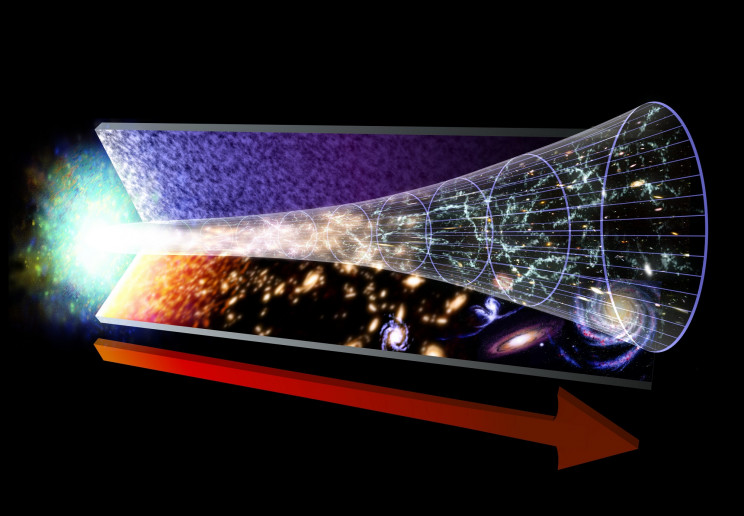 Artist’s
impression of the “Arrow of Time”. Source: NASA/GSFC[2]
The notion of finite time is sometimes traced to this period and
perhaps to the Zorastrian religion. At the core of this is the
belief that the Universe was created, represents the unfolding of a
divine plan, and has an end.
Later doctrines espoused that time began with creation, or
self-creation, and will end with a triumph of order over chaos, and
a version of the Day of Judgement where all of creation will be
reunited with the Creator. These concepts are likely to have been
transmitted to Judaism in around the 6th century BCE with the
Persian conquest of Babylon.
The idea of time as a linear progression would go on to inform
western cosmology for thousands of years, and still exists today
(for example, with the “Big Bang” and the “Arrow of Time”
theories.)
Between the 8th century BCE and the 6th century CE (the
period often referred to as “Classical Antiquity”), the concept
that physical laws governed the Universe began to gain greater
traction. In both India and Greece at this time,
scholars began offering explanations for natural phenomena that
emphasized cause and effect.
Birth of the atom
By the 5th century BCE, Greek philosopher Empedocles theorized
that the Universe was composed of the four elements of earth, air,
water, and fire. Around the same time, a similar system emerged in
China that consisted of the five elements of earth, water, fire,
wood, and metal.
This idea would become influential, but would soon be countered
by Greek philosopher Leucippus who theorized the idea that the
Universe was composed of indivisible particles known as “atomos”
(Greek for “uncuttable”).
The concept would be popularized by his pupil, Democritus (460 –
370 BCE), who argued that atoms were indestructible, eternal, and
determined the properties of all matter.
The Greek philosopher Epicurus (341–270 BCE) would refine and
elaborate on this idea. For this reason, it would come to be
associated with the school of philosophy he inspired
(Epicureanism).
The Indian philosopher Kanada, who is believed to have lived
between the 6th and 2nd century BCE, proposed a similar idea.
In his philosophy, all matter was composed of “paramanu” –
indivisible and indestructible particles. He also proposed that
light and heat were the same substance in a different form.
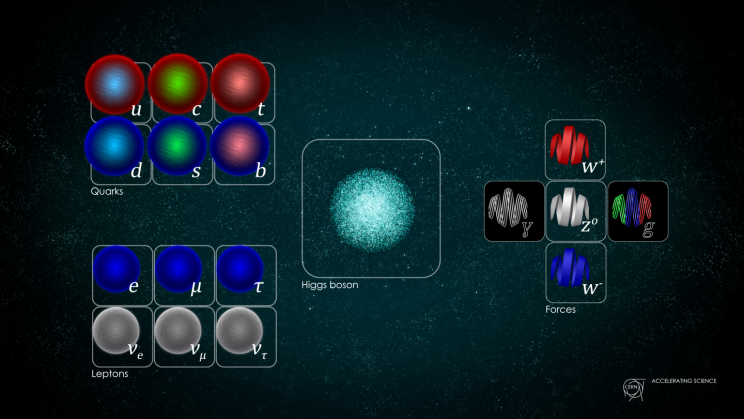
Particles of the Standard Model of particle
physics. Source: Daniel
Dominguez/CERN[3]
The Indian philosopher Dignana (480 – 540 CE), who was one of
the Buddhist founders of Indian logic school of thought, went
even farther by proposing that all matter was made up of
energy.
These theories were largely forgotten in the west but would
remain popular among Islamic and Asian scholars, who translated
them into Arabic and other languages. By around the 14th century,
interest in “atomism” would reemerge in the west, thanks to the
translation of classical works back into Latin.
Earth’s place in the Solar System
Between the 2nd millennium BCE and the 2nd century CE, astronomy
and astrology continued to develop and evolve. During this time,
astronomers monitored the proper motions of the planets and the
movement of the constellations through the Zodiac.
It was also during this time that Greek astronomers articulated
the geocentric model of the Universe, where the Sun, planets, and
stars revolve around the Earth.
These traditions were summarized in the 2nd century CE
mathematical and astronomical treatise, the Almagest[4], which was written by
Greek-Egyptian astronomer Claudius Ptolemaeus (aka. Ptolemy).
This treatise and the cosmological model it contained would be
considered as canon by many medieval European and Islamic scholars
and would remain the authoritative source on astronomy for over a
thousand years.
During the Middle Ages (ca. 5th – 15th century CE), Indian,
Persian, and Arabic scholars maintained and expanded on classical
astronomical traditions. At the same time, they added to them by
proposing some revolutionary ideas – like the rotation of the
Earth.
Some scholars went even further and proposed heliocentric models
of the Universe – such as Indian astronomer Aryabhata (476–550 CE),
Persian astronomers Albumasar (787 – 886 CE), and
Al-Sijzi (945 – 1020 CE).
It is possible that their works were inspired by the earlier
works of Aristarchus of Samos
(310 -230 BCE), Seleucus of
Seleucia[6] (190 BCE – 150 BCE), and
certain Pythagorean philosophers from the 4th and 5th centuries
BCE.[5]
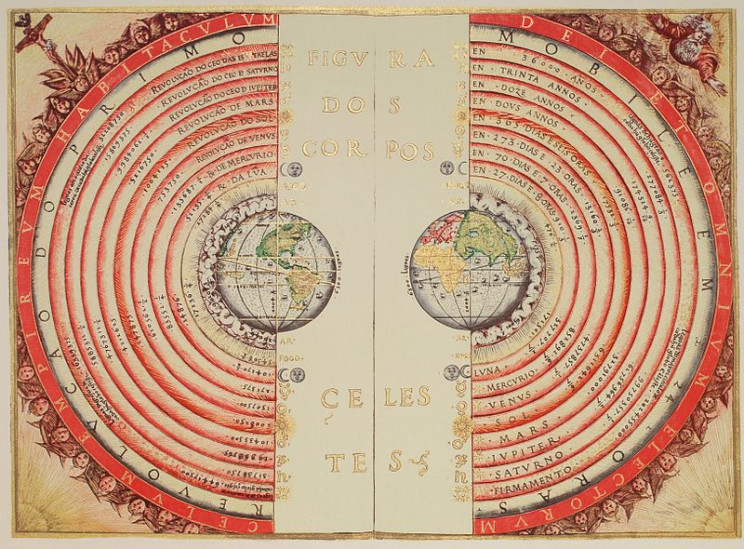 “Figure of
the heavenly bodies”. Source: Bartolomeu Velho/BNF[7]
By the 16th century, Nicolaus
Copernicus[8] published a complete
model of a heliocentric Universe. He proposed this model initially
in a 40-page manuscript titled Commentariolus[9]
(“Little Commentary”), which was released in 1514.
His theory resolved the lingering issues that plagued previous
heliocentric models and was based on seven general principles.
These postulated that:
- There is no single center of all the celestial orbs or
spheres. - The center of the Earth is the center, not of the universe,
but only of gravity and of the lunar sphere. - All the spheres encircle the Sun, which is as it were in
the middle of them all, so that the center of the universe is near
the Sun. - The ratio of the Earth’s distance from the Sun to the
height of the firmament is so much smaller than the ratio of the
Earth’s radius to its distance from the Sun that the distance
between the Earth and the Sun is imperceptible in comparison with
the loftiness of the firmament. - Whatever motion appears in the firmament is due, not to it,
but to the Earth. Accordingly, the Earth together with the
circumjacent elements performs a complete rotation on its fixed
poles in a daily motion, while the firmament and highest heaven
abide unchanged. - What appear to us as motions of the Sun are due, not to its
motion, but to the motion of the Earth and our sphere, with which
we revolve about the Sun as [we would with] any other planet. The
Earth has, then, more than one motion. - What appears in the planets as [the alternation of]
retrograde and direct motion is due, not to their motion, but to
the Earth’s. The motion of the Earth alone, therefore, suffices [to
explain] so many apparent irregularities in the
heaven.
Copernicus would expand on these ideas in his magnum opus –
De revolutionibus
orbium coelestium[10] (On the
Revolutions of the Heavenly Spheres) – which he
finished in 1532. However, fearing persecution, Copernicus would
not allow it to be published until shortly before his death (in
1534).
In this work, Copernicus would reiterate his seven major
arguments and provide detailed calculations to back them up. His
ideas would go on to inspire Italian astronomer, mathematician, and
inventor Galileo
Galilei[11] (1564 – 1642).
Galileo would use a telescope of his own creation, his
understanding of physics and mathematics, and the rigorous
application of the scientific method to refine Copernicus’
observations and calculations.
Galileo’s observations of the Moon, the Sun, and Jupiter would
prove to be very influential, and helped reveal flaws in the
geocentric model. His observations of the Moon, for example,
revealed a pockmarked and cratered surface, while his observations
of the Sun revealed sunspots.
 Comparison of
the geocentric and heliocentric models. Source: history.ucsb.edu[12]
He was also responsible for the discovery of Jupiter’s largest
moons – Io, Europa, Ganymede, and Callisto – which would later be
named the “Galilean Moons” in his honor.
These discoveries contradicted the long-held notions that the
heavens were perfect spheres (consistent with Christian theology)
and that no planets other than Earth had satellites.
His observations of the planets revealed that their appearances
and positions in the sky were consistent with the theory that they
orbited the Sun.
He shared these observations in treatese like the Sidereus
Nuncius[13] (The Starry
Messenger) and the On the Spots Observed in the
Sun, both of which were published in 1610.
But it was his 1632 treatise, Dialogo sopra i due massimi sistemi del
mondo[14] (Dialogue
Concerning the Two Chief World Systems), where he advocated
for the heliocentric model of the Universe.
Johannes Kepler (1571-1630) refined the model further with his
Laws of Planetary
Motion[15], which demonstrated
that the orbits of the planets were elliptical, rather than perfect
circles (as Galileo and previous astronomers had maintained).
This effectively settled the “Great Debate” about the nature of
the Solar System and made heliocentrism the scientific consensus
from the late 17th century onward.
From the Solar System to the Milky Way
Another revolutionary discovery that emerged during the 17th and
18th centuries was the realization that our Solar System was not
unique. Thanks to the invention of the telescope, our understanding
of the Milky Way changed drastically.
Rather than being a giant cloud in the form of a band (as was
previously thought), astronomers began to understand that the
nebulous structure they had been observing in the night sky for
millennia was actually billions of distant stars.
 Map of the
Milky Way. Source: NASA/JPL-Caltech/R. Hurt
(SSC/Caltech)[16]
Granted, the idea was not entirely new. In the 13th
century, Persian astronomer and polymath Nasir al-Din
al-Tusi (1201 – 1274) suggested this very possibility in his book,
Tadhkira[17]:
“The Milky Way, i.e. the Galaxy, is made up of a very large
number of small, tightly clustered stars, which, on account of
their concentration and smallness, seem to be cloudy patches.
Because of this, it was likened to milk in color.”
However, it was not until the Scientific Revolution (ca. 16th –
18th century) that astronomers were able to directly observe this.
In The Starry Messenger, Galileo described the observation
he conducted of the “nebulous stars” that were contained in the
Almagest’s star catalog.
These observations led him to conclude that the “nebulous”
sections of the Milky Way’s band were actually “congeries of
innumerable stars grouped together in clusters”. This discovery
further bolstered the case for heliocentrism, since it showed that
the Universe was much larger than previously thought.
In 1755, German philosopher Immanuel Kant theorized that the
Milky Way was a massive cluster of stars that were held together by
the force of their mutual gravity. He further predicted that these
stars (along with the Solar System) were part of a flattened disk
that rotated around a common center – much like the planets around
the Sun.
In 1785, astronomer William Herschel attempted to create the
first map of the Milky Way. His estimates of its size and shape
were thrown off by the fact that much of our galaxy is obscured by
dust and gas, but his attempt was an indication of the progress
that was being made.
By the 19th century, improved optics and telescopes allowed
astronomers to map out more of the night sky, which led many to
conclude that our Solar System was merely one of billions in the
Milky Way.
By the 20th century, they would come to see that the Milky Way
was merely one of billions in the Universe. But one thing at a
time…
Newton and Einstein revolutionize everything
Humanity’s understanding of the Universe would be revolutionized
again in the late 17th century by the work of British polymath
Sir Isaac
Newton[18] (1642/43 – 1727). Using
Kepler’s theory of motion, he developed a theory of gravity (aka.
Universal Gravitation).
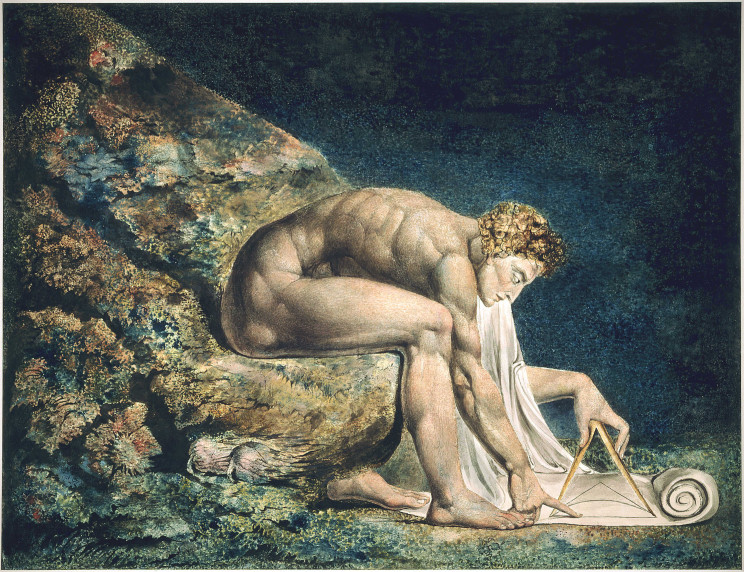 William
Blake’s Newton (1795). Source: William Blake Archive[19]
This was summarized in his major work, Philosophiæ Naturalis Principia
Mathematica[20] (“Mathematical
Principles of Natural Philosophy”), which was published in 1687 and
contained Newton’s Three Laws of Motion[21]. These laws stated
that:
- When viewed in an inertial reference frame, an object
either remains at rest or continues to move at a constant velocity,
unless acted upon by an external force. - The vector sum of the external forces (F) on an object is
equal to the mass (m) of that object multiplied by the acceleration
vector (a) of the object. In mathematical form, this is expressed
as, F=ma - When one body exerts a force on a second body, the second
body simultaneously exerts a force equal in magnitude and opposite
in direction on the first body.
These laws described how objects exert forces on each other, and
how motion occurs as a result. From his work, Newton was able
to calculate the mass of the planets, determine that Earth is not a
perfect sphere, and how Earth’s interaction with the Sun and Moon
influences ocean tides.
These and other detailed calculations would have a profound
influence on the sciences, and would form the basis of Classical
Physics (aka. Newtonian Physics), which would remain the accepted
canon for the next 200 years.
This would change in the early 20th century, when a young
theoretical physicist named Albert Einstein began publishing a
series of papers discussing his theories of Special and General Relativity[22].
These theories were in part the result of attempting to resolve
the inconsistencies between Newtonian physics and the
recently-discovered laws of electromagnetism – best
summarized by Maxwell’s equations[23] and the Lorentz force
law[24]).
Einstein would address this inconsistent in one of the papers he
wrote in 1905 while working at a patent office in Bern,
Switzerland. Titled, “On the Electrodynamics of Moving
Bodies[25]“, this paper became the
basis of Special Relativity (SR).
Einstein’s theory challenged the previously-held working
consensus that light moving through a medium would be dragged along
by that medium. This meant that the speed of light (which had
already been determined) was the sum of its speed through
a medium plus the speed of that medium.
This led to all kinds of theoretical complications, and
experiments attempting to resolve them all obtained null results.
Instead, Einstein stated that the speed of light is the same in all
inertial reference frames, a theory that did away with the need for
mediums or extraneous explanations.
As a theory, SR not only simplified the mathematical
calculations and resolved issues between electromagnetism and
physics, it also closely agreed with the speed of light and
explained aberrations that had emerged in experiments.
Between 1907 and 1911, Einstein began applying his theory of SR
to gravitational fields, another area where Newtonian Physics had
difficulty. By 1911, these efforts culminated with the publication
of “On the Influence of Gravitation on the
Propagation of Light[26]“.
This paper laid the groundwork for General Relativity (GR). In
it, Einstein predicted that time is relative to the observer and is
dependent on their position within a gravity field, and that
gravitational mass is identical to inertial mass (aka. the
Equivalence Principle[27]).
Another thing Einstein predicted in this paper was the idea that
two observers situated at varying distances from a gravitating mass
would perceive the flow of time differently (aka. gravitational time dilation[28]). These theories remain
an established part of modern physics.
The Universe is dark
Einstein’s theories, which garnered widespread-acceptance, had
many consequences for the sciences. In particular, his field
equations for Relativity also predicted the existence of Black
Holes and a Universe that was either in a state of constant
expansion or contraction.
In 1915, a few months after GR became widely publicized, German
physicist and astronomer Karl Schwarzschild found a solution to
Einstein’s field equations that gave rise to the theory of black
holes decades before one was observed.
Also known as a Schwarzschild radius, this solution
described how the mass of a sphere could become so
compressed that the escape velocity from the surface would be
the same as the speed of light. The “radius” in this case refers to
the size below which the gravitational attraction
between the particles of a body must cause it to undergo
irreversible gravitational collapse.[29]
In 1931, Indian-American astrophysicist Subrahmanyan
Chandrasekhar expanded on this by using SR to calculate how massive
a body would need to become before it collapsed in on itself –
later referred to as the Chandrasekhar limit[30].
By 1939, the discovery of neutron stars backed up
Chandrasekhar’s theories by showing that white dwarf with a mass
below this limit do in fact collapse. The resulting object (a
neutron star) is super-dense as a result and has an incredibly
powerful magnetic field.
From this, physicists like Robert Oppenheimer argued that a
white dwarf of sufficient mass would continue to collapse and form
a black hole. While this was another mass limit entirely (known as
the Tolman–Oppenheimer–Volkoff limit[31]), it was consistent
with Chandrasekhar’s theory.
By the 1960s and 1970s, astrophysicists conducted many tests of
GR using black holes and large-scale structures (like galaxies and
galaxy clusters). This would come to be known as the “Golden Age of
General Relativity” (1960 – 1975) since it allowed Einstein’s
theory to be tested like never before.
However, astrophysicists noticed something particularly chilling
about these tests as well. When looking at galaxies and larger
concentrations of matter in the Universe, they found that the
observed gravitational effects of these objects were not consistent
with their apparent mass.
This led the scientific community to conclude that within
galaxies, there was a whole lot of mass that they could not see.
This gave rise to the theory of Dark
Matter[32], a mysterious mass that
does not interact with “normal matter” (aka. visible or baryonic
matter) via the electromagnetic force.
This means it does not absorb, reflect or emit light,
making it extremely hard to spot. It only
interacts with matter through its gravitational force. Dark matter
is believed tooutweigh visible matter roughly six to one,
making up about 27% of the universe. It is also thought
to have had a profound influence on its evolution.
The Universe is expanding
Another consequence of GR was the prediction that the Universe
was either in a constant state of expansion or contraction. By 1927
– 1929, Belgian physicist (and Roman Catholic priest) Georges
Lemaître and American astronomer Edwin Hubble confirmed that it was
the former.
At the time, Einstein was still looking for a way to rationalize
the idea of a static Universe. To this end, he proposed the
“Cosmological
Constant[33]“, which was a
yet-undetected force that “held back gravity” to ensure the
distribution of matter in the cosmos was uniform over time.
Using redshift measurements of other galaxies, Hubble proved
Einstein wrong. These measurements showed that light coming from
these galaxies had shortened wavelengths – i.e. was shifted to the
red end of the spectrum – which indicated that the intervening
space was expanding.
Hubble’s observations also showed that the galaxies that were
farthest from our own were receding faster. This phenomenon would
come to be known as Hubble’s
Law[34], and the rate at which
this was happening would come to be known as the Hubble Constant[35].
In 1931, Georges Lemaitre would use the phenomena he
co-discovered to articulate an idea that the Universe had a
beginning. Upon confirming independently that the Universe was
expanding, he suggested that it was progressively smaller the
farther back in time one looked.
At some point in the past, he reasoned, the entire mass of the
Universe would have been concentrated on a single point. These
discoveries triggered a debate between physicists, who were divided
into two schools of thought.
The majority still advocated that the Universe was in a
steady-state (i.e. the Steady State Theory[36]), where matter is
continuously created as the Universe expands, thus ensuring
uniformity over time.
On the other side, there were those who believed that the
Universe was gradually expanding, and the density of matter was
slowly decreasing as a result. This idea came to be known as the
“Big Bang Theory[37]“, a moniker which was
facetiously assigned by proponents of the Steady State Theory.
After several decades, multiple lines of evidence emerged that
favored the Big Bang interpretation. This included the discovery
and confirmation of the Cosmic Microwave Background[38] (CMB) in 1965, which
had been predicted by the Big Bang Theory.
CMB is basically “relic radiation” left over from the Big Bang
that has been expanding at the speed of light ever since. By
gauging the distance of the CMB, which is about 13.8 billion years
in all directions, scientists were able to place constraints on the
age of the Universe.
By the 1990s, improvements in ground-based telescopes and the
introduction of space telescopes led to new and startling
discoveries. Scientists had believed that gravity would
eventually cause the expansion of the universe to slow.
However, astronomers now observed that for the past
four billion years, cosmic expansion has actually been
accelerating.
This gave rise to the theory of Dark Energy, a mysterious force that
somehow works against gravity and pushes the cosmos further
apart. Theorists came up with different explanations for
Dark Matter. Some suggested that Einstein’s “cosmological constant”
may have been correct all along. Others suggested that Einstein’s
theory of gravity was incorrect and a new theory was needed which
include some kind of field that creates this cosmic
acceleration. [39]
One leading cosmological theory today is described by the
Lambda Cold Dark Matter[40] (λCDM). It is currently
the simplest model that accounts for most of the observed
properties of the Universe. It states that most of the universe is
made up of dark energy, dark matter, and ordinary matter and is
also referred to as the standard model of Big Bang cosmology. It
assumes that general
relativity[41] is
the correct theory of gravity on cosmological scales and accounts
for many of the properties of the cosmos, including the cosmic
microwave background and the acceleration of the expansion of the
universe.
 The Lambda
CDM model of the Universe. Source: Alex Mittelmann/Coldcreation[42]
So what don’t we know?
The answer to that question is, quite a lot really! To answer it
effectively, though, we need to take a look at how scientists study
the Universe from top to bottom and take note of where the gaps
lie.
For starters, scientists understand how matter, time and space
behave on the largest of scales. This is best summarized by GR,
which accurately describes how mass and gravity are related and
affect spacetime.
However, since the 1960s, astrophysicists have come to accept
that there is a whole lot of mass out there that they cannot see.
While this makes sense theoretically, attempts to find Dark Matter
so far have yielded nothing conclusive.
So while you could say that we know how much matter is out
there, we cannot conclusively account for most of it. Similarly, we
have known that the Universe is in a state of expansion since the
late 1920s. However, we don’t know why exactly.
The rate at which the Universe is expanding can be explained by
the presence of a Dark Energy. But just like Dark Matter,
investigations have yet to determine what this truly is.
And there’s the extent of the Universe itself. With the
discovery of the CMB, astronomers and cosmologists were able to
trace the evolution of the cosmos and were able to make close
estimates of how old it is. The current estimate is that the cosmos
is 13.799 ± 0.021 billion years old.
But as for how big it is? That remains a mystery. Based on the
rate of cosmic expansion, astrophysicists estimate that the
“observable” Universe is a sphere measuring about 93 billion
light-years across. However, beyond that, the Universe likely
extends much farther and could even be infinite.
At the other end of things, scientists have determined that
there are four fundamental forces (aka. fundamental interactions)
that govern all matter and energy interactions in the Universe.
These forces consist of the gravitational force (which is
attributed to the curvature of spacetime and is described by GR)
and the three discrete fields of quantum mechanics – collectively
known as Quantum Field Theory[43] (QFT).
These fields include the weak nuclear force, the strong nuclear
force, and electromagnetism – that deal with subatomic particles
and their interactions, as described by the Standard
Model[44] of particle
physics.
Another way to look at it is to group these interactions into a
three-category system: gravitation, electroweak forces, and strong
forces. These latter two categories are subdivided into the weak
nuclear and electromagnetic forces, and into fundamental and
residual nuclear forces.
Whereas gravitation binds planets, stars, galaxies and galaxy
clusters together (i.e. the macro-level), electroweak forces bind
atoms and molecules, while strong forces bind hadrons and atomic
nuclei.
Here lies the problem. Scientists understand how gravity works
on the largest of scales, but not the smallest. This makes it
distinct from all other known forces in the Universe which have a
corresponding subatomic molecule.
For electricity and magnetism, there are electrons and photons.
For weak and strong nuclear forces, there are bosons, gluons, and
mesons. At present, though, there’s no such thing as a “graviton”,
at least not outside the hypothetical.
And so far, all attempts to find a conclusive theory of quantum
gravity – aka. a Theory of Everything (ToE) – have failed. Several
theories have been proposed to resolve this – the top contenders
being String Theory and Loop Quantum
Gravity[45] – but none have been
decisively proven yet.
How will it all end?
Okay, here’s the thing… we don’t know that either. Granted,
the notion that the Universe had a beginning naturally gives rise
to the idea that it will have a possible end. If the Universe did
begin as a tiny point in spacetime that suddenly started to expand,
does that mean it will continue to expand forever?
Or, as has also been theorized, will it cease expanding and
start contracting, eventually reducing back into a tiny, spherical
mass? This question is one that has raged ever since cosmologists
began to debate how the Universe began – Big Bang or Steady
State?
Prior to observations that showed how the Universe has been
expanding at an accelerated rate, most cosmologists were of two
minds on the subject. These were known as the “Big Crunch” and “Big
Freeze” scenarios.
In the former, the Universe will expand until it runs out of
energy and then begin to collapse in on itself. Assuming the
Universe reaches a point where its mass density is greater than its
critical density, the Universe will begin to contract.
Alternately, if the density of the Universe is equal to or below
the critical density, the Universe will keep expanding until star
formation ceases. Eventually, all the stars will reach the end of
their lifespans and become dead husks or black holes.
Eventually, the black holes would collide and form larger and
larger black holes. This would ultimately lead to “heat death” in
the Universe, where the last electromagnetic radiation would be
consumed. The black holes themselves would eventually disappear
after they shed the last of their Hawking Radiation[46].
Since the 1990s, observations that led to the theory of Dark
Energy stimulated new discussions on the fate of the Universe. It
is now theorized that as space continues to expand, more and more
of the observable Universe will pass beyond the CMB and become
invisible to observers.
Meanwhile, the CMB will continue to redshift until it becomes
visible only in the radio wavelength. Eventually, it will disappear
entirely and astronomers will see nothing but blackness beyond the
edge of what’s visible.
Another possibility is the “Big Rip” scenario, where continued
expansion will eventually lead all galaxies, stars, planets, and
even atoms themselves to be torn apart, leading to the death of all
matter.
Big Crunch, Big Freeze, or Big Rip? At this juncture, we just
don’t know. The same is true when it comes to theories of how the
Universe began – was it a Big Bang or more of a Big Bounce[47]?
This is also the case when it comes to our attempts to unify
gravity with the other fundamental forces. Right now, the best we
have are theories that have a certain logical consistency but
remain unproven.
—
As Socrates famously said: “One thing only I know, and that is
that I know nothing.” This knowledge, it is said, is what made
Socrates the wisest man in all the land. In the same respect,
humanity’s grasp of the Universe is strangely paradoxical.
We know it’s expanding, we’re just not sure how. We know how
much mass is out there, we just can’t see most of it. We know how
gravity works, just not how it fits with the other forces. We don’t
know how it began or will end, but we have some theories that fit
with the observable evidence.
So while there is much that we don’t know about the Universe, we
at least have a pretty good idea of what we don’t know. This puts
us at an advantage over previous generations of humanity who were
not only ignorant of the Universe at large but ignorant or their
ignorance.
We are also at a point in our technological evolution where we
can see more of the Universe than ever before, whether that’s on
the largest or smallest of scales. Between next-generation
instruments, supercomputers, and particle accelerators, scientists
are pushing the boundaries of what we can see.
The only way to overcome ignorance is to know where our
ignorance lies and then address it. In that respect, humanity is
poised to learn a great deal in the near future!
Further Reading:
References
- ^
ESO/S.
Brunier (interestingengineering.com) - ^
NASA/GSFC
(imagine.gsfc.nasa.gov) - ^
Daniel Dominguez/CERN
(home.cern) - ^
Almagest
(bertie.ccsu.edu) - ^
Aristarchus of Samos
(en.wikipedia.org) - ^
Seleucus of Seleucia
(en.wikipedia.org) - ^
Bartolomeu Velho/BNF
(commons.wikimedia.org) - ^
Nicolaus Copernicus
(www.universetoday.com) - ^
Commentariolus
(copernicus.torun.pl) - ^
De revolutionibus orbium
coelestium (ads.harvard.edu) - ^
Galileo Galilei
(www.universetoday.com) - ^
history.ucsb.edu
(marcuse.faculty.history.ucsb.edu) - ^
Sidereus Nuncius
(homepages.wmich.edu) - ^
Dialogo sopra i due massimi sistemi
del mondo (law2.umkc.edu) - ^
Laws of Planetary Motion
(www.universetoday.com) - ^
NASA/JPL-Caltech/R. Hurt
(SSC/Caltech) (www.spitzer.caltech.edu) - ^
Tadhkira
(www.alislam.org) - ^
Sir Isaac Newton
(www.universetoday.com) - ^
William Blake Archive
(commons.wikimedia.org) - ^
Philosophiæ Naturalis Principia
Mathematica (cudl.lib.cam.ac.uk) - ^
Three Laws of Motion
(www.universetoday.com) - ^
Special and General Relativity
(www.livescience.com) - ^
Maxwell’s equations
(hyperphysics.phy-astr.gsu.edu) - ^
Lorentz force law
(www.britannica.com) - ^
On the Electrodynamics of Moving
Bodies (hermes.ffn.ub.es) - ^
On the Influence of Gravitation on
the Propagation of Light
(www.relativitycalculator.com) - ^
Equivalence Principle
(hyperphysics.phy-astr.gsu.edu) - ^
gravitational time dilation
(users.sussex.ac.uk) - ^
Schwarzschild radius
(hyperphysics.phy-astr.gsu.edu) - ^
Chandrasekhar limit
(www.britannica.com) - ^
Tolman–Oppenheimer–Volkoff
limit (www.daviddarling.info) - ^
Dark Matter
(home.cern) - ^
Cosmological Constant
(map.gsfc.nasa.gov) - ^
Hubble’s Law
(www.universetoday.com) - ^
Hubble Constant
(www.cfa.harvard.edu) - ^
Steady State Theory
(cosmology.carnegiescience.edu) - ^
Big Bang Theory
(curious.astro.cornell.edu) - ^
Cosmic Microwave Background
(www.esa.int) - ^
Dark Energy
(www.universetoday.com) - ^
Lambda Cold Dark Matter
(lambda.gsfc.nasa.gov) - ^
General relativity
(en.wikipedia.org) - ^
Alex Mittelmann/Coldcreation
(commons.wikimedia.org) - ^
Quantum Field Theory
(plato.stanford.edu) - ^
Standard Model
(home.cern) - ^
String Theory and Loop Quantum
Gravity (www.quantamagazine.org) - ^
Hawking Radiation
(www.physicsoftheuniverse.com) - ^
Big Bounce
(en.wikipedia.org)