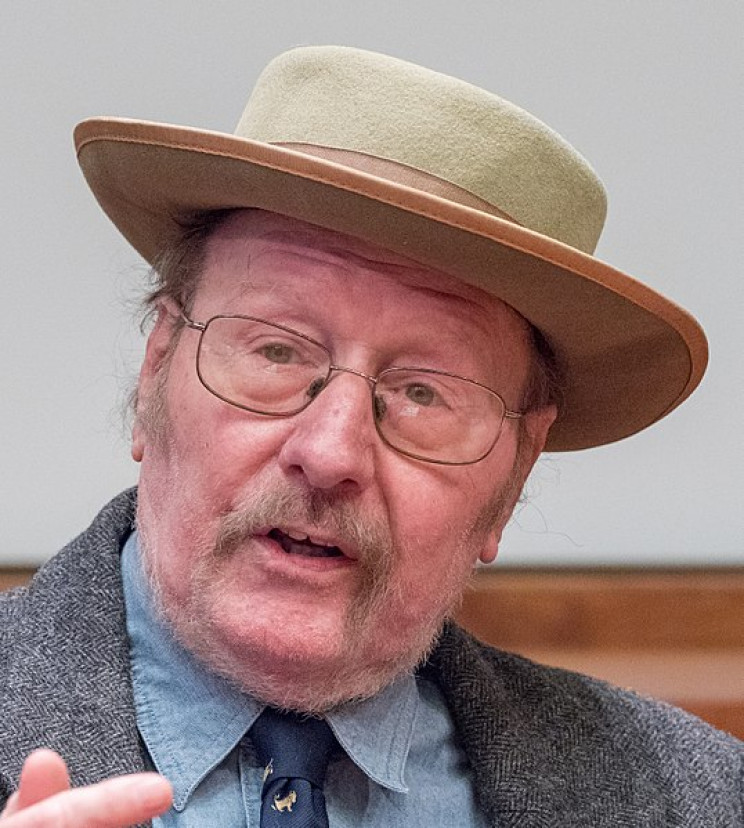
Jeffrey C. Hall[1]
is a Nobel Prize-winning geneticist whose interest in fruit flies[2]
has proved revolutionary for our understanding of our circadian
rhythms. Here we explore the man behind the Nobel Prize and briefly
touch on why his work was so important.
RELATED: NOBEL PRIZE IN MEDICINE
AWARDED FOR THE DISCOVERY OF HOW OUR CELLS TRACK TIME[3]
Who is Jeffrey C. Hall?
Hall is an American geneticist who is best known for his
research into the behavior and biological rhythms of the fruit
fly Drosophila
melanogaster[4]. He was born
on the 3rd of May, 1945 in Brooklyn, New York and was jointly
awarded the Nobel Prize for Physiology or Medicine for his
contributions to the discovery of how animal cells track
time.
Hall spent his youth living outside Washington D. C. where
his father worked for the Associated Press covering the ‘toings’
and ‘froings’ of the U.S. Senate. His father would prove to be a
great influence on Hall and instilled a need for him to keep up to
date with current affairs.
He had originally planned to pursue a career in medicine
but soon became enraptured by fruit flies during his undergraduate
studies at Amherst
College.[5]
 Source: Bengt Nyman/Wikimedia Commons[6]
Whilst at college, Hall worked under Philip Ives[7], who was also a major
influence on him. Under Ives’ supervision, Hall studied the
recombination and translocation induction in Drosophila specimen[8]s.
Based on his great work at Amherst, he was persuaded to
pursue a Ph.D. in genetics at the University of
Washington, Seattle.
After a stint at the California Institute of Technology in
Pasadena, Hall began to work at Brandeis University in Waltham,
Massachusetts[9]
in 1974.
In 2004, Hall was named Professor Emeritus of Biology at
Brandeis. Hall then joined the University of Maine[10] as an adjunct
professor. He later became the Libra Professor of
Neurogenetics.
Jeffrey taught at the university until 2012.
In addition to his well-deserved Nobel Prize, Hall was the
recipient of various other honors during his career, including, but
not limited to: –
Hall has also served as an editor for several scientific
journals and was an elected member of multiple scientific
organizations, including the American Academy of Arts and
Sciences[11] (2001) and
the National Academy of Sciences[12] (2003).
What scientific field does Jeffrey Hall work
in?
Hall’s main scientific discipline is
genetics.
His life’s work has mainly focussed on the molecular
mechanisms that underlie the biological rhythm of fruit flies[13]. His work, in no small
part, has enabled scientists to gain insights into the circadian
rhythm of animals.
“In our cells, an internal clock helps us to adapt our
biological rhythm to the different phases of day and night. Jeffrey
Hall, Michael Rosbash and Michael Young studied fruit flies to
figure out how this clock-works.
In 1984 they managed to identify a gene that encodes a
protein that accumulates during the night but is degraded during
the day. They also identified additional proteins that form part of
a self-regulating biological clockwork in the fruit fly’s
cells.
The same principles have been shown to apply to other
animals and plants.” – Nobel Prize[14].
In case you are not aware, this is the self-regulating 24-hour biological
clock[15] that drives the
behavior of many animals, including human beings. For this, he was
jointly awarded the Nobel Price in Physiology or Medicine in
2017.
He shared the prize with two other American
scientists, Michael Rosbash[16] and Michael W.
Young.
How courtship in fruit flies led to his Hall’s Nobel
Prize
Hall’s work has mainly focused on the neurogenetics of
courtship and biological rhythms in fruit flies. As part of this
research, Hall, while studying regions of the flies’ nervous
system, discovered parts that help regulate courtship “singing” behavior[17].
He, with one of his postdoctoral students, found that the
flies’ “songs” occur periodically and at regular intervals. His
team subsequently found that mutant flies appeared to conduct their
courtship rituals at abnormal times during daily sleep-wake
cycles.
“The mutations[18] underlying the
sleep-wake disturbances were in an unknown gene[19] that had been
named the period gene owing to its apparent
influence on circadian rhythm.” – Encyclopedia Britannica[20].
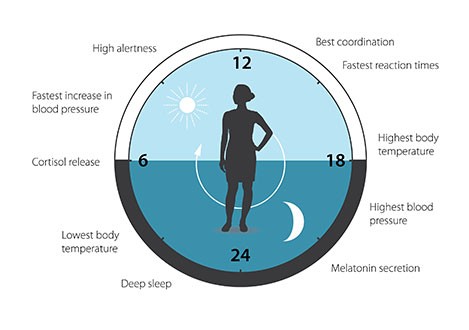 Human
Human
circadian rhythm. Source: Nobel Prize [21]
After receiving some criticism from his peers during the
mid-1980s, Hall collaborated with Roshbash, to successfully locate
and isolate this gene. At around the same time, another researcher
at Rockefeller University, New York, Young[22], independently managed
the same feat.
Robash and Hall later discovered that the levels of the
so-called period gene product, the Period
protein (PER)[23], seemed to fluctuate in
the fruit fly brain. From their studies, they found that PER builds
up at night and declines during the day.
These fluctuations, or oscillations, in PER levels also appeared
to be the product of a negative feedback loop. PER, they found, was
produced by the fruit fly until it reached a certain critical
level.
Once reached, the synthesis of PER would automatically turn
off.
“In this way, the protein’s production was regulated in a
continuous 24-hour cycle. Hall, Rosbash, and Young later discovered
additional rhythm-regulating genes and further elucidated the
mechanisms by which light and other factors influence timing in the
circadian clock.” – Encyclopedia Britannica[24].
Later work on this very subject in the 1990s helped Hall,
Robash, and others to find that their new gene was also expressed
in other cells of the flies’ bodies.
What is the relevance of Hall’s fruit fly research to other
animals?
Hall’s work[25] on studying the
circadian rhythm of fruit flies has proved to be revolutionary for
our understanding of the circadian rhythm.
Hall also managed to discover that the gene expresses
itself in response to dark-light cycles – – like day and night.
He found something called the pigment dispersing factor[26] protein (PDF)
helps control their circadian rhythms.
PDF, Hall also discovered, helps control the locomotor
activity of these genes in cells. PDF was localized to small ventral lateral
neurons (sLNvs)[27] in the
Drosophila brain.
Based on this discovery, Hall and his colleagues were able
to ascertain that these neurons act like a kind of
pacemaker for the circadian
rhythm in fruit flies[28]. He also concluded that
that PDF was the main protein for maintaining synchrony in other
cells of the body.
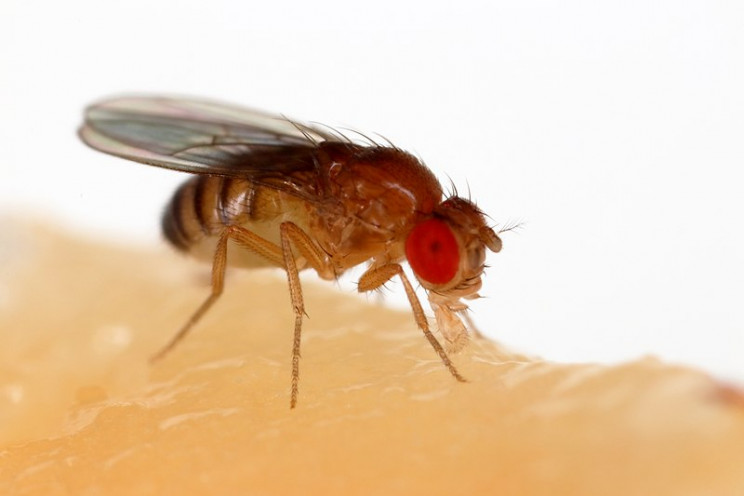 Source: Sanjay Acharya/Wikimedia Commons[29]
In human beings, this rhythm helps regulate when we sleep,
eat, release hormones, and raise/lower blood
pressures. A person’s habits can easily disrupt this natural
cycle[30] by working late shifts,
traveling long-distances by plane, and staying up late at
night.
While disruption like this can have serious implications
for your general health, they can, thankfully, be
reset.
This rhythm is controlled by similar genes and expressed
proteins in other animals as in the fruit fly. In humans, the
suprachiasmatic nucleus (SCN) located in the hypothalamus is
analogous to the fruit flies’ small ventral lateral
neurons (sLNvs).[31]
A protein called neuropeptide vasoactive intestinal peptide ([32]VIP)[33] is also a homolog for
fruit fly PDF in humans.
The neural and hormonal activities of SCN and VIP
respectively, regulate many different body functions in a 24-hour
cycle, using around
20,000 neurons.
“Every living organism on this planet
responds to the sun,” said Sir Paul Nurse (who shared the 2001
Nobel prize)[34].
“All plant and animal behavior is determined by the
light-dark cycle. We on this planet are slaves to the sun. The
circadian clock is embedded in our mechanisms of working, our
metabolism, it’s embedded everywhere, it’s a real core feature for
understanding life.” he added.
Selected facts about Jeffrey Hall
1. Hall was jointly awarded the Nobel Prize for Physiology or
Medicine in 2017.
2. Hall’s work has enabled scientists to uncover the genes and
hormones that help control an animal’s circadian rhythm.
3. Hall was born in May of 1945 and is currently 74 years
old.
4. Hall’s fascination with fruit flies began during his
undergraduate studies at Amherst College. It would dictate the rest
of his academic and scientific career.
5. Hall has various awards in recognition for his work including
The Genetics Society of America Medal,
The Gruber Prize in Neuroscience,
The Louisa Gross Horwitz Prize,
The Gairdner Foundation International
Award, The Shaw Prize and
the Wiley Prize.
References
- ^
Jeffrey C. Hall
(www.britannica.com) - ^
fruit
flies (interestingengineering.com) - ^
RELATED: NOBEL PRIZE IN MEDICINE
AWARDED FOR THE DISCOVERY OF HOW OUR CELLS TRACK TIME
(interestingengineering.com) - ^
Drosophila melanogaster
(www.britannica.com) - ^
Amherst College.
(www.amherst.edu) - ^
Bengt Nyman/Wikimedia Commons
(commons.wikimedia.org) - ^
Philip Ives
(academic.oup.com) - ^
Drosophila specimen
(www.ncbi.nlm.nih.gov) - ^
Brandeis University in Waltham,
Massachusetts (www.brandeis.edu) - ^
University of Maine
(www.britannica.com) - ^
American Academy of Arts and
Sciences (www.britannica.com) - ^
National Academy of Sciences
(www.britannica.com) - ^
biological rhythm of fruit flies
(interestingengineering.com) - ^
Nobel Prize
(www.nobelprize.org) - ^
self-regulating 24-hour biological
clock (www.sleepfoundation.org) - ^
Michael Rosbash
(www.britannica.com) - ^
courtship “singing” behavior
(medicalxpress.com) - ^
mutations
(www.britannica.com) - ^
gene
(www.britannica.com) - ^
Encyclopedia Britannica
(www.britannica.com) - ^
Nobel Prize
(www.nobelprize.org) - ^
Young
(www.nobelprize.org) - ^
Period protein (PER)
(www.uniprot.org) - ^
Encyclopedia Britannica
(www.britannica.com) - ^
Hall’s work
(www.cell.com) - ^
pigment dispersing factor
(www.ncbi.nlm.nih.gov) - ^
small ventral lateral neurons
(sLNvs) (www.ncbi.nlm.nih.gov) - ^
for the circadian rhythm in fruit
flies (www.mdpi.com) - ^
Sanjay Acharya/Wikimedia
Commons (en.wikipedia.org) - ^
easily disrupt this natural cycle
(www.ncbi.nlm.nih.gov) - ^
small ventral lateral neurons
(sLNvs). (www.ncbi.nlm.nih.gov) - ^
asoactive intestinal peptide (
(en.wikipedia.org) - ^
VIP)
(en.wikipedia.org) - ^
said Sir Paul Nurse (who shared the
2001 Nobel prize) (www.theguardian.com)