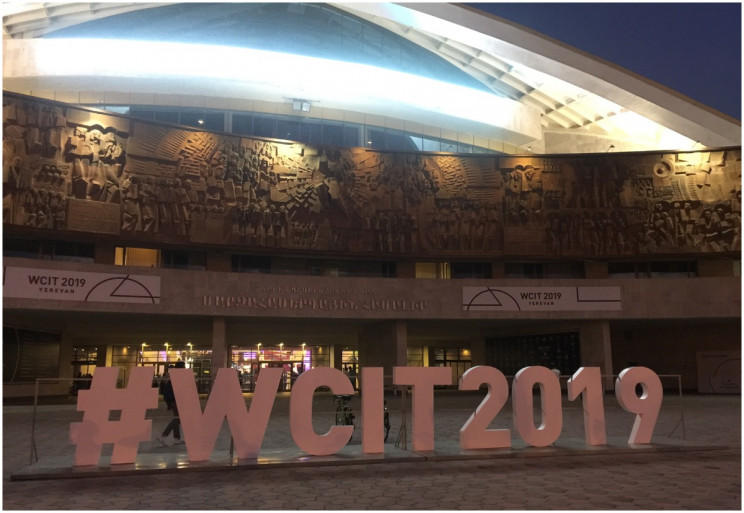
WCIT Yerevan Susan Fourtané for Interesting
Engineering
YEREVAN, Armenia — The current climate change[1]
emergency and the mobilization of thousands of activists around the
world demanding governments to take the issue seriously has also
had an impact on the technology industry.
As a result, technology leaders around the world gathered
this week at the 23rd World Congress of Information
Technology[2] (WCIT)
hosted by Armenia in its capital city, Yerevan, to discuss and
exchange ideas on what measures can the information communications
technology (ICT) industry take to contain and wisely manage its own
use of energy and resources.
It is usually taken for granted that the sun and
wind-powered new world of high-technology[3]
is cleaner and greener than the gritty old world of carbon and
steel. However, not many give too much thought to the dark side.
Yet, the reality is that powering vast amounts of high-tech
infrastructure of data centers and switches demands the generation
of great amounts of electrical energy.
Blockchain[4], Artificial Intelligence[5]
(AI), Big Data[6], 5G, Internet of Things[7]
(IoT), and the ever-more-data-hungry cryptography-based economy
cannot exist without the generation of electrical energy. And the
demands are going to increase even further.
So, how sustainable is high-technology really? The
never-ending growth of data consumption demands the use of vast
amounts of water and resources to power and cool the data centers
and the technological infrastructure necessary to support the
digital world. What is the cost and the impact on the
environment? What about the impact of extracting and disposing of
the toxic material that go into the manufacture of
high-technology?
How is the technology industry reacting to these and other
questions and what is the ICT industry planning to contain and
manage its own use of energy and resources?
What does it mean to be green?
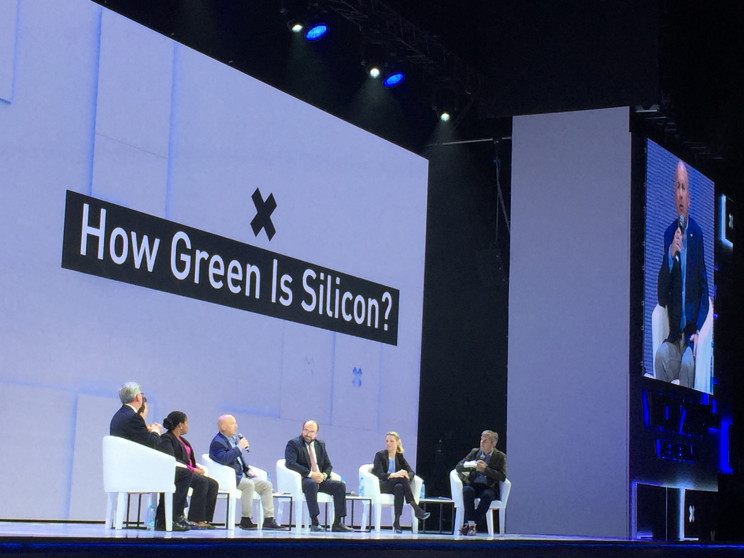 A panel of experts at WCIT in Yerevan
discussed how real green initiatives should be built from cradle to
grave in order to reduce carbon emissions / Source: Susan Fourtané
for Interesting Engineering
In his keynote speech at WCIT in Yerevan,
Curt
Hébert[8], Former Chairman of the
U.S. Federal Energy Regulatory Commission (FERC), now full-time
energy law lawyer said that “when we think about green initiatives
we need to think about them from cradle to grave.”
One of his examples focused on solar. “There is no carbon
emissions generated from the electricity generated from solar.
That’s perfect,” he said. However, the production of the
photovoltaic panels has a carbon footprint. When looking at
renewables we have to look at all the phases of solar power, for
instance, and not just at the energy producing
phase.
Hébert referenced an article by the Manhattan Institute
published in the Wall Street Journal in May which mentions that the
International Energy Agency (IEA) highlighted that “energy demand
worldwide in 2018 grew by its fastest pace in the decade. Driven by
robots, the global economy with fossil fuels is meeting nearly
70 percent of the growth for the second year
running.
“Using wind, solar, and batteries as the primary sources for a
nation’s energy supply remains far too expensive. So, we have to
figure that out. Cost is an issue. The economy is always an issue
because when it comes to the price of electricity, who do we have
to worry about? Regulators,” he said. Regulators get to decide how
much we have to change for the commodity.”
According to Hébert, the reality from the financial point of
view is that “there is a little chance that wealthy nations will
agree to subsidize expenses for green tech for the rest of the
world.” He made a point saying that this means there is a need to
understand the true cost of a green initiative.
Back to the example of solar energy, the life-cycle of the solar
panel from cradle to grave produces carbon emissions. Mining,
production, transportation, installation produce 3 to 13 percent of
the energy that will be produced by the solar panel during its
30-year life-cycle, according to the National Renewable Energy
Laboratory of the Department of Energy of the United
States.
Hébert said that “there needs to be a balance between what we do
environmentally, the environment itself, and the economy and
economic development.
To make ICT greener we need
-
Eco-friendly materials
-
Sustainable products
-
Supply chain responsibility in the procurement process
-
Reuse and recycling
-
Low-energy intensity
-
Low-water intensity
-
Waste minimization
-
Low-carbon technology
Following his keynote, Curt Hébert joined
a panel discussion moderated by author Andrew Blum[9] and integrated by
Jenny
Bofinger-Schuster[10], VP of Sustainability
and Cities at Siemens; Brian
Lillie[11], Former CPO of Equinix
and Board Member of Lumentum & Talend; Ulili
Onovakpuri[12], Partner at Kapor
Capital; and John S.
Shegerian[13], Founder and Executive
Chairman at Electronics Recyclers International (ERI).
How green is Silicon?
“In 2004, electronics were the fastest growing solid waste
stream in the world. Today, they are still the fastest growing
solid waste stream in the world,” said John S.
Shegerian. “Just think about what we rely on our iPhones
and iPads, gadgets in our cars and in our homes that
make our lives better and more connected.”
His message and call for recycling all electronics was clear.
“All of those materials can be recycled responsibly and create a
great outcome. Economic sustainability can merge with environmental
sustainability and we can all participate in making the world a
better place,” Shegerian said.
In conclusion, to make Silicon greener we must pay attention to
the cradle to grave life-cycle and we must do a better job. ICT
cannot be supported by a renewable only energy today, but in the
future this may be possible.
Related Articles:
References
- ^
climate
change (interestingengineering.com) - ^
23rd
World Congress of Information Technology
(wcit2019.org) - ^
high-technology
(interestingengineering.com) - ^
Blockchain
(interestingengineering.com) - ^
Artificial Intelligence
(interestingengineering.com) - ^
Big
Data (interestingengineering.com) - ^
Internet
of Things (interestingengineering.com) - ^
Curt Hébert
(www.brunini.com) - ^
Andrew
Blum (www.andrewblum.net) - ^
Jenny Bofinger-Schuster
(www.linkedin.com) - ^
Brian Lillie
(www.linkedin.com) - ^
Ulili Onovakpuri
(www.linkedin.com) - ^
John S. Shegerian
(www.linkedin.com)