Google has addressed yet another actively exploited zero-day in
Chrome browser, marking the second such fix released by the company
within a month.
The browser maker on Friday shipped 89.0.4389.90 for Windows,
Mac, and Linux, which is expected to be rolling out over the coming
days/weeks to all users.
While the update contains a total of five security fixes, the
most important flaw rectified by Google concerns a use after free[1]
vulnerability in its Blink rendering engine. The bug is tracked as
CVE-2021-21193.
Details about the flaw are scarce except that it was reported to
Google by an anonymous researcher on March 9.
As is usually the case with actively exploited flaws, Google
issued a terse statement acknowledging that an exploit for
CVE-2021-21193 but refrained from sharing additional information
until a majority of users are updated with the fixes and prevent
other threat actors from creating exploits targeting this
zero-day.
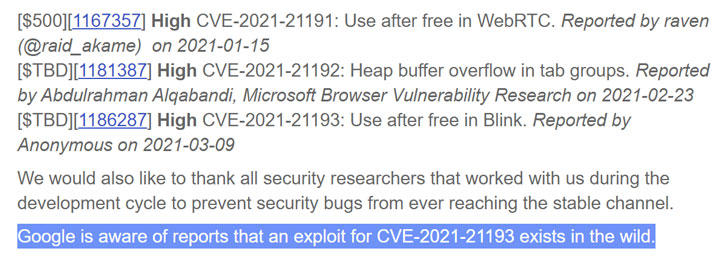
“Google is aware of reports that an exploit for CVE-2021-21193
exists in the wild,” Chrome Technical Program Manager Prudhvikumar
Bommana noted[2]
in a blog post.
With this update, Google has fixed three zero-day flaws in
Chrome since the start of the year.
Earlier this month, the company issued a fix for an “object
lifecycle issue in audio” (CVE-2021-21166) which it said was being
actively exploited. Then on February 4, the company resolved
another actively-exploited heap buffer overflow flaw
(CVE-2021-21148) in its V8 JavaScript rendering engine.
Chrome users can update to the latest version by heading to
Settings > Help > About Google Chrome to mitigate the risk
associated with the flaw.
References
- ^
use
after free (cwe.mitre.org) - ^
noted
(chromereleases.googleblog.com)