Cybersecurity researchers disclosed details about 13
vulnerabilities in the Nagios network monitoring application that
could be abused by an adversary to hijack the infrastructure
without any operator intervention.
“In a telco setting, where a telco is monitoring thousands of
sites, if a customer site is fully compromised, an attacker can use
the vulnerabilities to compromise the telco, and then every other
monitored customer site,” Adi Ashkenazy, CEO of Australian
cybersecurity firm Skylight Cyber, told The Hacker News via
email.
Nagios is an open-source IT infrastructure tool analogous to
SolarWinds Network Performance Monitor (NPM) that offers monitoring
and alerting services for servers, network cards, applications, and
services.
The issues, which consist of a mix of authenticated remote code
execution (RCE) and privilege escalation flaws, were discovered and
reported to Nagios in October 2020, following which they were
remediated[1]
in November[2].
Chief among them is CVE-2020-28648[3]
(CVSS score: 8.8), which concerns an improper input validation in
the Auto-Discovery component[4] of Nagios XI that the
researchers used as a jumping-off point to trigger an exploit chain
that strings together a total of five vulnerabilities to achieve a
“powerful upstream attack.”
“Namely, if we, as attackers, compromise a customer site that is
being monitored using a Nagios XI server, we can compromise the
telecommunications company’s management server and every other
customer that is being monitored,” the researchers said[5]
in a write-up published last week.
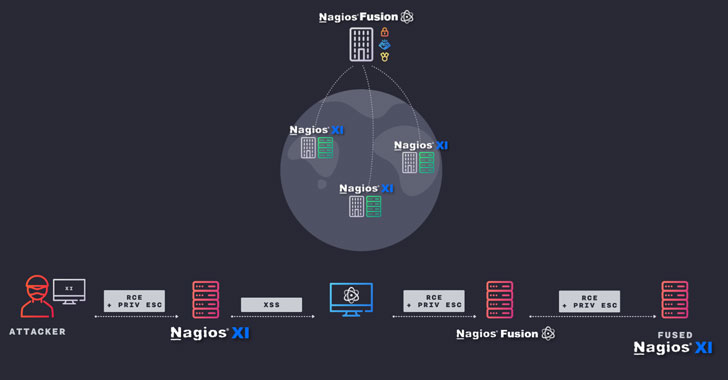
Put differently; the attack scenario works by targeting a Nagios
XI server at the customer site, using CVE-2020-28648 and
CVE-2020-28910 to gain RCE and elevate privileges to “root.” With
the server now effectively compromised, the adversary can then send
tainted data to the upstream Nagios Fusion server that’s used to
provide centralized infrastructure-wide visibility by periodically
polling the Nagios XI servers.
“By tainting data returned from the XI server under our control
we can trigger Cross-Site Scripting [CVE-2020-28903] and execute
JavaScript code in the context of a Fusion user,” Skylight Cyber
researcher Samir Ghanem said.
The next phase of the attack leverages this ability to run
arbitrary JavaScript code on the Fusion server to obtain RCE
(CVE-2020-28905) and subsequently elevate permissions
(CVE-2020-28902) to seize control of the Fusion server and,
ultimately, break into XI servers located at other customer
sites.
The researchers have also published a PHP-based
post-exploitation tool called SoyGun[6] that chains the
vulnerabilities together and “allows an attacker with Nagios XI
user’s credentials and HTTP access to the Nagios XI server to take
full control of a Nagios Fusion deployment.”
A summary of the 13 vulnerabilities is listed below –
- CVE-2020-28648 – Nagios XI authenticated
remote code execution (from the context of a low-privileged
user) - CVE-2020-28900 – Nagios Fusion and XI
privilege escalation from nagios to root via
upgrade_to_latest.sh - CVE-2020-28901 – Nagios Fusion privilege
escalation from apache to nagios via command
injection on component_dir parameter in cmd_subsys.php - CVE-2020-28902 – Nagios Fusion privilege
escalation from apache to nagios via command
injection on timezone parameter in cmd_subsys.php - CVE-2020-28903 – XSS in Nagios XI when an
attacker has control over a fused server - CVE-2020-28904 – Nagios Fusion privilege
escalation from apache to nagios via the
installation of malicious components - CVE-2020-28905 – Nagios Fusion authenticated
remote code execution (from the context of low-privileges
user) - CVE-2020-28906 – Nagios Fusion and XI
privilege escalation from nagios to root via
modification of fusion-sys.cfg / xi-sys.cfg - CVE-2020-28907 – Nagios Fusion privilege
escalation from apache to root via
upgrade_to_latest.sh and modification of proxy config - CVE-2020-28908 – Nagios Fusion privilege
escalation from apache to nagios via command
injection (caused by poor sanitization) in cmd_subsys.php - CVE-2020-28909 – Nagios Fusion privilege
escalation from nagios to root via modification
of scripts that can execute as sudo - CVE-2020-28910 – Nagios XI getprofile.sh
privilege escalation - CVE-2020-28911 – Nagios Fusion information
disclosure: Lower privileged user can authenticate to fused server
when credentials are stored
With SolarWinds[7]
falling victim to a major supply chain attack last year, targeting
a network monitoring platform like Nagios could enable a malicious
actor to orchestrate intrusions into corporate networks, laterally
expand their access across the IT network, and become an entry
point for more sophisticated threats.
“The amount of effort that was required to find these
vulnerabilities and exploit them is negligible in the context of
sophisticated attackers, and specifically nation-states,” Ghanem
said.
“If we could do it as a quick side project, imagine how simple
this is for people who dedicate their whole time to develop these
types of exploits. Compound that with the number of libraries,
tools and vendors that are present and can be leveraged in a modern
network, and we have a major issue on our hands.”
References
- ^
remediated
(www.nagios.com) - ^
November
(www.nagios.com) - ^
CVE-2020-28648
(nvd.nist.gov) - ^
Auto-Discovery component
(support.nagios.com) - ^
said
(skylightcyber.com) - ^
SoyGun
(github.com) - ^
SolarWinds
(thehackernews.com)