
Apple on Monday rolled out security updates for iOS[1], macOS[2], tvOS[3], watchOS[4], and Safari[5] web browser to fix
multiple vulnerabilities, including an actively exploited zero-day
flaw in macOS Big Sur and expand patches for two previously
disclosed zero-day flaws.
Tracked as CVE-2021-30713, the zero-day concerns a permissions
issue in Apple’s Transparency, Consent, and Control (TCC[6]) framework in macOS that
maintains a database of each user’s consents. The iPhone maker
acknowledged that the issue may have been exploited in the wild but
stopped short of sharing specifics.
The company noted that it rectified the problem with improved
validation.
However, in a separate report, mobile device management company
Jamf said the bypass flaw was being actively exploited by XCSSET, a
malware that’s been out in the wild since August 2020 and known to
propagate via modified Xcode IDE projects[7]
hosted on GitHub repositories and plant malicious packages into
legitimate apps installed on the target system.
“The exploit in question could allow an attacker to gain Full
Disk Access, Screen Recording, or other permissions without
requiring the user’s explicit consent — which is the default
behavior,” Jamf researchers Stuart Ashenbrenner, Jaron Bradley, and
Ferdous Saljooki said[8]
in a write-up.
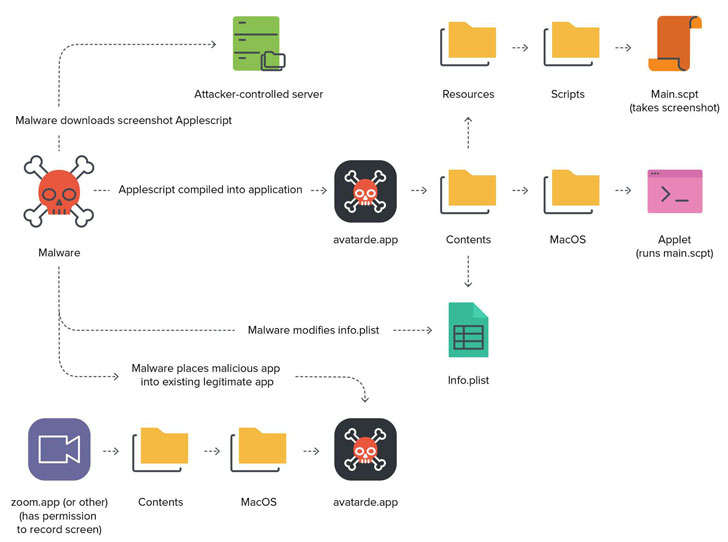
Taking the form of a AppleScript module, the zero-day flaw
allowed the hackers to exploit the devices XCSSET was installed to
leverage the permissions that have already been provided to the
trojanized application to amass and exfiltrate sensitive
information.
Specifically, the malware checked for screen capture permissions
from a list of installed applications, such as Zoom, Discord,
WhatsApp, Slack, TeamViewer, Upwork, Skype, and Parallels Desktop,
to inject the malware (“avatarde.app”) into the app’s folder,
thereby inheriting the necessary permissions required to carry out
its nefarious tasks.
“By leveraging an installed application with the proper
permissions set, the attacker can piggyback off that donor app when
creating a malicious app to execute on victim devices, without
prompting for user approval,” the researchers noted.
XCSSET was also the subject of closer scrutiny last month[9]
after a new variant of the malware was detected targeting Macs
running on Apple’s new M1 chips to steal wallet information from
cryptocurrency apps. One of its primary functions is to siphon
Safari browser cookies as well as install a developer version of
the Safari application to load JavaScript backdoors from its
command-and-control server.
Also fixed as part of Monday’s updates are two other actively
exploited flaws in its WebKit browser engine affecting Safari,
Apple TV 4K, and Apple TV HD devices, almost three weeks after
Apple addressed the same issues in iOS, macOS, and watchOS[10] earlier this month.
- CVE-2021-30663 – An integer overflow issue in
WebKit, which could be exploited to achieve arbitrary code
execution when processing maliciously crafted web content. - CVE-2021-30665 – A memory corruption issue in
WebKit that could lead to arbitrary code execution when processing
maliciously crafted web content.
Users of Apple devices are recommended to update to the latest
versions to mitigate the risk associated with the flaws.
References
- ^
iOS
(support.apple.com) - ^
macOS
(support.apple.com) - ^
tvOS
(support.apple.com) - ^
watchOS
(support.apple.com) - ^
Safari
(support.apple.com) - ^
TCC
(support.apple.com) - ^
Xcode
IDE projects (developer.apple.com) - ^
said
(www.jamf.com) - ^
last
month (thehackernews.com) - ^
iOS,
macOS, and watchOS (thehackernews.com)