
Microsoft on Monday revealed that its Azure cloud platform
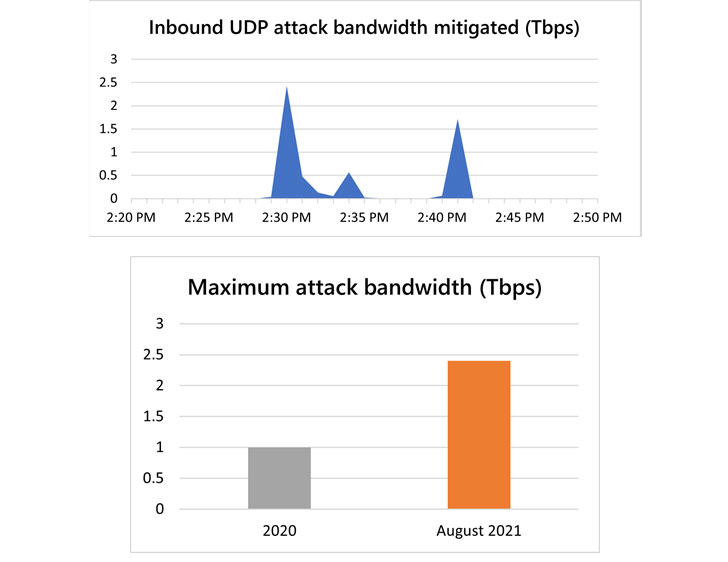
mitigated a 2.4 Tbps distributed denial-of-service (DDoS) attack in
the last week of August targeting an unnamed customer in Europe,
surpassing a 2.3 Tbps attack[1]
stopped by Amazon Web Services in February 2020.
“This is 140 percent higher than 2020’s 1 Tbps attack[2]
and higher than any network volumetric event previously detected on
Azure,” Amir Dahan, senior program manager for Azure Networking,
said[3]
in a post, calling it a “UDP reflection[4]” lasting for about 10
minutes.
Reflected amplification attacks are a type of denial of service
attacks wherein a threat actor takes advantage of the
connectionless nature of UDP protocol with spoofed requests so as
to overwhelm a target server or network with a flood of packets,
causing disruption or rendering the server and its surrounding
infrastructure unavailable.
The attack is said to have originated from a botnet of
approximately 70,000 compromised devices primarily located across
the Asia-Pacific region, such as Malaysia, Vietnam, Taiwan, Japan,
and China, as well as the U.S.
Microsoft said it observed three short-lived bursts, each
ramping up in seconds to terabit volumes — the first at 2.4 Tbps,
the second at 0.55 Tbps, and the third at 1.7 Tbps.
News of the DDoS attack comes a month after Russian internet
giant Yandex became the target of a record-breaking distributed
denial-of-service (DDoS) attack by a new botnet called Mēris[5], which battered the
company’s web infrastructure with millions of HTTP requests, before
hitting a peak of 21.8 million requests per second (RPS).
“Bad actors, now more than ever, continuously look for ways to
take applications offline,” Dahan said. “Attacks of this size
demonstrate the ability of bad actors to wreak havoc by flooding
targets with gigantic traffic volumes trying to choke network
capacity.”
References
- ^
2.3 Tbps
attack (aws.amazon.com) - ^
2020’s 1
Tbps attack (azure.microsoft.com) - ^
said
(azure.microsoft.com) - ^
UDP
reflection (thehackernews.com) - ^
Mēris
(thehackernews.com)