Windows 10, iOS 15, Google Chrome, Apple Safari, Microsoft
Exchange Server, and Ubuntu 20 were successfully broken into using
original, never-before-seen exploits at the Tianfu Cup 2021, the
fourth edition of the international cybersecurity contest held in
the city of Chengdu, China.
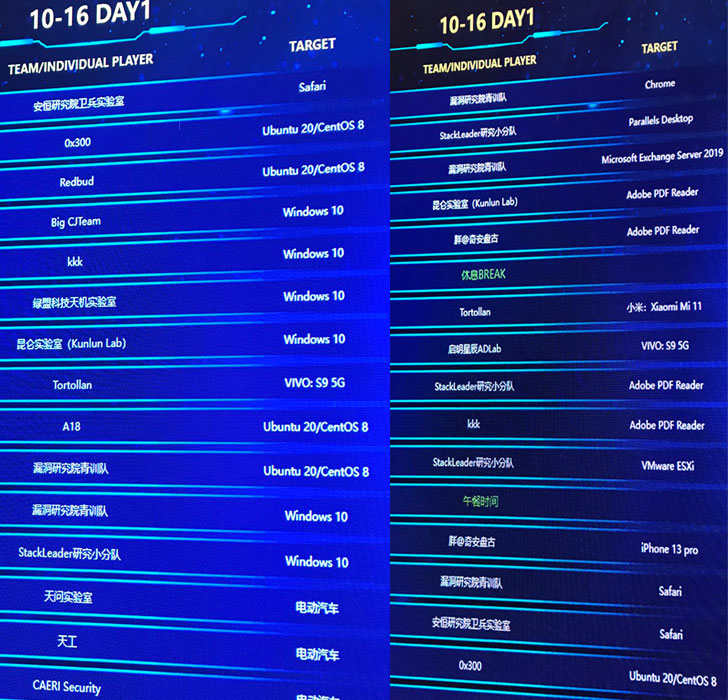
Targets this year included[1]
Google Chrome running on Windows 10 21H1, Apple Safari running on
Macbook Pro, Adobe PDF Reader, Docker CE, Ubuntu 20/CentOS 8,
Microsoft Exchange Server 2019, Windows 10, VMware Workstation,
VMware ESXi, Parallels Desktop, iPhone 13 Pro running iOS 15,
domestic mobile phones running Android, QEMU VM, Synology DS220j
DiskStation, and ASUS RT-AX56U router.
The Chinese version of Pwn2Own was started[2]
in 2018 in the wake of government regulation in the country that
barred security researchers from participating in international
hacking competitions because of national security concerns.
With the exception of Synology DS220j NAS, Xiaomi Mi 11
smartphone, and an unnamed Chinese electric vehicle, attacks[3]
were mounted successfully against every other target —
- Adobe PDF Reader
- Apple iPhone 13 Pro (running iOS 15)
- Apple Safari
- ASUS RT-AX56U
- Docker CE
- Google Chrome
- Microsoft Exchange Server
- Microsoft Windows 10
- Parallels Desktop
- QEMU VM
- Ubuntu 20/CentOS 8
- VMware ESXi
- VMWare Workstation
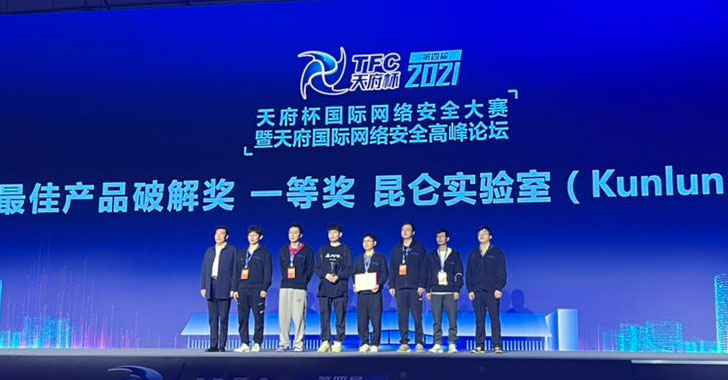
The two-day tournament, which took place over the weekend on
October 16 and 17, saw security researchers winning 1.88 million in
prize money, with Kunlun Lab taking the top spot[4]
($654,500) for demonstrating successful exploits in iOS 15,
including a remote code execution flaw in mobile Safari within 15
seconds. Researchers from the cybersecurity firm also pwned Google
Chrome “to get Windows system kernel level privilege with only two
bugs,” Kunlun Lab’s CEO @mj0011) tweeted.
Team PangU emerged second with a total haul of $522,500 for
showing off a remote jailbreak in iPhone13 Pro running iOS 15,
marking the first time the newly released iPhone model has been
cracked at a public forum, while the Vulnerability Research
Institute (VRI) came third with $392,500.
Details of the flaws have not been made public, but the
companies are expected to release patches for the newly uncovered
flaws in the upcoming weeks.