
A newly disclosed vulnerability affecting Intel processors could
be abused by an adversary to gain access to sensitive information
stored within enclaves and even run arbitrary code on vulnerable
systems.
The vulnerability (CVE-2021-0186[1], CVSS score: 8.2) was
discovered by a group of academics from ETH Zurich, the National
University of Singapore, and the Chinese National University of
Defense Technology in early May 2021, who used it to stage a
confidential data disclosure attack called “SmashEx[2]” that can corrupt
private data housed in the enclave and break its integrity.
Introduced with Intel’s Skylake processors, SGX (short for
Software Guard eXtensions) allows developers to run selected
application modules in a completely isolated secure compartment of
memory, called an enclave or a Trusted Execution Environment (TEE),
which is designed to be protected from processes running at higher
privilege levels like the operating system. SGX ensures that data
is secure even if a computer’s operating system has been tampered
with or is under attack.
“For normal functioning, the SGX design allows the OS to
interrupt the enclave execution through configurable hardware
exceptions at any point,” the researchers outlined. “This feature
enables enclave runtimes (e.g., Intel SGX SDK and Microsoft Open
Enclave) to support in-enclave exception or signal handling, but it
also opens up enclaves to re-entrancy bugs. SmashEx is an attack
which exploits enclave SDKs which do not carefully handle
re-entrancy in their exceptional handling safely.”
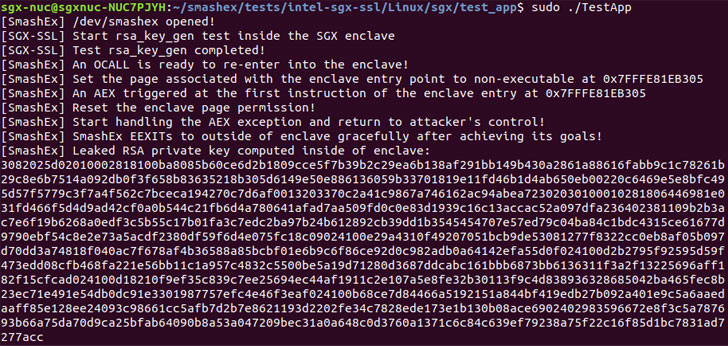
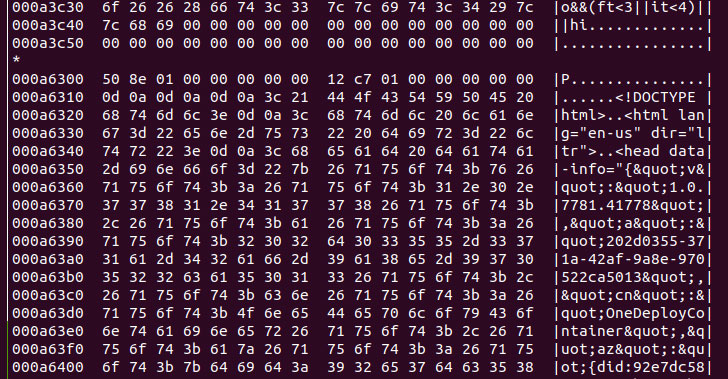
It’s worth noting that an enclave may also have Outside Calls,
or OCALLS[3], which allow enclave
functions to call out to the untrusted application and then return
to the enclave. But when the enclave is also handling in-enclave
exceptions (e.g., timer interrupt or division-by-zero), the
vulnerability provides a brief window for a local attacker to
hijack the control flow of execution by injecting an asynchronous
exception immediately after the enclave is entered.
Armed with this capability, the adversary can then corrupt the
in-enclave memory to leak sensitive data such as RSA private keys
or execute malicious code.
Since SmashEx affects runtimes that support in-enclave exception
handling, the researchers noted that “such OCALL return flow and
the exception handling flow should be written with care to ensure
that they interleave safely,” and that “when the OCALL return flow
is interrupted, the enclave should be in a consistent state for the
exception handling flow to progress correctly, and when the
exception handling flow completes, the enclave state should also be
ready for the enclave to resume.”
Intel has since released software updates to mitigate this
vulnerability with SGX SDK versions 2.13 and 2.14 for Windows and
Linux respectively. Microsoft, for its part, addressed[4]
the issue (CVE-2021-33767[5]) in its July 2021 Patch
Tuesday updates with Open Enclave version 0.17.1 of the SDK. The
research team’s findings[6]
are expected to be presented next month at the ACM Conference on
Computer and Communications Security.
“Asynchronous exception handling is a commodity functionality
for real-world applications today, which are increasingly utilizing
enclaves,” the researchers said, adding the research highlights
“the importance of providing atomicity guarantees at the OS-enclave
interface for such exceptions.”