
State-sponsored actors backed by the Russian government
regularly targeted the networks of several U.S. cleared defense
contractors (CDCs) to acquire proprietary documents and other
confidential information pertaining to the country’s defense and
intelligence programs and capabilities.
The sustained espionage campaign is said to have commenced at
least two years ago from January 2020, according to a joint advisory[1]
published by the U.S. Federal Bureau of Investigation (FBI),
National Security Agency (NSA), and Cybersecurity and
Infrastructure Security Agency (CISA).
“These continued intrusions have enabled the actors to acquire
sensitive, unclassified information, as well as CDC-proprietary and
export-controlled technology,” the agencies said[2]. “The acquired
information provides significant insight into U.S. weapons
platforms development and deployment timelines, vehicle
specifications, and plans for communications infrastructure and
information technology.”
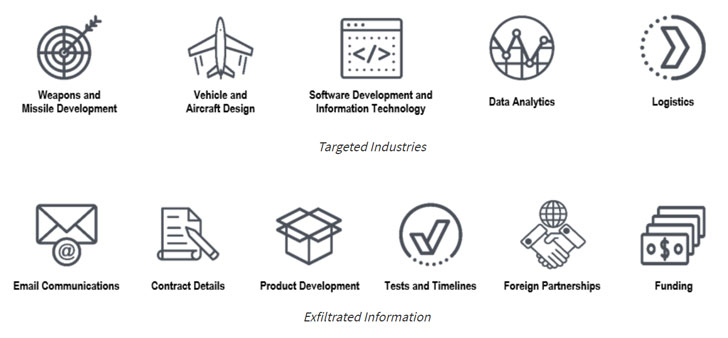
Compromised entities include contractors that dabble in command,
control, communications, and combat systems; surveillance and
reconnaissance; weapons and missile development; vehicle and
aircraft design; and software development, data analytics, and
logistics.
The threat actors rely on “common but effective” tactics to
breach target networks such as spear-phishing, credential
harvesting, brute-force attacks, password spray techniques, and
exploitation of known vulnerabilities in VPN devices, before moving
laterally to establish persistence and exfiltrate data.
Some of the vulnerabilities[3]
leveraged by the attackers for initial access and privilege
escalation are as follows –
- CVE-2018-13379[4] (CVSS score: 9.8) – Path
traversal vulnerability in Fortinet’s FortiGate SSL VPN - CVE-2020-0688[5] (CVSS score: 8.8) –
Microsoft Exchange validation key remote code execution
vulnerability - CVE-2020-17144[6] (CVSS score: 8.4) –
Microsoft Exchange remote code execution vulnerability
Many of the intrusions also involve gaining a foothold to
enterprise and cloud networks, with the adversaries maintaining
persistent access to the compromised Microsoft 365 environments for
as long as six months to repeatedly harvest emails and data.
“As CDCs find and patch known vulnerabilities on their networks,
the actors alter their tradecraft to seek new means of access,” the
agencies explained. “This activity necessitates CDCs maintain
constant vigilance for software vulnerabilities and out-of-date
security configurations, especially in internet-facing
systems.”
Among other malicious activities observed is the routine use of
virtual private servers (VPSs) as an encrypted proxy and the use of
legitimate credentials to exfiltrate emails from the victim’s
enterprise email system. The advisory, however, does not single out
any Russian state actor by name.
“Over the last several years, Russian state-sponsored cyber
actors have been persistent in targeting U.S. cleared defense
contractors to get at sensitive information,” said[7]
Rob Joyce, director of NSA Cybersecurity. “Armed with insights like
these, we can better detect and defend important assets
together.”
References
- ^
joint
advisory (www.cisa.gov) - ^
said
(www.cisa.gov) - ^
vulnerabilities
(thehackernews.com) - ^
CVE-2018-13379
(nvd.nist.gov) - ^
CVE-2020-0688
(nvd.nist.gov) - ^
CVE-2020-17144
(nvd.nist.gov) - ^
said
(www.nsa.gov)
Read more https://thehackernews.com/2022/02/us-says-russian-hackers-stealing.html