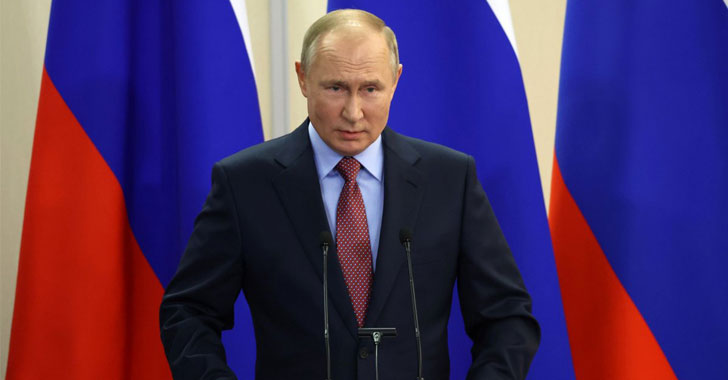
The Russian government on Thursday warned of cyber attacks aimed
at domestic critical infrastructure operators, as the country’s
full-blown invasion of Ukraine enters the second day.
In addition to cautioning of the “threat of an increase in the
intensity of computer attacks,” Russia’s National Computer Incident
Response and Coordination Center said[1]
that the “attacks can be aimed at disrupting the functioning of
important information resources and services, causing reputational
damage, including for political purposes.”
“Any failure in the operation of [critical information
infrastructure] objects due to a reason that is not reliably
established, first of all, should be considered as the result of a
computer attack, the agency added.
Furthermore, it notified of possible influence operations
undertaken to “form a negative image of the Russian Federation in
the eyes of the world community,” echoing a similar alert[2]
released by the U.S. Cybersecurity and Infrastructure Security
Agency (CISA) last week about information manipulation efforts from
foreign actors to strike critical entities.
The agency, however, didn’t share more specifics on the nature
of the attacks or their provenance.
The advisory comes as multiple[3]
government[4]
and banking[5]
websites[6]
in Russia, including that of military (mil.ru), the Kremlin
(kremlin.ru), and the State Duma (duma.gov.ru), were rendered
unreachable amid a spate of cyber offensives targeting Ukraine that
resulted in the deployment of a data wiper[7]
called HermeticWiper[8]
on hundreds of machines in the East European nation.
“It’s important to note that the wiper leverages high privileges
on the compromised host to make the host ‘unbootable’ by overriding
the boot records and configurations, erase device configurations,
and delete shadow copies,” Lavi Lazarovitz, head of security
research at CyberArk Labs, said in a statement shared with The
Hacker News.
“The wiper is configured to not encrypt domain controllers –
that is to keep the domain running and allow the ransomware to use
valid credentials to authenticate to servers and encrypt those.
This further highlights that the threat actors use compromised
identities to access the network and / or move laterally,”
Lazarovitz elaborated.
It’s not clear how many networks have been affected by the
previously unseen data-wiping malware, which targeted organizations
in the financial, defense, aviation, and IT industries, according
to Symantec. The Broadcom-owned company also said it observed
evidence of wiper attacks against machines in Lithuania, implying a
spillover effect.
What’s more, HermeticWiper shares overlaps with another data
wiper called WhisperGate[9]
that was first reported as being used against Ukrainian
organizations in January. Like the latter, the newly discovered
malware is accompanied by the distribution of a ransomware strain
on compromised systems.
The ransomware malware[10] is a 64-bit, 3.14 MB
.EXE file, written in Golang, per Cybereason researcher Chen Erlich[11], who shared an analysis
of the executable.
“It appears likely that the ransomware was used as a decoy or
distraction from the wiper attacks,” Symantec said[12]. “This has some
similarities to the earlier WhisperGate wiper attacks against
Ukraine, where the wiper was disguised as ransomware.”
Initial forensic analysis suggests that the attacks may have
been in preparation mode for at least three months, what with
potentially related malicious activity detected in a Lithuanian
organization as early as November 12, 2021. Also, one of the
HermeticWiper samples was found to have a compilation timestamp of
December 28, 2021.
While the latest disruptive actions are yet to be formally
attributed, the U.K. and U.S. governments linked the DDoS attacks[13] on Ukraine in
mid-February to Russia’s Main Intelligence Directorate (also known
as GRU).
As the attacks continue to unfold both on the physical and
digital realms, Reuters reported[14] that the Ukrainian
government is seeking the help of the underground hacker community
in the country to fend off cyber infiltrations aimed at critical
infrastructure and conduct covert espionage missions against the
invading Russian forces.
References
- ^
said
(safe-surf.ru) - ^
similar
alert (thehackernews.com) - ^
multiple
(twitter.com) - ^
government
(twitter.com) - ^
banking
(twitter.com) - ^
websites
(twitter.com) - ^
data
wiper (www.welivesecurity.com) - ^
HermeticWiper
(thehackernews.com) - ^
WhisperGate
(thehackernews.com) - ^
ransomware malware
(www.virustotal.com) - ^
Chen
Erlich (twitter.com) - ^
said
(symantec-enterprise-blogs.security.com) - ^
DDoS
attacks (cip.gov.ua) - ^
reported
(www.reuters.com)
Read more https://thehackernews.com/2022/02/putin-warns-russian-critical.html