A threat actor with affiliations to the cyber warfare division
of Hamas has been linked to an “elaborate campaign” targeting
high-profile Israeli individuals employed in sensitive defense, law
enforcement, and emergency services organizations.
“The campaign operators use sophisticated social engineering
techniques, ultimately aimed to deliver previously undocumented
backdoors for Windows and Android devices,” cybersecurity company
Cybereason said[1]
in a Wednesday report.
“The goal behind the attack was to extract sensitive information
from the victims’ devices for espionage purposes.”
The monthslong intrusions, codenamed “Operation Bearded
Barbie,” have been attributed to an Arabic-speaking and
politically-motivated group called Arid Viper, which operates out
of the Middle East and is also known by the monikers APT-C-23 and
Desert Falcon.
Most recently, the threat actor was held responsible[2]
for attacks aimed at Palestinian activists and entities starting
around October 2021 using politically-themed phishing emails and
decoy documents.
The latest infiltrations are notable for their specific focus on
plundering information from computers and mobile devices belonging
to Israeli individuals by luring them into downloading trojanized
messaging apps, granting the actors unfettered access.
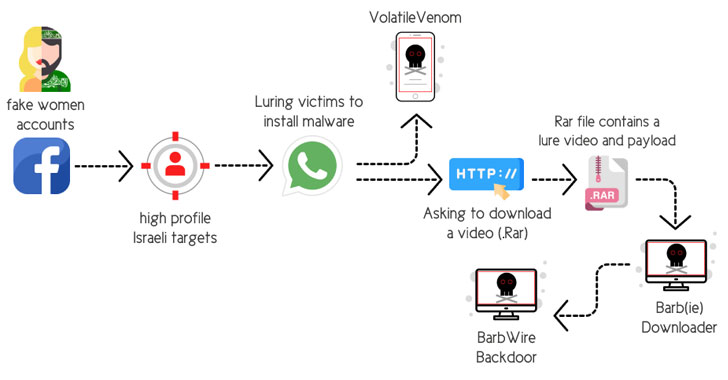
The social engineering attacks involved the use of fake personas on Facebook[3], relying on the tactic
of catfishing to set up fictitious profiles of attractive young
women to gain the trust of the targeted individuals and befriend
them on the platform.
“After gaining the victim’s trust, the operator of the fake
account suggests migrating the conversation from Facebook over to
WhatsApp,” the researchers elaborated. “By doing so, the operator
quickly obtains the target’s mobile number.”
Once the chat shifts from Facebook to WhatsApp, the attackers
suggest the victims that they install a secure messaging app for
Android (dubbed “VolatileVenom”) as well as open a RAR archive file
containing explicit sexual content that leads to the deployment of
a malware downloader called Barb(ie).
Other hallmarks of the campaign have included the group
leveraging an upgraded arsenal of malware tools, including the
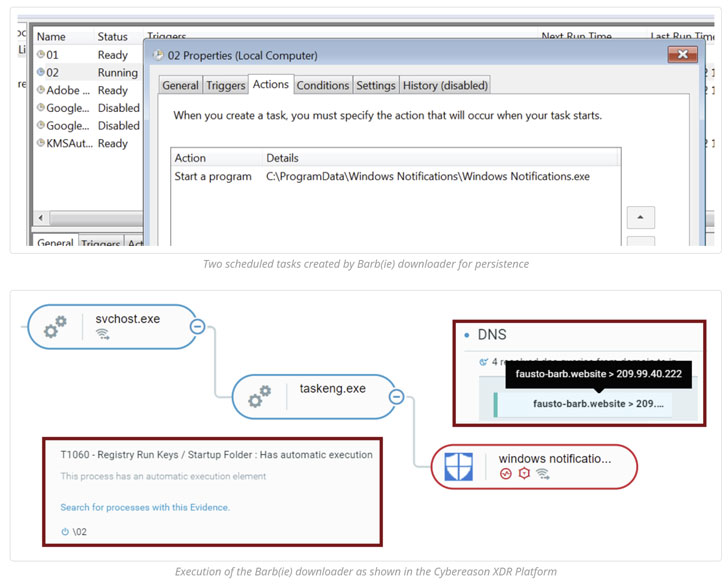
BarbWire Backdoor, which is installed by the downloader module.
The malware serves as a tool to completely compromise the victim
machine, allowing it to establish persistence, harvest stored
information, record audio, capture screenshots, and download
additional payloads, all of which is transmitted back to a remote
server.
VolatileVenom, on the other hand, is Android spyware that’s
known to spoof legitimate messaging apps[4] and masquerade as system
updates and which has been put to use in different campaigns by
Arid Viper since at least 2017[5].
One such example of a rogue Android app is called “Wink Chat,”
where victims attempting to sign up to use the application are
presented an error message that “it will be uninstalled,” only for
it to stealthily run in the background and extract a wide variety
of data from the mobile devices.
“The attackers use a completely new infrastructure that is
distinct from the known infrastructure used to target Palestinians
and other Arabic-speakers,” the researchers said.
“This campaign shows a considerable step-up in APT-C-23
capabilities, with upgraded stealth, more sophisticated malware,
and perfection of their social engineering techniques which involve
offensive HUMINT capabilities using a very active and well-groomed
network of fake Facebook accounts that have been proven quite
effective for the group.”
References
- ^
said
(www.cybereason.com) - ^
held
responsible (thehackernews.com) - ^
fake
personas on Facebook (thehackernews.com) - ^
spoof
legitimate messaging apps
(thehackernews.com) - ^
since at
least 2017 (thehackernews.com)
Read more https://thehackernews.com/2022/04/hamas-linked-hackers-targeting-high.html