
A previously undocumented Chinese-speaking advanced persistent
threat (APT) actor dubbed Aoqin Dragon has been
linked to a string of espionage-oriented attacks aimed at
government, education, and telecom entities chiefly in Southeast
Asia and Australia dating as far back as 2013.
“Aoqin Dragon seeks initial access primarily through document
exploits and the use of fake removable devices,” SentinelOne
researcher Joey Chen said[1]
in a report shared with The Hacker News. “Other techniques the
attacker has been observed using include DLL hijacking, Themida-packed files[2], and DNS tunneling to
evade post-compromise detection.”
The group is said to have some level of association with another
threat actor known as Naikon[3]
(aka Override Panda), with campaigns primarily directed against
targets in Australia, Cambodia, Hong Kong, Singapore, and
Vietnam.
Infections chains mounted by Aoqin Dragon have banked on
Asia-Pacific political affairs and pornographic-themed document
lures as well as USB shortcut techniques to trigger the deployment
of one of two backdoors: Mongall and a modified version of the
open-source Heyoka project[4].
This involved leveraging old and unpatched security
vulnerabilities (CVE-2012-0158[5]
and CVE-2010-3333[6]), with the decoy
documents enticing targets into opening the files. Over the years,
the threat actor also employed executable droppers masquerading as
antivirus software to deploy the implant and connect to a remote
server.
“Although executable files with fake file icons have been in use
by a variety of actors, it remains an effective tool especially for
APT targets,” Chen explained. “Combined with ‘interesting’ email
content and a catchy file name, users can be socially engineered
into clicking on the file.”
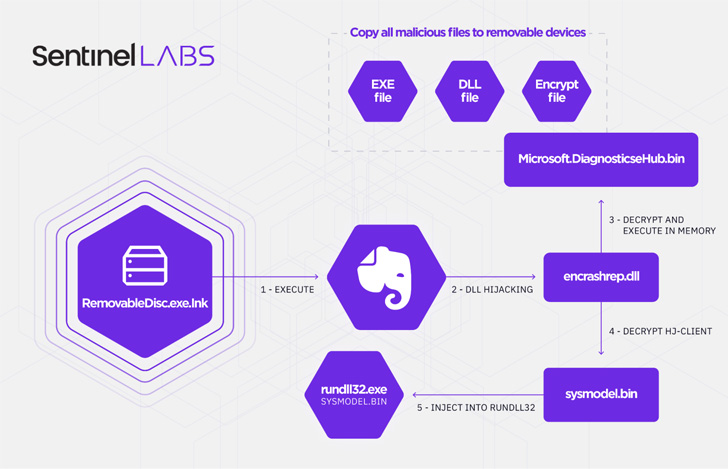
That said, Aoqin Dragon’s newest initial access vector of choice
since 2018 has been its use of a fake removable device shortcut
file (.LNK), which , when clicked, runs an executable
(“RemovableDisc.exe”) that sports the icon for the popular
note-taking app Evernote but is engineered to function as a loader
for two different payloads.
One of the components in the infection chain is a spreader that
copies all malicious files to other removable devices and the
second module is an encrypted backdoor that injects itself into
rundll32[7]‘s memory, a native Windows process[8]
used to load and run DLL files.
Known to be used[9]
since at least 2013, Mongall (“HJ-client.dll”) is described as a
not-so “particularly feature rich” implant but one that packs
enough features to create a remote shell and upload and download
arbitrary files to and from the attacker-control server.
Also used by the adversary is a reworked variant of Heyoka
(“srvdll.dll”), a proof-of-concept (PoC) exfiltration tool “which
uses spoofed DNS requests to create a bidirectional tunnel.” The
modified Heyoka backdoor is more powerful, equipped with
capabilities to create, delete, and search for files, create and
terminate processes, and gather process information on a
compromised host.
“Aoqin Dragon is an active cyber espionage group that has been
operating for nearly a decade,” Chen said, adding, “it is likely
they will also continue to advance their tradecraft, finding new
methods of evading detection and stay longer in their target
network.”
References
- ^
said (s1.ai) - ^
Themida-packed files
(blog.malwarebytes.com) - ^
Naikon
(thehackernews.com) - ^
Heyoka project
(heyoka.sourceforge.net) - ^
CVE-2012-0158
(nvd.nist.gov) - ^
CVE-2010-3333
(nvd.nist.gov) - ^
rundll32
(docs.microsoft.com) - ^
native
Windows process (redcanary.com) - ^
used
(www.welivesecurity.com)
Read more https://thehackernews.com/2022/06/a-decade-long-chinese-espionage.html