Cybersecurity researchers have taken the wraps off what they
call a “nearly-impossible-to-detect” Linux malware that could be
weaponized to backdoor infected systems.
Dubbed Symbiote by threat intelligence firms
BlackBerry and Intezer, the stealthy malware is so named for its
ability to conceal itself within running processes and network
traffic and drain a victim’s resources like a parasite[1].
The operators behind Symbiote are believed to have commenced
development on the malware in November 2021, with the threat actor
predominantly using it to target the financial sector in Latin
America, including banks like Banco do Brasil and Caixa.
“Symbiote’s main objective is to capture credentials and to
facilitate backdoor access to a victim’s machine,” researchers
Joakim Kennedy and Ismael Valenzuela said in a report[2]
shared with The Hacker News. “What makes Symbiote different from
other Linux malware is that it infects running processes rather
than using a standalone executable file to inflict damage.”
It achieves this by leveraging a native Linux feature called
LD_PRELOAD[3]
— a method previously employed by malware such as Pro-Ocean[4]
and Facefish[5]
— so as to be loaded by the dynamic linker[6]
into all running processes and infect the host.
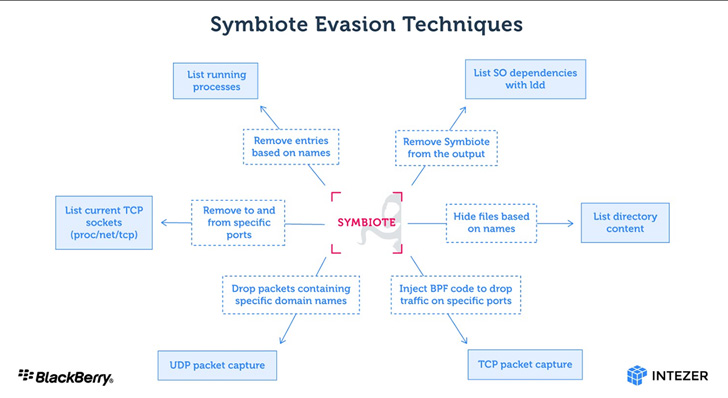
Besides hiding its presence on the file system, Symbiote is also
capable of cloaking its network traffic by making use of the
extended Berkeley Packet Filter (eBPF) feature. This is carried out
by injecting itself into an inspection software’s process and using
BPF to filter out results that would uncover its activity.
Upon hijacking all running processes, Symbiote enables rootkit
functionality to further hide evidence of its presence and provides
a backdoor for the threat actor to log in to the machine and
execute privileged commands. It has also been observed storing
captured credentials encrypted in files masquerading as C header[7]
files.
This is not the first time a malware with similar capabilities
has been spotted in the wild. In February 2014, ESET revealed a
Linux backdoor called Ebury[8]
that’s built to steal OpenSSH credentials and maintain access to a
compromised server.
“Since the malware operates as a user-land level rootkit,
detecting an infection may be difficult,” the researchers
concluded. “Network telemetry can be used to detect anomalous DNS
requests and security tools such as AVs and EDRs should be
statically linked to ensure they are not ‘infected’ by userland
rootkits.”
References
Read more https://thehackernews.com/2022/06/symbiote-stealthy-linux-malware.html