
A new piece of research from academics at ETH Zurich has
identified a number of critical security issues in the MEGA cloud
storage service that could be leveraged to break the
confidentiality and integrity of user data.
In a paper titled “MEGA: Malleable Encryption Goes
Awry[1],” the researchers point
out how MEGA’s system does not protect its users against a
malicious server, thereby enabling a rogue actor to fully
compromise the privacy of the uploaded files.
“Additionally, the integrity of user data is damaged to the
extent that an attacker can insert malicious files of their choice
which pass all authenticity checks of the client,” ETH Zurich’s
Matilda Backendal, Miro Haller, and Kenneth G. Paterson said in an
analysis of the service’s cryptographic architecture.
MEGA, which advertises[2]
itself as the “privacy company” and claims to provide
user-controlled end-to-end encrypted cloud storage, has more than
10 million daily active users, with over 122 billion files uploaded
to the platform to date.
Chief among the weaknesses is an RSA[3]
Key Recovery Attack that makes it possible for MEGA (itself acting
maliciously) or a resourceful nation-state adversary in control of
its API infrastructure to recover a user’s RSA private key by
tampering with 512 login attempts and decrypt the stored
content.
“Once a targeted account had made enough successful logins,
incoming shared folders, MEGAdrop files and chats could have been
decryptable,” Mathias Ortmann, MEGA’s chief architect, said[4]
in response to the findings. “Files in the cloud drive could have
been successively decrypted during subsequent logins.”
The recovered RSA key can then be extended to make way for four
other attacks –
- Plaintext Recovery Attack, which allows MEGA
to decrypt node keys — an encryption key associated with every
uploaded file and are encrypted with a user’s master key — and use
them to decrypt all user communication and files.
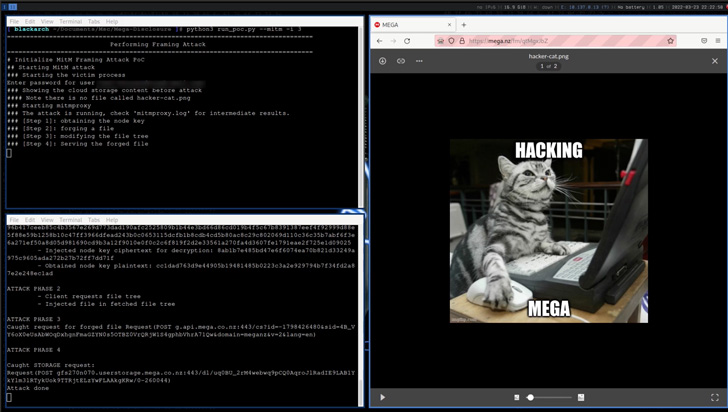
- Framing Attack, wherein MEGA can insert
arbitrary files into the user’s file storage that are
indistinguishable from genuinely uploaded ones.
- Integrity Attack, a less stealthy variant of
the Framing Attack that can be exploited to forge a file in the
name of the victim and place it in the target’s cloud storage,
and
“Each user has a public RSA key used by other users or MEGA to
encrypt data for the owner, and a private key used by the user
themselves to decrypt data shared with them,” the researchers
explained. “With this [GaP Bleichenbacher attack], MEGA can decrypt
these RSA ciphertexts, albeit requiring an impractical number of
login attempts.”
In a nutshell, the attacks could be weaponized by MEGA or any
entity controlling its core infrastructure to upload lookalike
files and decrypt all files and folders owned by or shared with the
victim as well as the chat messages exchanged.
The shortcomings are severe as they undermine MEGA’s supposed
security guarantees, prompting the company to issue updates to
address the first three of the five issues. The fourth
vulnerability related to the breach of integrity is expected to be
addressed in an upcoming release.
As for the Bleichenbacher-style attack against MEGA’s RSA
encryption mechanism, the company noted the attack is “challenging
to perform in practice as it would require approximately 122,000
client interactions on average” and that it would remove the legacy
code from all of its clients.
MEGA further emphasized that it’s not aware of any user accounts
that may have been compromised by the aforementioned attack
methods.
“The reported vulnerabilities would have required MEGA to become
a bad actor against certain of its users, or otherwise could only
be exploited if another party compromised MEGA’s API servers or TLS
connections without being noticed,” Ortmann pointed out.
“The attacks […] arise from unexpected interactions between
seemingly independent components of MEGA’s cryptographic
architecture,” the researchers elaborated. “They hint at the
difficulty of maintaining large-scale systems employing
cryptography, especially when the system has an evolving set of
features and is deployed across multiple platforms.”
“The attacks presented here show that it is possible for a
motivated party to find and exploit vulnerabilities in real world
cryptographic architectures, with devastating results for security.
It is conceivable that systems in this category attract adversaries
who are willing to invest significant resources to compromise the
service itself, increasing the plausibility of high-complexity
attacks.”
References
- ^
MEGA: Malleable Encryption Goes
Awry (mega-awry.io) - ^
advertises
(mega.io) - ^
RSA
(en.wikipedia.org) - ^
said
(blog.mega.io)
Read more https://thehackernews.com/2022/06/researchers-uncover-ways-to-break.html