
Military entities located in Bangladesh continue to be at the
receiving end of sustained cyberattacks by an advanced persistent
threat tracked as Bitter.
“Through malicious document files and intermediate malware
stages the threat actors conduct espionage by deploying Remote
Access Trojans,” cybersecurity firm SECUINFRA said[1]
in a new write-up published on July 5.
The findings from the Berlin-headquartered company build on a
previous report[2]
from Cisco Talos in May, which disclosed the group’s expansion in
targeting to strike Bangladeshi government organizations with a
backdoor called ZxxZ[3].
Bitter, also tracked under the codenames APT-C-08 and T-APT-17,
is said to be active since at least late 2013[4] and has a track record
of targeting China, Pakistan, and Saudi Arabia using different
tools such as BitterRAT and ArtraDownloader.
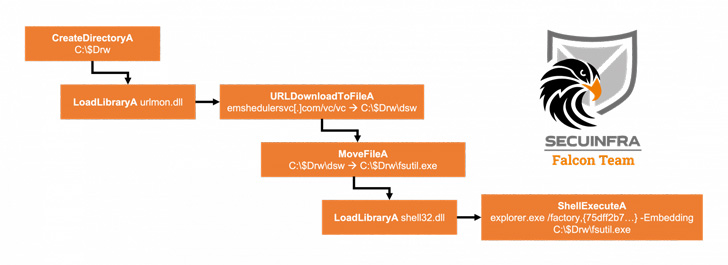
The latest attack chain detailed by SECUINFRA is believed to
have been conducted in mid-May 2022, originating with a weaponized
Excel document likely distributed by means of a spear-phishing
email that, when opened, exploits the Microsoft Equation Editor
exploit (CVE-2018-0798[5]) to drop the next-stage
binary from a remote server.
ZxxZ (or MuuyDownloader by the Qi-Anxin Threat Intelligence
Center), as the downloaded payload is called, is implemented in
Visual C++ and functions as a second-stage implant that allows the
adversary to deploy additional malware.
The most notable change in the malware is that it has dropped
using “ZxxZ” as the separator used when sending information back to
the command-and-control (C2) server in favor of an underscore,
suggesting that the group is actively making modifications to its
source code to stay under the radar.
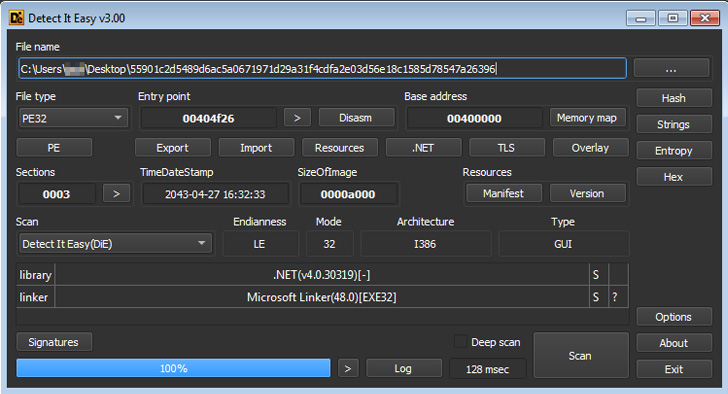
Also put to use by the threat actor in its campaigns is a
backdoor dubbed Almond RAT, a .NET-based RAT that first came to light[6]
in May 2022 and offers basic data gathering functionality and the
ability to execute arbitrary commands. Additionally, the implant
employs obfuscation and string encryption techniques to evade
detection and to hinder analysis.
“Almond RATs main purposes seem to be file system discovery,
data exfiltration and a way to load more tools/establish
persistence,” the researchers said. “The design of the tools seems
to be laid out in a way that it can be quickly modified and adapted
to the current attack scenario.”
References
- ^
said
(www.secuinfra.com) - ^
previous
report (thehackernews.com) - ^
ZxxZ
(c3rb3ru5d3d53c.github.io) - ^
since at
least late 2013 (www.forcepoint.com) - ^
CVE-2018-0798
(nvd.nist.gov) - ^
first
came to light (twitter.com)
Read more https://thehackernews.com/2022/07/bitter-apt-hackers-continue-to-target.html