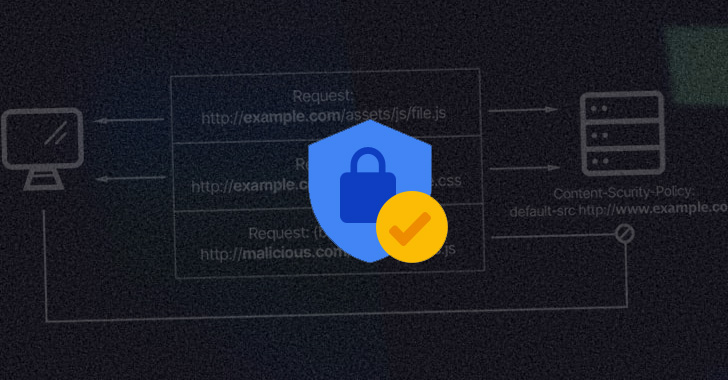
Businesses know they need to secure their client-side scripts.
Content security policies (CSPs) are a great way to do that. But
CSPs are cumbersome. One mistake and you have a potentially
significant client-side security gap. Finding those gaps means long
and tedious hours (or days) in manual code reviews through
thousands of lines of script on your web applications. Automated
content security policies can help streamline the code review
process by first identifying all first- and third-party scripts and
the assets they access, and then generating an appropriate content
security policy to help better secure the client-side attack
surface.
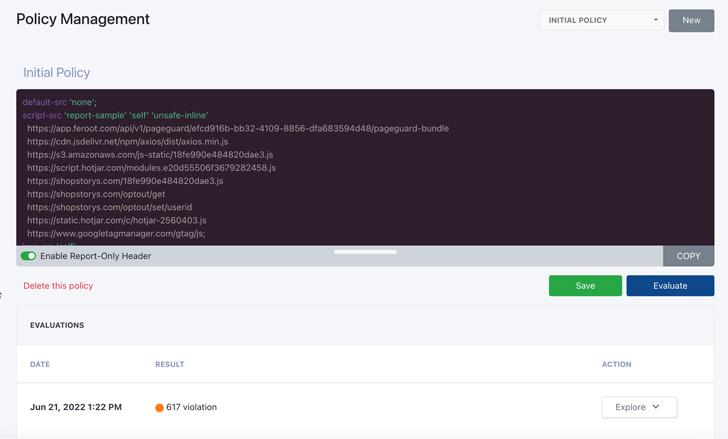
There are few developers or AppSec professionals who claim to
enjoy deploying CSPs. First, the CSP has to work for the specific
web application. Then the team needs to make sure it provides the
appropriate level of protection. The CSP also can’t conflict with
any existing widgets or plugins (or the decision must be made to
not deploy the CSP or deactivate those plugins, which can cause
problems in other areas, such as customer engagement, marketing,
and sales).
And then, when a CSP fails, there is the dreaded audit to
determine the why and where.
The CSP-audit-avoidance problem (aka avoiding manual code
reviews or death by a thousand scripts) is fairly common. Today,
client-side web applications contain thousands of scripts,
assembled from multiple open-source libraries or other third- and
fourth-party repositories. Few development or security teams take
the time to maintain a detailed record of all the scripts used in
web application assembly, including their functions, their sources,
and whether they’ve been updated or patched to address any known
security issues.
Even when teams do identify all third-party script sources,
that’s no guarantee that the scripts are safe. Ongoing issues still
surface with package managers containing obfuscated and malicious
JavaScript used to harvest sensitive information from websites and
web applications. In a recent example, researchers discovered that
malicious packages had been downloaded 27,000 times[1]
by unsuspecting developers.
Unfortunately, the CSP-audit-avoidance problem expands an
already significant client-side attack surface.
The problems with CSPs have nothing to do with their value. CSPs
are great at providing violation reporting and policy optimization
and help uncover vulnerable scripts that lead to JavaScript
injection attacks, cross-site scripting (XSS), and skimming
attacks, like Magecart. Manual content security policies are just a
pain to manage, which means developers may avoid critical CSP
processes, leading to increased security risk.
Automated content security
policies[2] help manage CSPs to
better protect the client-side attack surface and remove the risk
associated with manual CSP oversight. By identifying all first- and
third-party scripts, digital assets, and the data these assets
access, businesses can streamline the CSP creation and management
process, and improve overall client-side security. Automated CSPs
are managed at the domain level for better reporting and version
control.
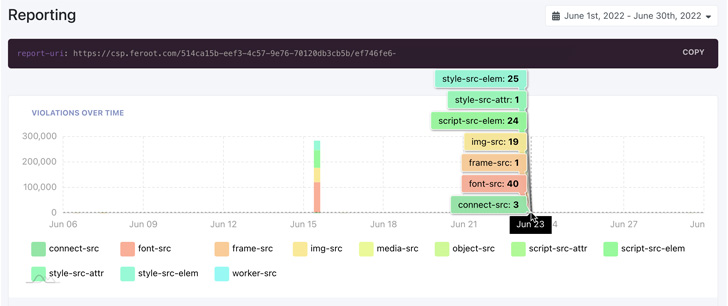
Automated CSPs work by crawling a website or web application and
initiating synthetic users to assess how scripts are operating on
the web application and what type of data the script may be
accessing. The system then generates the CSP to align it with the
security needs of the website or web application. Automated CSPs
also work within the actual production environment, to emulate
policies for quick testing (and avoid constant CSP deployment in a
development environment) and focus on bringing policy violations as
close to zero as possible.
Additional features of an automated CSP include creating new
policies after a detected violation to enable fast updates and
address current security threats and ingesting log data into
security incident and event management (SIEM) and other log-based
data collection systems for integration into current security
practices and workflows.

With violation reporting fully integrated, an automated CSP
solution complements current security processes and workflows. It
also provides critical support for regulatory and compliance
standards like PCI DSS 4.0, HIPAA, and others.
Feroot
Security[3] offers DomainGuard, a
purpose-built, automated CSP that helps organizations manage their
client-side attack surface by simplifying the content security
policy management process. DomainGuard integrates violation
reporting with existing security tools to complement current
security processes and workflows and significantly reduce the time
it takes to create and manage CSPs across teams, websites, and web
applications.
References
- ^
downloaded 27,000 times
(thehackernews.com) - ^
Automated content security policies
(www.feroot.com) - ^
Feroot Security
(www.feroot.com)
Read more https://thehackernews.com/2022/07/avoiding-death-by-thousand-scripts.html