The Russian state-sponsored hacking collective known as APT29
has been attributed to a new phishing campaign that takes advantage
of legitimate cloud services like Google Drive and Dropbox to
deliver malicious payloads on compromised systems.
“These campaigns are believed to have targeted several Western
diplomatic missions between May and June 2022,” Palo Alto Networks
Unit 42 said[1]
in a Tuesday report. “The lures included in these campaigns suggest
targeting of a foreign embassy in Portugal as well as a foreign
embassy in Brazil.”
APT29, also tracked under the monikers Cozy Bear, Cloaked Ursa,
or The Dukes, has been characterized as an organized cyberespionage
group working to collect intelligence that aligns with Russia’s
strategic objectives.
Some aspects of the advanced persistent threat’s activities,
including the infamous SolarWinds supply chain attack[2] of 2020, are separately
tracked by Microsoft under the name Nobelium, with Mandiant calling
it an evolving, disciplined, and highly skilled threat actor that
operates with a heightened level of operational security.”
The most recent intrusions are a continuation of the same covert
operation previously detailed by Mandiant[3]
and Cluster25[4]
in May 2022, in which the spear-phishing emails led to the
deployment of Cobalt Strike Beacons by means of an HTML dropper
attachment dubbed EnvyScout (aka ROOTSAW) attached directly to the
missives.
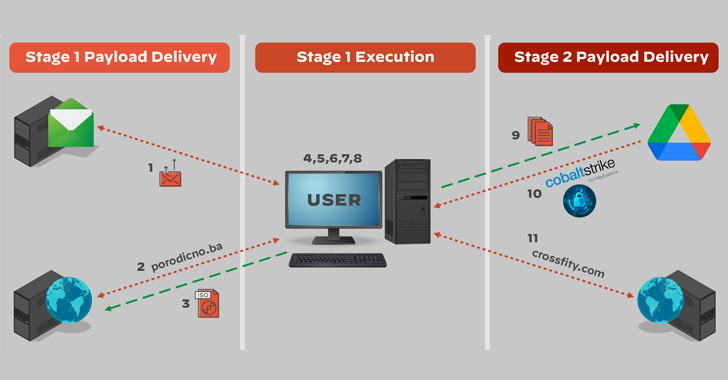
What’s changed in the newer iterations is the use of cloud
services like Dropbox and Google Drive to conceal their actions and
retrieve additional malware into target environments. A second
version of the attack observed in late May 2022 is said to have
adapted further to host the HTML dropper in Dropbox.
“The campaigns and the payloads analyzed over time show a strong
focus on operating under the radar and lowering the detection
rates,” Cluster25 noted at the time. “In this regard, even the use
of legitimate services such as Trello and Dropbox suggest the
adversary’s will to operate for a long time within the victim
environments remaining undetected.”
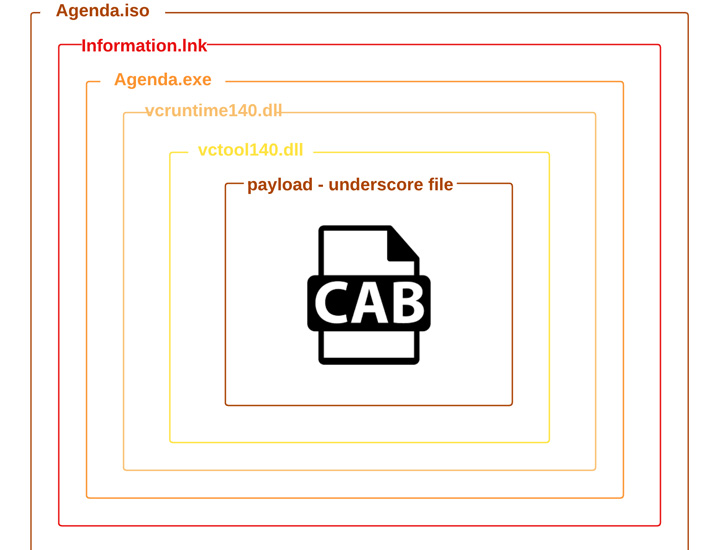
EnvyScout[5], for its part, serves as
an auxiliary tool to further infect the target with the actor’s
implant of choice, in this case, a .NET-based executable that’s
concealed in multiple layers of obfuscation and used to exfiltrate
system information as well as execute next-stage binaries such as
Cobalt Strike fetched from Google Drive.
“The use of DropBox and Google Drive services […] is a new
tactic for this actor and one that proves challenging to detect due
to the ubiquitous nature of these services and the fact that they
are trusted by millions of customers worldwide,” the researchers
said.
The findings also coincide with a new declaration from the
Council of the European Union, calling out the spike in malicious
cyber activities perpetrated by Russian threat actors and
“condemn[ing] this unacceptable behavior in cyberspace.”
“This increase in malicious cyber activities, in the context of
the war against Ukraine, creates unacceptable risks of spillover
effects, misinterpretation and possible escalation,” the Council
said[6]
in a press statement.
References
Read more https://thehackernews.com/2022/07/russian-hackers-using-dropbox-and.html