Cybersecurity researchers are warning of “massive phishing
campaigns” that distribute five different malware targeting banking
users in India.
“The bank customers targeted include account subscribers of
seven banks, including some of the most well-known banks located in
the country and potentially affecting millions of customers,” Trend
Micro said[1]
in a report published this week.
Some of the targeted banks include Axis Bank, ICICI Bank, and
the State Bank of India (SBI), among others.
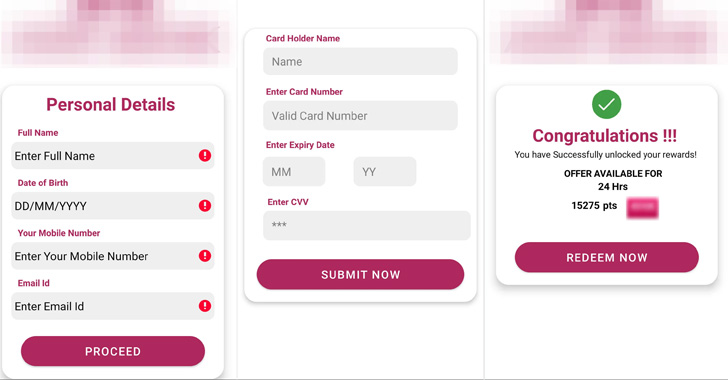
The infection chains all have a common entry point in that they
rely on SMS messages containing a phishing link that urge potential
victims to enter their personal details and credit card information
to supposedly get a tax refund or gain credit card reward
points.
The smishing attacks, which deliver Elibomi, FakeReward,
AxBanker, IcRAT, and IcSpy, are just the latest in a series of
similar rewards-themed malware campaigns that have been documented
by Microsoft, Cyble[2], and K7 Labs[3]
over the past year.

Elibomi, first documented[4]
by McAfee in September 2021, is engineered to steal personal data,
take screenshots, and even capture the lock screen code or pattern
by abusing Android’s accessibility API permissions, enabling it to
seize control of the compromised devices.
The mobile malware has undergone numerous revisions, with a new
variant of Elibomi called Drinik[5]
observed impersonating the Income Tax Department of India to target
users of 18 different banks.
“Elibomi implements an overlay by adding a view to the current
window as an evasion technique from users, instead of having an
overlay on other apps such as bank applications to steal users’
credentials,” the researchers said.
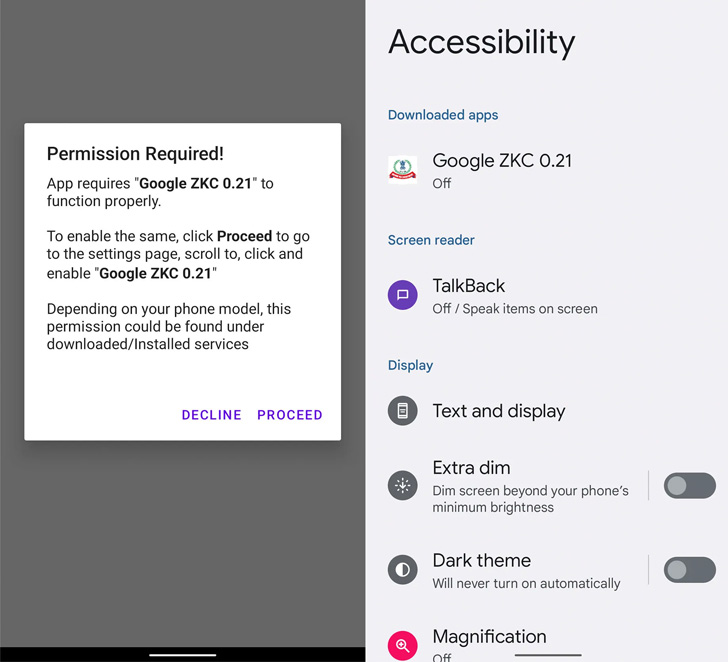
In a similar vein, the FakeReward and AxBanker banking trojans,
once installed, prompt the victim to grant it permissions to access
SMSes and notifications, which are then leveraged to exfiltrate
incoming SMS messages. AxBanker further displays fake pages to
siphon credit card information.
The apps themselves are delivered through phishing websites with
domain names similar to that of their legitimate counterparts, in
addition to reusing the brand logos to increase the likelihood of a
successful attack and trick the user into downloading the malicious
app to get “instant reward points.”
The similarity in stolen data and phishing themes
notwithstanding, Trend Micro said there is no concrete evidence
tying all these malware families to a single threat actor.
“While no other customers outside India have been targeted by
these malware families, phishing campaigns in the country have
significantly increased and are increasingly becoming adept at
detection evasion[6],” Trend Micro noted.
“One possible reason for this uptick is the growing number of
new threat actors entering the India underground market, bringing
with them profitable business models, and interacting with other
malicious players to learn, exchange ideas from, and establish
connections.”
References
- ^
said
(www.trendmicro.com) - ^
Microsoft, Cyble
(thehackernews.com) - ^
K7
Labs (labs.k7computing.com) - ^
documented
(www.mcafee.com) - ^
Drinik
(thehackernews.com) - ^
detection evasion
(unit42.paloaltonetworks.com)
Read more https://thehackernews.com/2022/11/warning-this-widespread-malicious.html