Threat hunting is the process of looking for malicious activity
and its artifacts in a computer system or network. Threat hunting
is carried out intermittently in an environment regardless of
whether or not threats have been discovered by automated security
solutions. Some threat actors may stay dormant in an organization’s
infrastructure, extending their access while waiting for the right
opportunity to exploit discovered weaknesses.
Therefore it is important to perform threat hunting to identify
malicious actors in an environment and stop them before they
achieve their ultimate goal.
To effectively perform threat hunting, the threat hunter must
have a systematic approach to emulating possible adversary
behavior. This adversarial behavior determines what artifacts can
be searched for that indicate ongoing or past malicious
activity.
MITRE ATT&CK
Over the years, the security community has observed that threat
actors have commonly used many tactics, techniques, and procedures
(TTPs) to infiltrate and pivot across networks, elevate privileges,
and exfiltrate confidential data. This has led to the development
of various frameworks for mapping the activities and methods of
threat actors. One example is the MITRE ATT&CK framework.
MITRE ATT&CK is an acronym that stands for MITRE Adversarial
Tactics, Techniques, and Common Knowledge (ATT&CK). It is a
well-documented knowledge base of real-world threat actor actions
and behaviors. MITRE ATT&CK framework has 14 tactics and many
techniques that identify or indicate an attack in progress. MITRE
uses IDs to reference the tactic or technique employed by an
adversary.
The Wazuh unified XDR and SIEM platform
Wazuh[1] is an open source
unified XDR and SIEM platform. The Wazuh solution is made up of a
single universal agent that is deployed on monitored endpoints for
threat detection and automated response. It also has central
components (Wazuh server, indexer, and dashboard) that analyze and
visualize the security events data collected by the Wazuh agent. It
protects on-premises and cloud workloads.
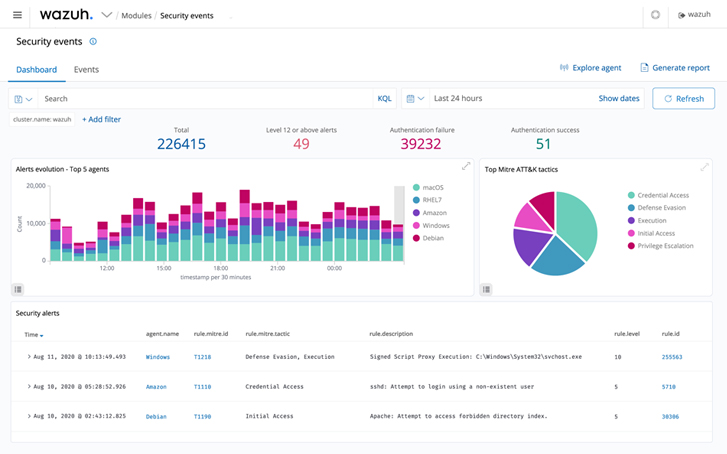 |
| Figure 1: Wazuh security event dashboard |
Threat hunting with Wazuh
Threat hunters use various tools, processes, and methods to
search for malicious artifacts in an environment. These include but
are not limited to using tools for security monitoring, file
integrity monitoring, and endpoint configuration assessment.
Wazuh offers robust capabilities like file integrity monitoring,
security configuration assessment, threat detection, automated
response to threats, and integration with solutions that provide
threat intelligence feeds.
Wazuh MITRE ATT&CK module
Wazuh comes with the MITRE ATT&CK module out-of-the-box and
threat detection rules mapped against their corresponding MITRE
technique IDs. This module has four components which are:
a. The intelligence component of the Wazuh MITRE
ATT&CK module: Contains detailed information about
threat groups, mitigation, software, tactics, and techniques used
in cyber attacks. This component helps threat hunters to identify
and classify different TTPs that adversaries use.
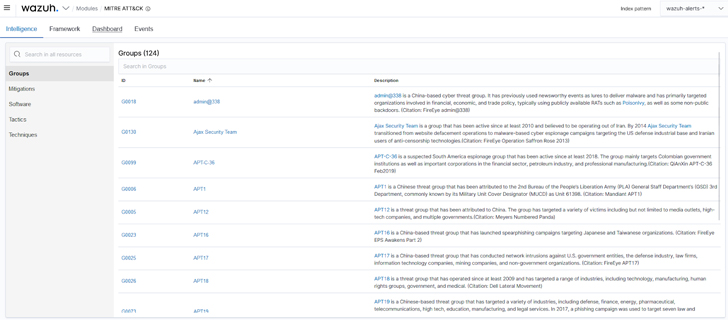 |
| Figure 2: Wazuh MITRE ATT&CK Intelligence |
b. The framework component of the Wazuh MITRE ATT&CK
module: Helps threat hunters narrow down threats or
compromised endpoints. This component uses specific techniques to
see all the events related to that technique and the endpoints
where these events happened.
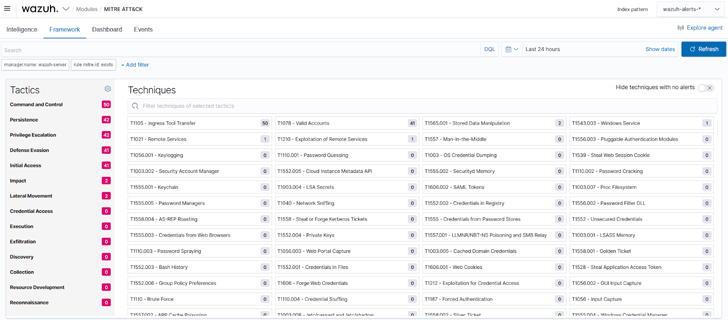 |
| Figure 3: Wazuh MITRE ATT&CK framework |
c. The dashboard component of the MITRE ATT&CK
module: Helps to summarize all events into charts to
assist threat hunters in having a quick overview of MITRE related
activities in an infrastructure.
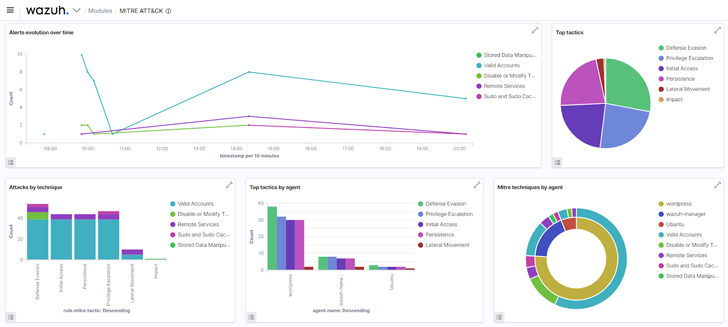 |
| Figure 4: Wazuh MITRE ATT&CK dashboard |
d. The Wazuh MITRE ATT&CK events component:
Displays events in real-time, with their respective MITRE IDs, to
better understand each reported alert.
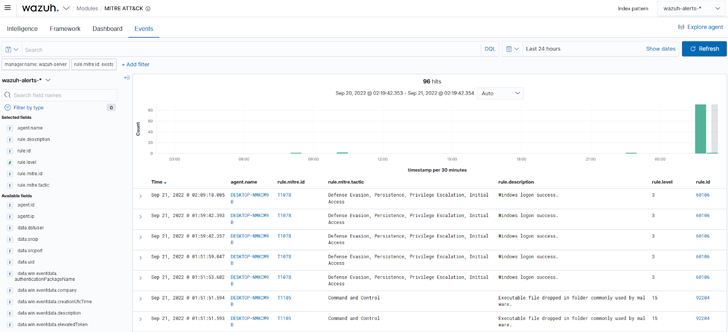 |
| Figure 5: Wazuh MITRE ATT&CK events |
Wazuh rules and decoders
Wazuh has out-of-the-box rules and decoders to parse security
and runtime data generated from different sources. Wazuh supports
rules for different technologies (e.g., Docker, CISCO, Microsoft
Exchange), which have been mapped to their appropriate MITRE IDs.
Users can also create custom rules and decoders and map each rule
with its appropriate MITRE tactic or technique. This blog post[2]
shows an example of leveraging MITRE ATT&CK and Wazuh custom
rules to detect an adversary.
Security Configuration Assessment (SCA) module
The Wazuh SCA module performs periodic scans in endpoints to
detect system and application misconfigurations. It can also be
used to scan for indicators of compromise, like malicious files and
folders that have been created by malware. Analyzing software
inventories, services, misconfigurations, and changes in the
configuration on an endpoint can help threat hunters detect attacks
underway.
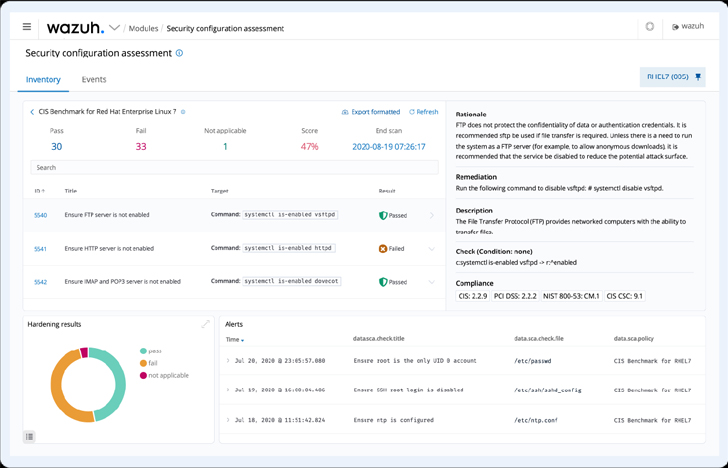 |
| Figure 6: Wazuh SCA dashboard |
Integration with threat intelligence solutions
Due to its open source nature, Wazuh provides an opportunity to
integrate with threat intelligence APIs and other security
solutions. Wazuh integrates with open source threat intelligence
platforms like Virustotal[3], URLHaus, MISP, and
AbuseIPDB[4]
to name a few. Depending on the integration, relevant alerts appear
in the Wazuh dashboard. Specific information, such as IP addresses,
file hashes, and URLs, can be queried using filters on the Wazuh
dashboard.
File integrity monitoring
File integrity monitoring (FIM) is used to monitor and audit
sensitive files and folders on endpoints. Wazuh provides an FIM
module that monitors and detects changes in specified directories
or files on an endpoint’s filesystem. The FIM module can also
detect when files introduced to endpoints match hashes of known
malware.
Wazuh archives
Wazuh archives can be enabled to collect and store all security
events ingested from monitored endpoints. This feature assists
threat hunters by providing them with data that can be used to
create detection rules and stay ahead of threat actors. Wazuh
archives are also helpful in meeting regulatory compliance where
audit log history is required.
Conclusion
The MITRE ATT&CK framework helps to properly classify and
identify threats according to discovered TTPs. Wazuh uses its
dedicated MITRE ATT&CK components to display information about
how security data from endpoints correspond to TTPs. The threat
hunting capabilities of Wazuh help cybersecurity analysts to detect
apparent cyber attacks as well as underlying compromises to
infrastructure.
Wazuh is a free and open source platform that can be used by
organizations with cloud and on-premises infrastructure. Wazuh has
one of the fastest-growing open source community[5] in the world, where
learning, discussions, and support is offered at zero cost. Check
out this documentation[6]
to get started with Wazuh.
References
Read more https://thehackernews.com/2022/11/threat-hunting-with-mitre-att-and-wazuh.html