Feb 15, 2023The Hacker News
In an ideal world, security and development teams would be
working together in perfect harmony. But we live in a world of
competing priorities, where DevOps and security departments often
butt heads with each other.
Agility and security[1]
are often at odds with each other— if a new feature is delivered quickly but[2]
contains security vulnerabilities, the SecOps team will need to
scramble the release and patch the vulnerabilities, which can take
days or weeks. On the other hand, if the SecOps team takes too long
to review and approve a new feature, the development team will get
frustrated with the slow pace of delivery.
Security needs to move slowly and cautiously, while development
wants to “move fast and break things” and release new features
quickly. DevOps teams can view security as an impediment to their
work instead of an important part of the process. With each team
pulling in opposite directions, there is often tension and conflict
between the two teams, slowing development and leaving
organizations open to security risks.
It’s Time to Automate Security Testing
One way to resolve this conflict is to automate testing with
every release. Instead of running a one-time pen test when the web
application is launched, security teams should ensure
vulnerabilities are not being reintroduced with every new release
and update in an approach known as “continuous security[3].”
In continuous security, the SecOps team is involved early and
often in the development process. They work with developers to
understand the risks associated with new features and help them
find ways to mitigate them. By being involved early on, the SecOps
team can help to ensure that new features are developed with
security in mind from the very beginning.
Advantages of Continuous Pen Testing
Penetration testing[4]
is a critical component of web application security. As attack
surfaces expand and applications become more complex, regular pen
tests become a crucial component of a strong web application
security posture.
However, pen testing is often conducted periodically, which
results in a “security sprint” every time a new test is scheduled.
When conducted late in the release cycle, pen testing can be
disruptive to the development process. Discovering vulnerabilities
only at certain flagpole points in development often requires
extensive and costly rework for Dev and DevOps teams.
As part and parcel of shifting left and improving the workflows
between DevOps and Security teams, web application security testing
needs to be built into the development process. This way,
vulnerabilities can be discovered and fixed before the code is even
deployed to production.
A continuous testing approach is an effective way to integrate
security testing into the development process so that organizations
can identify vulnerabilities without disrupting release cycles.
However, despite its advantages, regular and ongoing pen testing
can be challenging to implement. It is a resource-intensive process
and requires tools and expertise that may not be readily
available.
Pen-Testing-as-a-Service: Aligning DevOps and SecOps
Priorities
One solution is to partner with a provider that specializes in
continuous pen testing and can help implement it in your
organization. With Pen-Testing-as-a-Service (PTaaS)[5], you can get started
with continuous pen testing quickly and easily without investing in
additional resources or expanding your team.
PTaaS solutions build a shared understanding of security issues
and their impact. When development team members are given the
opportunity to test their code for vulnerabilities and fix them
before they reach production, they become more engaged in the
security of the applications they are building. Some PTaaS
solutions go one step further by offering features that make it
easy for developers to fix vulnerabilities, such as providing
one-click fixes for common issues.
Outpost24’s Pen Testing as a Service (PTaaS) provides continuous
pen tests for web applications throughout a contract period,
typically a year or longer. It includes the tools and the expertise
you need to implement continuous pen testing in your
organization.
Outpost24’s PTaaS solution offers several advantages,
including:
- Increased web application security: By
integrating security testing into the development process, you can
find and fix vulnerabilities early on before they have a chance to
cause problems. - Continuous coverage: PTaaS provides continuous
coverage of your applications so you can be confident that they are
always secure, even after development updates and vulnerability
remediation. - Expertise on demand: With PTaaS, you have
access to the expertise you need when you need it, including 24/7
Portal communications. - Improved efficiency: PTaaS can help your
SecOps communication with DevOps thanks to clear remediation steps
and re-testing that allow for continuous development throughout the
pen testing period.
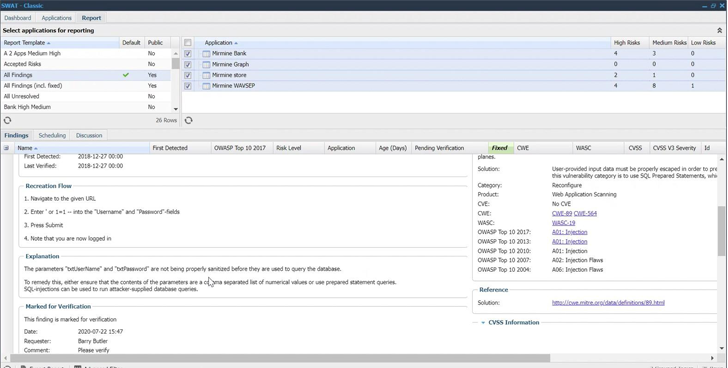 |
| Here’s an example of the remediation process for one of the vulnerabilities found by Outpost24’s continuous pen testing. |
PTaaS is a cost-effective solution that merges application
development and security processes into DevSecOps — a continuous,
automated, and secure software development lifecycle. By aligning
the priorities of development, security, and operations teams,
PTaaS enables organizations to deliver secure software faster.
Learn more about how Outpost24 can help you implement
continuous penetration testing in your organization by getting in
touch, here[6].
Found this article interesting? Follow us on Twitter [7]
and LinkedIn[8]
to read more exclusive content we post.
References
- ^
Agility
and security (techbeacon.com) - ^
delivered quickly but
(www.researchgate.net) - ^
continuous security
(blogs.cisco.com) - ^
Penetration testing
(owasp.org) - ^
Pen-Testing-as-a-Service (PTaaS)
(outpost24.com) - ^
how
Outpost24 can help you implement continuous penetration testing in
your organization by getting in touch, here
(outpost24.com) - ^
Twitter
(twitter.com) - ^
LinkedIn
(www.linkedin.com)
Read more https://thehackernews.com/2023/02/regular-pen-testing-is-key-to-resolving.html