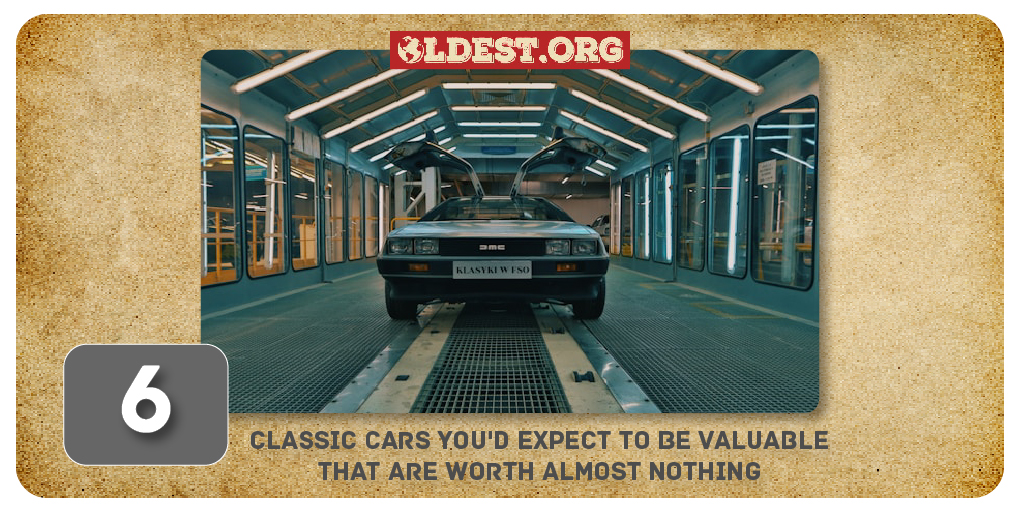
Some classic cars just feel like they should be worth big money—sleek lines, vintage appeal, and names you’ve heard your whole life. But when it comes time to sell, reality hits hard. Plenty of once-celebrated models now go for shockingly low prices, even though they look like they belong in a collector’s showroom. Here are six classic cars that seem valuable at first glance but their current prices tell a very different story..
6. Ford Pinto
CC BY-SA 3.0, Link
When you think of 1970s Americana on wheels, the Ford Pinto probably comes to mind. This subcompact was everywhere during the disco era, and its boxy shape is instantly recognizable. Yet despite its place in automotive history, most Pintos struggle to crack five figures at sale.
Ford churned out roughly 3 million of these budget-friendly rides between 1971 and 1980, flooding the market with a car designed to meet strict cost and weight limits rather than wow enthusiasts. The Pinto’s reputation took a serious hit thanks to highly publicized fuel-tank safety controversies and a tendency to dissolve into rust. Today, it’s remembered more as a cautionary tale than a collectible treasure, leaving most examples worth just a few thousand bucks—if that.
5. Chevrolet Vega
CC BY-SA 3.0, Link
The Vega looked promising on paper: a sporty, American-built compact with styling cues that echoed the beloved Camaro. Chevy marketed it as the domestic answer to foreign imports, and it seemed destined for classic status. Instead, it became a punchline.
Early Vegas were plagued by catastrophic rust issues and aluminum-engine problems that caused constant overheating. Many owners simply scrapped them rather than deal with the headaches. Since the Vega was cheap and forgettable when new, surviving models are typically well-worn daily drivers. Regular versions hover in the low thousands, with only rare variants like the Cosworth Vega commanding any serious attention from collectors.
4. Cadillac Cimarron
CC BY 2.0, Link
A luxury badge doesn’t always guarantee prestige. The Cimarron stands as one of Cadillac’s most notorious missteps—a glorified Chevrolet Cavalier wearing a wreath-and-crest grille and carrying a luxury price tag that felt like highway robbery.
Introduced in 1982, the Cimarron disappointed buyers who expected genuine Cadillac refinement but got a thinly disguised economy car instead. The damage to its reputation was permanent. Even though Cimarrons are relatively rare today, collectors treat them like curiosities at best and embarrassments at worst. Values remain stubbornly low, making this one of the cheapest ways to own a Cadillac—classic or otherwise.
3. Cadillac Allanté
CC BY-SA 4.0, Link
Here’s a car that sounds exotic on paper: an Italian-designed two-seat roadster with bodies built by Pininfarina in Turin, then flown to Detroit on a dedicated “air bridge” for final assembly. Cadillac positioned it as a Mercedes-SL fighter with European flair and American luxury.
Reality didn’t match the hype. The Allanté suffered from underwhelming performance, questionable build quality, and electronics that aged poorly. Its complicated production process drove up costs without delivering the refinement buyers expected. Today, maintaining an Allanté can be expensive and frustrating, scaring off potential enthusiasts. Despite the Italian pedigree and unique backstory, these roadsters sell for surprisingly modest sums compared to European competitors from the same era.
For more automotive history, explore our guide to the oldest car companies that shaped the industry from the ground up.
2. Chrysler TC by Maserati
CC BY-SA 3.0, Link
A Chrysler built in collaboration with Maserati should be a slam-dunk collectible, right? This short-lived roadster wore Italian bodywork and borrowed components from the Maserati Biturbo, seemingly guaranteeing exotic appeal. Instead, it’s one of the automotive world’s forgotten experiments.
The TC arrived fashionably late to its own party and looked uncomfortably similar to the Chrysler LeBaron convertible that cost far less. Buyers saw an overpriced badge job rather than a genuine Italian exotic. Between mechanical complexity, sketchy reliability, and awkward market positioning, the TC never found its audience. Clean examples trade for used-sedan money today—a far cry from what you’d expect for a car wearing the Maserati trident.
1. DeLorean DMC-12
CC BY-SA 4.0, Link
Thanks to “Back to the Future,” the DeLorean is arguably the most famous car on this list. Its brushed stainless-steel body and gullwing doors make it instantly recognizable worldwide, leading many to assume every DeLorean must be worth supercar money. The reality is more grounded.
Built from 1981 to 1983, the DMC-12 offered modest performance and uneven build quality. The stainless panels require special care, and tracking down replacement parts can be challenging. While movie fame keeps values higher than the other cars here, they’re still well below what casual observers might guess. Unless you’ve got a pristine, low-mileage example, expect prices that surprise people who think they’re looking at a six-figure time machine.
Conclusion
While these cars may never break auction records or be one amongst the collector’s favorites, they still offer charm, personality, and an easy way to enjoy vintage motoring. Their surprisingly low prices serve as a reminder that value is shaped by more than aesthetics—it’s shaped by demand, reputation, and history. For anyone dreaming of owning a classic without draining their savings, these underrated models might just be it.
The post 6 Classic Cars You’d Expect To Be Valuable That Are Worth Almost Nothing appeared first on Oldest.org.