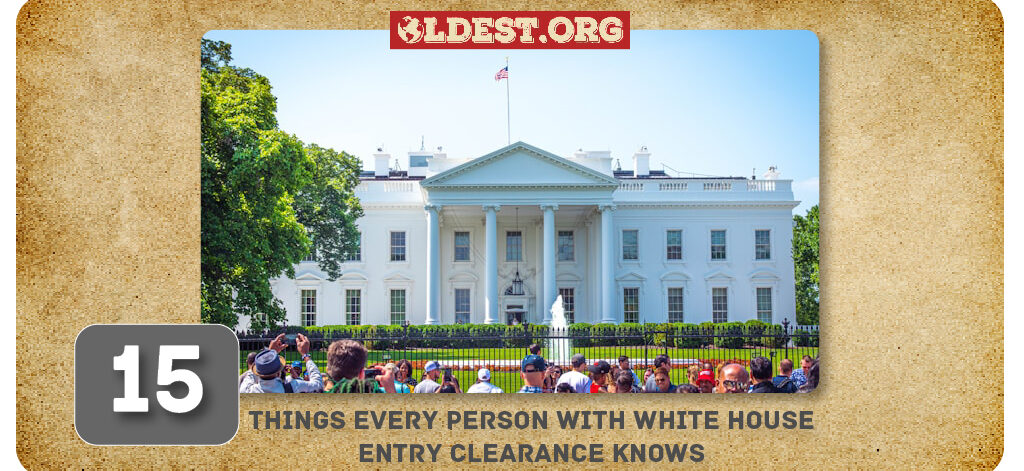
Most people imagine White House entry clearance as a single dramatic moment. A badge is issued. A door opens. You step into history.
The White House breathes through routines, security layers, whispered conversations, and decisions that ripple far beyond its walls. People with legitimate entry clearance quickly learn that what matters most is not what you see but what you understand.
So, to appease your curiosity, here are the 15 things every person with White House entry clearance knows.
1. Your Badge Is Your Identity, Not Your Status
Source: Canva
Inside the White House, no one cares who you are outside its gates. Titles, résumés, and public recognition fade fast. What matters is your clearance level and whether your badge works where it’s supposed to. The clearance is hierarchical, precise, and unforgiving. Some doors open. Others do not. And no amount of confidence will change that. People learn quickly that flashing a badge is not about authority; it is about responsibility. If you lose or misuse it, the access is going to disappear faster than you got it.
2. Security Is Everywhere, Even When You Stop Noticing It
Source: Canva
At first, the security presence feels overwhelming. Uniformed officers. Plainclothes agents. Cameras you spot and many you don’t. After a while, it fades into the background. But, the catch is that it never goes away. The White House is a 24/7 monitored environment, and every movement leaves a trace. Every access point logs a moment. Security is not aggressive or theatrical. It is quiet, constant, and deeply systematic.
3. The Building Is Smaller Than You Expect
Photo by Ana Lanza on Unsplash
From the outside, the White House feels grand and expansive. Inside, it surprises people with how compact it is. Corridors are narrow. Offices are modest. Ceilings are lower than expected in many areas. But, you can’t forego how heavy the emotional weight is. Every room carries layers of history. Decisions made in these spaces have shaped wars, economies, and lives, which suggests that the symbolic scale of the place is enormous.
4. Silence Is a Skill When You Are Inside (and out)
Source: Canva
One of the first unspoken lessons is knowing when not to speak. People with entry clearance are exposed to fragments of conversations, overheard briefings, and moments that never make it into public records. Most of it is not classified in a technical sense. It is simply not yours to share. You learn how to listen without reacting, how to forget what does not belong to you, and how to carry knowledge without displaying it.
White House entry clearance often brings direct exposure to members of the U.S. Congress, revealing how executive access and legislative power intersect.
5. Everything Runs on Schedules, Down to the Minute
Source: Canva
Time inside the White House is not flexible. It is engineered. Every meeting, movement, and transition is choreographed. Delays ripple outward. A late arrival can disrupt security sweeps, media schedules, and executive availability. So, people that do have access to the space learn to respect time, not be in the way and not linger where you aren’t supposed to. The clock is the main governing force inside.
6. You Learn the Geography Like a Second Language
Photo by Possessed Photography on Unsplash
At some point, people stop thinking in terms of “rooms” and start thinking in terms of routes. Which hallway avoids press traffic. Which staircase is faster during high-security periods. Which entrances are locked after certain hours. Navigation becomes strategic. The truth is that the White House is layered, featuring public rooms, semi-public rooms and no access zones. You simply don’t wander but move around with intention.
7. The Press Is Always Closer Than You Think
Photo by The Climate Reality Project on Unsplash
Even when you don’t see cameras, the press presence is felt. People with clearance understand that information leaks rarely happen by accident. A misplaced comment, a visible reaction, or a poorly timed movement can become a headline. So, you learn to keep your face neutral and your body language calm and composed when inside.
8. No One Is Immune to Protocol
Source: Link
One of the most grounding realizations is watching powerful individuals follow strict rules. Inside the White House, everyone clears security, everyone follows procedure and everyone waits when told to wait. The protocol imposed isn’t about control but moreso about coordination. Since the stakes inside the White House are high, having solid systems matter more than personalities. This means that authority exists but can’t be bypassed by ego.
9. You Stop Being Starstruck Faster Than You Expect
Photo by krakenimages on Unsplash
The first few days can feel surreal. Familiar faces. Historic rooms. Moments you’ve only seen on television. Then, when work begins, things shift. Exposure normalizes everything. The awe softens. What remains is focus. You learn that proximity to power does not automatically bring clarity or certainty. It brings responsibility and pressure.
White House access also offers unique historical perspective on figures like the youngest First Ladies in U.S. history, whose influence extended well beyond ceremonial roles.
10. Information Has Weight, Even When It’s Incomplete
Photo by Anne Nygård on Unsplash
Rarely does anyone see the full picture. So, when you have a clearance for the White House, you work with fragments. There are partial briefings, narrow scopes and limited context by design. You are trusted with what you need, not with everything. This, in turn, teaches humility and also restraint. Also, the last thing you want is to jump to conclusions, primarily because your actions can impact millions of people.
11. The Building Never Really Sleeps
Photo by Tabrez Syed on Unsplash
Even at night, the White House is active. Lights glow in unexpected windows. Security shifts rotate. Staff move quietly through corridors. The work adapts, but it never fully stops. Since crises do not follow “office hours,” the building is thus prepared for any kind of emergency that comes through, at any time during the day.
12. Trust Is Earned Slowly and Lost Instantly
Source: Canva
Access inside the White House is not permanent. The truth is that trust inside the most important building in the U.S. is cumulative and fragile. You commit one careless mistake, one breach of protocol and one lapse of judgement and your career will come to a halt, almost immediately. There are no dramatic exists, just revoked access and closed doors.
13. You Learn to Separate Personal Beliefs from Professional Duty
Source: Canva
The White House houses diverse ideologies, opinions, and perspectives. People with entry clearance quickly learn that personal views are secondary to professional conduct. You may not agree with every policy discussed or decision made. That does not change expectations. Your need to function professionally without any emotional bias.
14. History Is Not a Concept Inside the Building but Presence
Photo by Dimitri Karastelev on Unsplash
There are moments when history feels close. A painting you pass daily. A room where a defining speech was drafted. A corridor walked by generations of leaders. These reminders are subtle but constant. When you have clearance to the White House, you become temporary participants in a very long story.
15. Leaving the White House Changes How You See the World
Source: Link
Once you have worked inside, the outside feels different. News coverage feels flatter. Political debates seem louder but less precise. You gain an appreciation for complexity that never fully fades. People who had White House entry clearance often speak less, not more, about politics afterward. They understand how layered reality is behind the scenes.
Those granted White House entry clearance often gain insight into leadership styles shaped by age and ambition, much like the youngest U.S. presidents who redefined executive power early.
Final Words
White House entry clearance does not grant power. It grants proximity. Proximity to systems that must function under relentless pressure. Proximity to people making decisions with imperfect information. Proximity to a place where history feels less like a subject and more like a responsibility. The key is to respect that and practice restraint.
The post 15 Things Every Person with White House Entry Clearance Knows appeared first on Oldest.org.