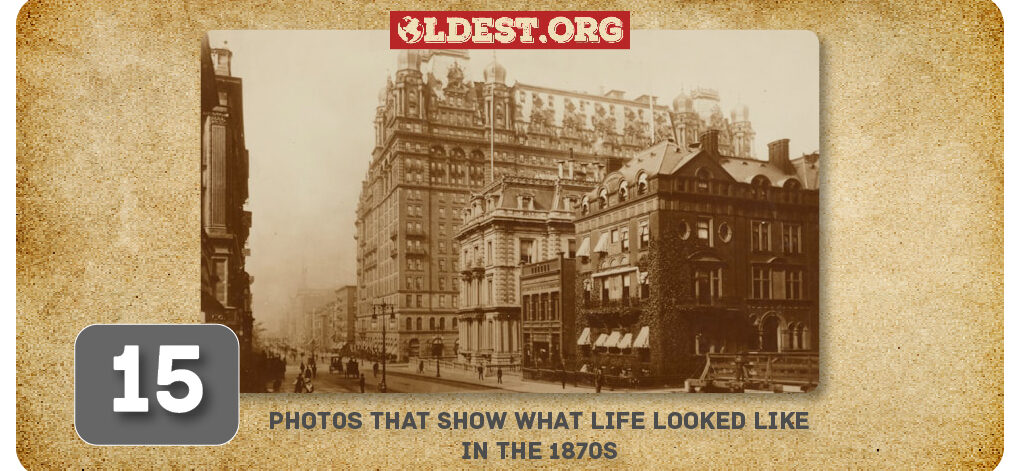
The 1870s was a decade caught between two worlds—one foot still planted in the horse-drawn past, the other stepping boldly into the industrial future. These fifteen remarkable photographs capture that fascinating in-between moment, revealing how people worked, traveled, and navigated a rapidly changing world.
15. Old Faithful’s First Portrait
Public Domain, Link
William Henry Jackson captured Yellowstone’s most famous geyser erupting in 1871-72, creating images so powerful they helped convince Congress to establish the world’s first national park. These albumen prints, showing tiny human figures dwarfed by towering plumes of steam, made the case that some American wonders were worth protecting rather than exploiting.
14. The Canyon at Yellowstone’s Edge
Source: Reddit
Jackson’s 1871 photograph of Lower Yellowstone Falls shows survey tents perched precariously on the canyon rim, transforming raw wilderness into something that could be mapped, studied, and eventually visited. These images circulated through Eastern newspapers and became many Americans’ first glimpse of the West, sparking a tourism boom once the railroads arrived.
13. Broadway’s Beautiful Chaos
Source: Facebook
This stereoview of Broadway at Broome Street around 1870 captures New York at peak congestion—horse-drawn omnibuses, wagons, and carriages packed so tightly that crossing two blocks could take fifteen minutes. Before subways existed, this noisy, manure-laden chaos was simply the price of living in America’s booming commercial capital.
12. Curtain Call on Broadway
Public Domain, Link
Elegant enclosed carriages line up outside Wallack’s Theatre in this circa-1870 scene, where theater-going served as both entertainment and social display for New York’s upper classes. The Broadway sidewalk functioned as a stage itself, where the right carriage announced your status as clearly as the seat you’d purchased inside.
Discover surprising truths in our guide to famous historical myths and facts throughout time.
11. The Gilded Age Takes Shape
Source: Facebook
Photographs from the New York State Archives show Manhattan in full transformation, with new commercial blocks rising beside older structures while crowds navigated muddy streets below. These images perfectly capture why the era earned its “Gilded Age” nickname—spectacular wealth piling up for financiers while overcrowding and poverty spread through the neighborhoods beneath.
10. Cairo’s Staged Exoticism
Source: Link
French photographer Émile Béchard spent the 1870s in Cairo creating carefully composed portraits of water sellers, merchants, and dancers for European tourists seeking visual souvenirs of the “Orient.” These theatrical images reveal more about Western fantasies than Egyptian reality, transforming everyday workers into exotic symbols for foreign consumption.
9. Women Framed and Fixed
Public Domain, Link
Studio portraits of Egyptian women from this era—posed as harem figures, dancers, or vendors—reduced complex lives to narrow stereotypes designed to satisfy European curiosity. The stark contrast with later photos showing Egyptian women leading mass demonstrations in 1919 reveals just how limiting these early colonial-era portraits were.
8. Cataloging Caste in Bombay
No restrictions, Link
This group portrait of Parbu caste Brahmins from 1870s Bombay exemplifies how colonial photography turned living communities into administrative categories. Sold as cartes de visite to British officials and travelers, these images blended anthropology, bureaucracy, and souvenir culture into single frames.
7. Empire’s New Roads Through Old Villages
Source: Facebook
Photographs of rural India in the 1870s show ox-carts and village life juxtaposed with railway embankments and colonial roads cutting through the landscape. These images document the awkward moment when British rule began layering new economic systems onto centuries-old patterns of agrarian life.
Explore the history and rise of the oldest remote jobs and how work evolved across time.
6. Charity and Crisis in New York
Source: Facebook
Large brick hospitals photographed in 1870s New York—many run by religious or ethnic groups—reveal the city’s response to explosive growth and the poverty it generated. These institutions evolved from earlier almshouses to become a permanent fixture on the urban landscape, offering basic care in an era before modern social insurance.
5. The Canal That Built an Empire State
CC BY-SA 3.0, Link
Photographs of upstate New York in the 1870s show riverfront factories, canal locks, and farmsteads working together in an economy that made the state a national powerhouse. The Erie Canal, though completed decades earlier, still formed the commercial backbone connecting Great Lakes goods to Atlantic markets through New York harbor.
4. Science in the Saddle
Source: Link
Informal scenes from Jackson’s Yellowstone expeditions reveal the unglamorous reality behind those romantic landscape shots—men wrestling with tents, pack animals, and a portable darkroom in rugged terrain. Jackson’s wet-plate process required coating and developing each glass plate within minutes, meaning he hauled an entire chemical laboratory into the wilderness on horseback.
3. The Land Had People
Source: Instagram
Jackson’s 1871 portraits of Shoshone individuals near Yellowstone quietly acknowledged what his sweeping landscapes often erased—that the “empty wilderness” was actually Indigenous homeland. These dignified portraits captured a bittersweet irony: the same images helping create the national park would soon justify policies restricting Native access to ancestral territories.
2. Rails Beneath the Horses’ Hooves
Public Domain, Link
Horse-drawn streetcars running on embedded rails through 1870s city streets represented a transitional technology—mechanical efficiency creeping into an animal-powered world. By this decade, miles of track crisscrossed Manhattan, making horse-cars the dominant urban transit system before electricity would revolutionize everything within twenty years.
1. The Decade in Miniature
Source: Pinterest
Archive collections from Getty Images and similar sources offer a mosaic of 1870s life—rigid Victorian family portraits alongside factory workers, street vendors, and crowded rail stations. Many survived as albumen prints mounted on card stock, originally sold as stereoviews or souvenirs, now serving as crucial evidence of how ordinary people actually lived in this hinge moment between two eras.
Uncover fascinating stories in our look at ancient myths proven to be true and the history behind them.
Conclusion
These fifteen photographs don’t just show us what the 1870s looked like—they show people navigating the collision between tradition and modernity, between local customs and global empires, between the intimate scale of horse-drawn life and the coming industrial age.
The post 15 Photos That Show What Life Looked Like In The 1870s appeared first on Oldest.org.