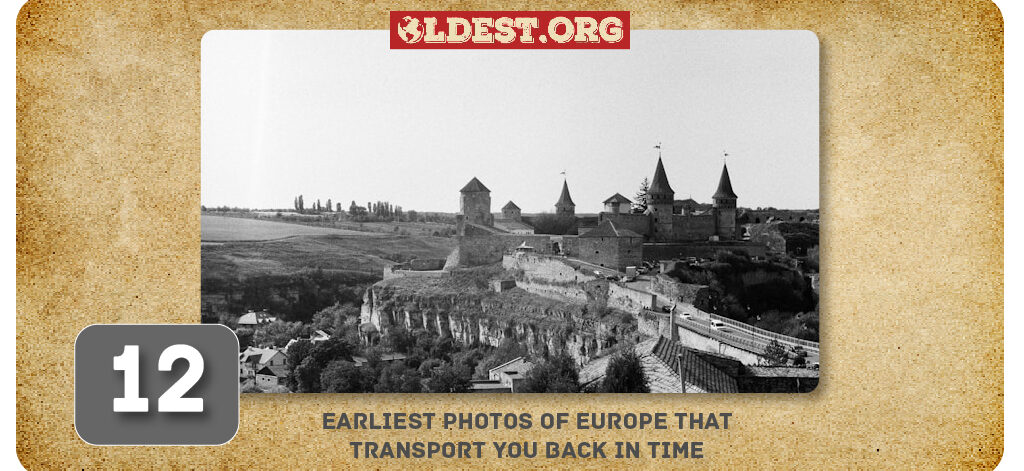
The invention of photography in the 19th century offered Europe a new way to view itself. Cities, harbors, and monuments were no longer just described in text, but were recorded on light-sensitive plates.
These first images of Europe had their imperfections (such as unpopulated streets due to long exposure times, ghostlike images of water, and fuzzy images of people). Still, those imperfections enhance the images’ authenticity. They allow the modern viewer to see how Europe looked at the time, before there were automobiles, world wars, or glass skyscrapers.
Below are a dozen outstanding examples of early photographic images from reputable European repository collections, illustrating what Europe looked like in a very different era.
1. Paris, Boulevard du Temple, 1838
Public Domain, Link
Louis Daguerre captured this scene while experimenting with the daguerreotype process that soon spread across Europe. The boulevard seems deserted, but near the corner stands a man receiving a shoe shine, likely the first human ever photographed in Europe.
The image matters because it preserves pre-Haussmann Paris, still filled with medieval buildings and gas lamps. Europe in 1838 was politically restless after the July Monarchy, and the photo reflects everyday Western European life ruled by horses and artisans. Looking at it today transports viewers to the birthplace of European photography.
2. London, Westminster Bridge, 1845
CC BY-SA 4.0, Link
Photographed by William Henry Fox Talbot, this earliest view of London shows Britain leading Europe’s Industrial Revolution. The Thames looks like smooth glass because movement vanished during exposure, a common trait of early European photos.
The image is relevant for understanding Victorian Europe, where parliamentary architecture coexisted with crowded working districts. Gas lamps and brick façades seen here predate modern London and influenced photographers across France and Germany. The photograph acts as a time capsule of a European capital expanding through empire and rail links.
3. France, View from the Window at Le Gras, 1826
Public Domain, Link
Created by Joseph Nicéphore Niépce, this is the oldest surviving photograph taken in Europe and the world. The rooftops appear abstract, yet they represent Europe, still largely pre-industrial. Before this, Europe recorded views only through painting and engraving.
The relevance in time lies in showing photography as a scientific curiosity, defining European modernity. This earliest photo inspired Daguerre and later European pioneers who refined exposure chemistry. Looking at it now transports readers to rural France of 1826, where the idea of photographing Europe seemed magical.
4. Rome, The Colosseum, 1850
Public Domain, Link
This early photograph shows Rome surrounded by fields rather than the dense urban landscape of today’s Italy. Italy was still a fragmented Europe of duchies, yet Europeans regarded Rome as the spiritual capital. The photo is relevant because the earliest photographers focused on classical European monuments to legitimize the new medium. Crowds vanished, giving the Colosseum sacred stillness.
Europe in 1850 was fascinated with archaeology and papal culture, themes visible here. The image transports viewers back to a Mediterranean Europe, balancing antiquity with nationalism.
Explore more about Europe’s diverse nations in our guide to countries in Europe.
5. Berlin, Unter den Linden, 1840
Public Domain, Link
Prussian Europe appears in this earliest photo of Berlin before German unification reshaped Central Europe. Cobblestones and church spires illustrate a Europe of kingdoms.
The avenue seems calm because carriages move too fast to be exposed. Europe in 1840 was witnessing rising nationalism across Austria and Italy, and Berlin stood at that threshold. The image matters because it documents a royal town becoming a future European powerhouse. Looking at it now transports readers to the scholarly Berlin of 19th-century Europe.
6. Venice, Grand Canal, 1844
Public Domain, Link
Venice became Europe’s most photographed dream, and this daguerreotype proves why. Gondolas vanished, creating empty water surfaces typical of early European photos. Palazzos rise exactly as Habsburg travelers crossing Europe would have seen them.
Europe in 1844 valued the romantic medieval European heritage, inspiring tourism. Photography and tourism across France and Britain grew together, shaping continental identity. This image transports viewers to Adriatic Europe, where Renaissance Europe’s trade routes still echoed in diplomacy.
7. Brussels, Grand Place, 1900
Source: Reddit
Belgium was a young European kingdom after the collapse of Napoleonic Europe. This earliest photo preserves medieval guild houses representing the shared heritage of Europe. The still façades mattered for Belgium, showcasing legitimacy within the European balance of power.
In 1847, Europe was redefining borders through reform movements. Crowds appear slightly blurred, reminding us how exposure manipulated reality. The image transports readers back to the Low Countries, where artisans became the ancestors of European banks.
8. Amsterdam, Dam Square, 1890’s
Public Domain, Link
Northern European commercial culture appears clearly in this wet-plate photo. Merchants’ houses lean over canals that defined Dutch Europe trade networks linking Europe to Asia. In the 1850s, Europe was building colonial routes and banking systems. Long exposure created ghost water surfaces visible here.
Dutch photographers focused on ordinary neighborhoods in Leiden and Rotterdam rather than on monuments alone. The image transports viewers to bourgeois Amsterdam of 1857, a fintech ancestor within the European economy.
For more stunning European destinations, check out places in Europe that feel unreal.
9. Madrid, Puerta del Sol
Public Domain, Link
Spain represented conservative Europe, wrestling with decline of American colonies. This earliest photo transports you to Iberian Europe before trams and civil wars changed Spain.
Vast skies and tiled roofs reflect the Southern European climate. Photography reached Madrid later than Paris, making this image rare across European archives. Exposure removed pedestrians, giving a calm square. Looking at it now transports readers back to a monarchical Europe in 1855, when authority was being preserved.
10. Edinburgh, Calton Hill Panorama, 1845
Public Domain, Link
Scotland’s Enlightenment European heritage meets industrial Britain in this photograph. Roofs spread like a textbook of neoclassical European monuments, influencing Germany and France.
In 1845, Europe valued engineering and universities. Fox Talbot Europe scientists inspired the earliest photographers who traveled across Nordic Europe, capturing daily life. The image transports viewers to the intellectual Edinburgh of 19th-century Europe, where philosophers’ legacy met shipyards, defining Britain’s role within European modernity.
11. Prague, Charles Bridge and Old Town, 1854
Freepik
This early photograph of Prague taken around 1854 presents the Charles Bridge stretching toward the Old Town Tower during the Habsburg era. The Vltava River appears smooth and mirrorlike, a signature effect of the long exposures used by Europe’s first photographers. Prague in the mid-19th century stood at the crossroads of Slavic and Germanic Europe, and the image preserves a city that had already witnessed centuries of European trade and religious reform.
The photo is relevant because it shows Bohemian Europe before electrified trams and the later political storms of Europe reached the region. Readers are transported back to a scholarly Prague filled with printers, composers, and cafés that shaped intellectual life in Eastern Europe.
The gothic statues on the bridge illustrate how the earliest photographers across Europe focused on architecture to overcome technical limits. Looking at this image today feels like stepping into a novel written when Europe was still ruled by empires rather than modern republics. It remains one of the most authentic visual portals to Central Europe of the 1850s.
12. Stockholm, Royal Castle, 1856
Source: Link
This serene view of Stockholm shows Sweden as a peaceful northern European country investing in rail links with Russia and Germany. The waterways that defined Nordic Europe’s identity are captured perfectly here. Europe in the 1850s admired the stability of the Swiss and the Swedes while revolutions shook neighboring countries.
Photography preserved summer stillness before frozen winters dominated Scandinavia. The image transports readers to the Calton-style parliamentary culture of Europe, where the monarchy cooperated with parliament, defining Sweden within European diplomacy.
Conclusion
Images have an incredible ability to rewrite memory. The oldest photographs taken in Paris and the first human photographs to be captured are incredible time capsules of Canal Cities, Cathedrals, & Nordic Castles, and they allow today’s audiences to witness their own history in a new and vivid way!
The post See The Earliest Photos Of Europe That Transport You Back In Time appeared first on Oldest.org.