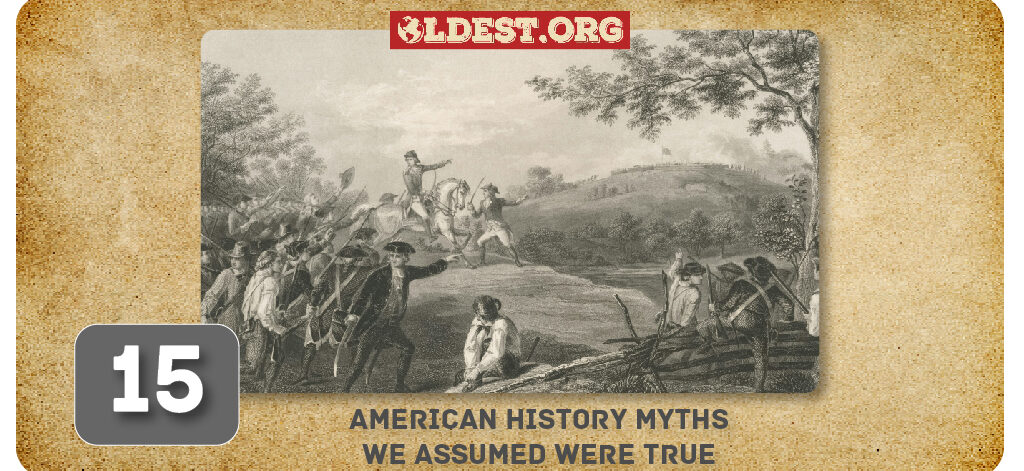
The thing about history is that most of what we “know” didn’t come from dusty archives or original letters. Instead, they came from school textbooks trying to simplify things, movies trying to entertain us, and stories repeated so often they started feeling true.
And, somewhere along the line, nuance got lost. Context got shaved off. And a few outright myths snuck in and made themselves comfortable. American history, in particular, has a talent for turning complex, messy realities into neat little narratives.
So, let’s slow down and look again and dispel the top 15 American history myths that we assumed were true.
1. Christopher Columbus Proved the Earth Was Round
Photo by Elena Mozhvilo on Unsplash
This is probably the most stubborn myth of all. Many of us were taught that Columbus set sail into the unknown to prove the Earth wasn’t flat. Except educated people already knew the Earth was round long before Columbus. Ancient Greek scholars like Eratosthenes had calculated the Earth’s circumference centuries earlier with surprising accuracy. Medieval European scholars were not flat-Earth believers either. Sailors, astronomers, and clergy accepted a spherical Earth as fact.
2. The Pilgrims Came to America for Religious Freedom
Public Domain, Link
This one sounds noble and tidy. Pilgrims fleeing persecution, searching for a land where they could worship freely. The reality is more complicated. The Pilgrims weren’t fighting for religious freedom in the modern sense. They were separatists who wanted to practice their own strict beliefs without interference. In fact, once settled, they enforced their own religious rules and were not particularly tolerant of dissent.
3. Thanksgiving Was a Peaceful, Feel-Good Celebration
Public Domain, Link
The image is familiar: Pilgrims and Native Americans sharing a harmonious feast, grateful and united. There likely was a harvest celebration in 1621 involving the Wampanoag people and the English settlers. But it wasn’t the cozy dinner portrayed in paintings and classrooms. It was a political event shaped by fragile alliances, power dynamics, and survival concerns.
4. The Declaration of Independence Freed the Slaves
Public Domain, Link
The Declaration of Independence is often spoken of as a universal declaration of freedom. “All men are created equal” is quoted as if it instantly applied to everyone. In reality, slavery continued for nearly a century after 1776. Many of the men who signed the Declaration owned slaves themselves.
You can also explore the battles that defined American history, highlighting key conflicts that shaped the nation’s path and lasting legacy.
5. Paul Revere Rode Alone Shouting “The British Are Coming!”
CC BY 2.0, Link
Thanks to poetry and pop culture, Paul Revere has become a lone hero galloping through the night, yelling warnings at sleeping colonists. In reality, Revere was one of several riders. He didn’t shout dramatically because many colonists still considered themselves British. He used coded language and discreet warnings instead.
6. The American Revolution Was Supported by Everyone in the Colonies
Public Domain, Link
The idea of a united colonial uprising is comforting, but inaccurate. The colonies were deeply divided. Roughly one-third of colonists supported independence. Another third remained loyal to Britain. The rest were undecided or just trying to survive. Several families were split and neighbors turned against each other.
7. Betsy Ross Designed the First American Flag
Public Domain, Link
There’s no solid evidence that Betsy Ross designed or sewed the first American flag. The story comes primarily from her descendants decades after the fact. She was a skilled upholsterer and flag maker, so it’s possible she made flags. But the iconic story of her presenting a flag design to George Washington is unsupported by contemporary documentation.
8. The Founding Fathers Agreed on Everything Important
Public Domain, Link
We often imagine the Founding Fathers as a unified group with a shared vision. In reality, they argued constantly. They disagreed on federal power, states’ rights, economic policy, foreign alliances, and the role of the presidency. The Constitution itself is a document built on compromise, not consensus.
9. The Civil War Was Fought Mainly Over States’ Rights
Public Domain, Link
This myth has lingered for generations, especially in certain regions. But when you read the declarations written by seceding states, the central issue is clear. They were protecting slavery. States’ rights mattered, but primarily the right to own enslaved people and maintain an economic system built on forced labor. Slavery was not a side issue. It was the core issue.
Be sure to check out our fascinating facts about Native American history, uncovering important insights and lesser-known cultural stories.
10. Cowboys Were Mostly White American Men
Public Domain, Link
Hollywood gave us a very specific cowboy image. The reality was far more diverse. A significant number of cowboys were Black, Mexican, Native American, or of mixed heritage. Many of the techniques associated with cowboy culture came from Mexican vaqueros.
11. Ellis Island Immigrants Had Their Names Changed by Officials
Source: Reddit
Many families believe their ancestors’ names were changed by Ellis Island officials who couldn’t pronounce them. In fact, passenger lists were created at ports of departure, not upon arrival. Officials at Ellis Island worked from those lists and rarely altered names. Most name changes happened later, voluntarily, as immigrants tried to assimilate or avoid discrimination.
12. Prohibition Made Alcohol Illegal Everywhere
Public Domain, Link
Prohibition banned the manufacture, sale, and transport of alcohol. It did not ban drinking itself. People found loopholes. They stocked up before the ban, brewed at home, or turned to illegal suppliers. Enforcement varied widely, and corruption was common.
13. The Boston Tea Party Was a Spontaneous Act of Rage
Public Domain, Link
The Boston Tea Party is often imagined as an impulsive outburst. Angry colonists, fed up with British taxes, storm ships and toss tea into the harbor in a fit of rebellion. In reality, it was carefully planned. The participants organized logistics, coordinated timing, and even enforced rules. No other property was damaged. Locks that were broken were later replaced.
14. Native Americans Were a Single, Unified Culture
Public Domain, Link
Textbooks and movies often treat Native Americans as one group with shared customs, beliefs, and lifestyles. The truth is that there were hundreds of distinct tribes, each with its own language, governance systems, spiritual practices, and social structures. Some were nomadic. Others built permanent cities. Some relied on hunting, others on agriculture and trade. Lumping them together erases enormous cultural diversity and oversimplifies centuries of complex history.
You can also explore the most significant Americans in history, spotlighting individuals whose actions and ideas shaped the nation.
15. Women Had No Influence in Early American History
Public Domain, Link
Because women were excluded from voting and formal political power, it’s often assumed they had little influence in early America. That assumption is misleading. Women shaped political thought through writing, organizing, boycotts, education, and social networks. They influenced elections, managed businesses, ran farms, and sustained communities. Figures such as Abigail Adams openly challenged male leaders on issues such as education and women’s rights.
Final Words
You might wonder why any of this matters. After all, these are old stories. The past is done. But myths shape identity. They influence how nations see themselves, how people understand power, freedom, and responsibility. When history is simplified, it becomes easier to misuse. This is why we need to let go of these myths and replace them with facts.
The post 15 American History Myths We Assumed Were True appeared first on Oldest.org.