

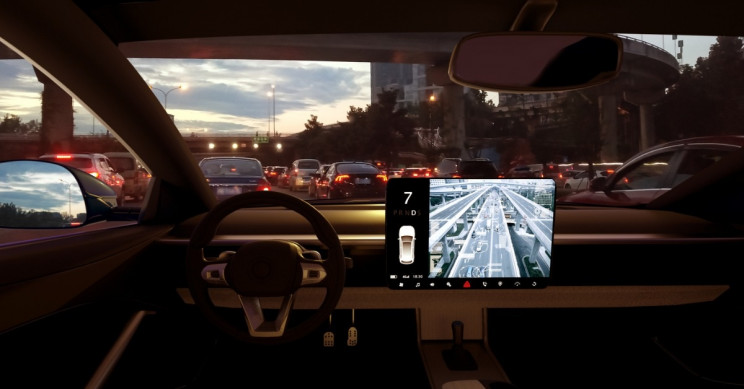
Self-driving cars are no longer reserved for futuristic movies
and literature. These days they are becoming a reality and
consumers across the world are on board with the new way to get
from point A to point B.
That’s according to a new survey conducted by ANSYS, the
engineering simulation software company. In its new ANSYS Global
Autonomous Vehicles Report, it found seven out of 10 consumers
think autonomous cars[1]
drive better and will be more advanced than humans by
2029.
RELATED: BOEING’S SELF-FLYING AIR
TAXIN COMPLETES FIRST TEST FLIGHT [2]
Most want to wait for the technology to be
perfected
The group surveyed more than 22,000 people in Benelux, China,
France, Germany, India, Italy, Japan, Spain, Sweden, the UK, and
U.S., to get their thoughts on the self-driving car market. What
the company found is consumers want to use autonomous travel with
some willing to ride in self-driving cars and planes today. The
majority, however, want to wait until the technology is perfected
before boarding a plane without a pilot.
“We are at the threshold of a fully autonomous era that
will revolutionize global transportation. This report confirms the
world’s optimism – but also legitimate concerns – for AVs,” said
Eric Bantegnie, vice president and general manager of the systems
business unit at ANSYS in a press release[3]
highlighting the research. “To drive worldwide AV adoption,
manufacturers must prove the technology is safer and more reliable
than humans. ANSYS simulation solutions make that
possible.”
Indians very open to self-driving cars
According to the survey[4], 77% of respondents said
they would drive in an autonomous car in their lifetime while 50%
said they would do so within the next five years. Of the
respondents, 14% said they would hop on board today. Of the
countries surveyed ANSYS found people living in India were the most
open to riding in a self-driving car today while in the UK they
were the most skeptical. Just 8% said they were comfortable with
autonomous cars today although more than half said they would ride
in one during their lifetime.
As for how these self-driving cars stack up with the
skills of human drivers, the survey found most think the technology
will improve in the next decade with autonomous vehicles eventually
possessing more skills than human drivers. Of the respondents, 13%
think that is the case today. People living in Japan[5]
have the most trust in the technology compared to the other
countries polled.
Automated planes are already a
reality
As for self-driving airplanes, ANSYS found 70% said they
would fly in one during their lifetime while 21% said they would do
it now or within a year while 21% said they would do so within five
years. Of the respondents in China, 97% said they would feel
comfortable flying in an autonomous airplane in their lifetime.
That compares to 46% in the UK.
“Although the public shares some safety concerns about
both modes of transportation, many of those surveyed trust
the technology that operates these vehicles. 71% of
respondents believe that autonomous cars are better drivers
than humans or will surpass human abilities within 10 years.
70% of consumers were comfortable with flying in an autonomous
plane in their lifetime, the majority of which were not aware
of the level of autonomy already involved in commercial
flight,” wrote ANSYS in the report. “With younger generations
increasingly open to autonomous travel and an opportunity for
improved education on AVs, it is reasonable to expect global
comfort with autonomous travel to continue to
rise.”
References
- ^
autonomous cars
(interestingengineering.com) - ^
RELATED:
BOEING’S SELF-FLYING AIR TAXIN COMPLETES FIRST TEST
FLIGHT (interestingengineering.com) - ^
press release
(www.ansys.com) - ^
survey
(www.ansys.com) - ^
Japan
(interestingengineering.com)