
The use of power grids is increasing around the world, and with
it, a few hurdles need to be jumped over. The rapidly developing
power grids we use today continuously work on harnessing as much
solar, or wind power[1], among other methods, as
possible.
This trend is due to rise each year, meaning that more and more
power grids will be needed.
Furthermore, these grids will need to work efficiently, and at
their best capacity.
However, renewable energy generation technologies are variable
and not always fully dispatchable. A team of international researchers[2] led by the Singapore
University of Technology and Design have put their heads together
to find a solution.
RELATED: TESLA UNVEILS NEW ENERGY
GRID STORAGE PRODUCT CALLED ‘MEGAPACK’[3]
Uncontrollable resources
Renewable energy works from uncontrollable resources that
fluctuate. The classical optimal power flow[4] (OFP) options in place
sometimes offer inefficient power generation policies, which lead
to line overloads and mass power outages.
Not a fun predicament to be caught up in.
The current OFPs are computed based on very simple predictions
of expectations and generation levels for a specific time frame.
Even though these predictions can be quite accurate for traditional
power grids, they’re unpredictable when it comes to renewable
generators.
Regardless of the large investments in the industry, power
outages due to uncertain renewable power generation occur[5]
regularly. This goes to show that a new approach is needed, as the
current strategy solely based on technological improvements of the
transmission lines is no longer sufficient.
What has the team discovered?
This is where an international team of researchers[6]
from the Singapore University of Technology and Design (SUTD), the
Politecnico Di Torino in Italy, and the Pennsylvania State
University in the U.S. comes in.
The researchers have proposed a new probabilistic dispatch
strategy for these modern power grids that lowers generation costs,
but also ensures that constraints in the power network are secure.
This method prevents overload or power outages.
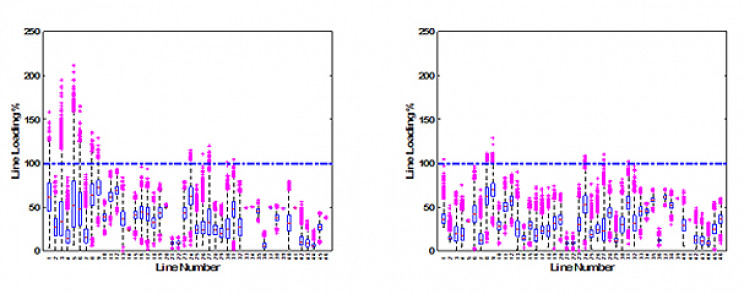
Line loading percentage for the proposed approach (Right)
compared to the classical approach (Left). Source: Singapore University of Technology and
Design[7]
“One of the advantages of the probabilistic approach
pursued in this research is to avoid conservatism associated with
the existing methods. Instead of requiring that the network
constraints are satisfied for all possible values of uncertainty,
we pushed the boundaries and allowed for a small well-defined risk
of constraint violation to develop this new approach,” explained
lead author Dr. Mohammadreza Chamanbaz,[8] Senior Research Fellow,
SUTD.
References
- ^
wind
power (interestingengineering.com) - ^
team of international researchers
(www.sciencedaily.com) - ^
RELATED:
TESLA UNVEILS NEW ENERGY GRID STORAGE PRODUCT CALLED ‘MEGAPACK’
(interestingengineering.com) - ^
classical optimal power flow
(www.sutd.edu.sg) - ^
occur
(www.sutd.edu.sg) - ^
team of researchers
(www.eurekalert.org) - ^
Singapore University of Technology and
Design (www.sutd.edu.sg) - ^
Dr. Mohammadreza Chamanbaz,
(www.eurekalert.org)