SpaceX[1]
could be launching astronauts with its Crew Dragon spacecraft up
into space as early as the start of 2020[2], said NASA
Administrator, Jim Bridenstine[3]. If all goes according
to plan, this would be a momentous moment for American space
exploration.
There has previously been some tension between Bridenstine[4]
and SpaceX founder, Elon Musk, over the very delayed Crew Dragon
spacecraft. However, the duo have stated that all is well once
again.
Once the spacecraft is operational it would serve as the main
transportation for astronauts up to the International Space Station[5] (ISS) for the first time
for Americans since 2011.
RELATED: VALVE LEAK CAUSED SPACEX’S
DRAGON CREW CAPSULE EXPLOSION[6]
Safety is a priority
It was at a news conference that Musk and Bridenstine[7], alongside the two
astronauts due to fly out on the Crew Dragon capsule, that Musk
announced their hopes of launching into space in early
2020.
However, he strongly stressed that the astronauts’ safety[8]
comes first and foremost and if there are any issues with the
upcoming tests, the launch would be delayed.
Bridenstine[9]
backed these comments up by saying “If everything goes
according to plan, it would be in the first quarter of next
year. But remember—and this is the important thing that
we have to get right on messaging—there are still things that we
can learn or could learn that could be challenging that we have to
resolve.”
Bridenstine continued, “I’m not saying that’s going to happen, I
don’t know. That’s why we test[10].”
Testing is crucial, especially as the Crew Dragon’s parachutes
and propulsion system had some issues earlier this year.
“It’s a pretty arduous engineering job to get the
parachutes right,” said Musk[11]. “Parachutes,
they look easy but they are definitely not easy. We want to get at
least something on the order of 10 successful tests in a row before
launching astronauts.”
After spending the day with CEO Elon Musk,
NASA chief Jim Bridenstine says he’s now “very confident” in
SpaceX’s Crew Dragon spacecraft, indicating the two men are back on
the same page after their crossfire last month about delays in the
program https://t.co/6W8dfH1Xc6[12]
— CNN International (@cnni) October 11, 2019[13]
Why is this such an important moment for American space
exploration?
Since closing off its space shuttle program in 2011[14], NASA has relied on
Russia’s Soyuz spacecraft to ferry its astronauts to and from the
space station. Each seat costs $85 million.
It’s quite understandable, then, that NASA has put SpaceX[15] and Boeing in charge of
designing and building new space shuttles.
In 2014, NASA awarded SpaceX $2.6 billion[16] for their Crew Dragon[17] project, and Boeing
received $4.2 billion for their CST-100 Starliner[18]. The hope is for these
companies to build a functional and operational Commercial Crew
Program.
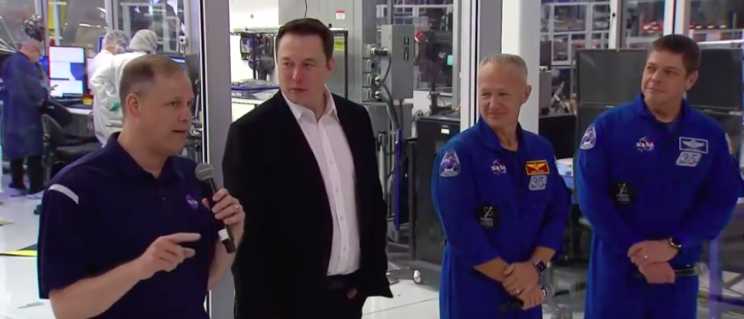
Jim Bridenstine, Elon Musk, and the two astronauts due to launch
next year, at the press conference. Source: CNBC
Television/YouTube[19]
Which is exactly what they’ve been working on, and it looks as
though SpaceX may be on the cusp on finalizing their project.
We’ll have to wait and see how the tests play out in the coming
months, and whether or not we’ll be watching the first all-American
space shuttle launch in early 2020.
References
- ^
SpaceX
(interestingengineering.com) - ^
start of 2020
(www.theverge.com) - ^
Jim Bridenstine
(www.nasa.gov) - ^
Bridenstine
(interestingengineering.com) - ^
International Space Station
(www.nasa.gov) - ^
RELATED:
VALVE LEAK CAUSED SPACEX’S DRAGON CREW CAPSULE EXPLOSION
(interestingengineering.com) - ^
Bridenstine
(interestingengineering.com) - ^
safety
(www.theverge.com) - ^
Bridenstine
(phys.org) - ^
test
(phys.org) - ^
said Musk
(phys.org) - ^
https://t.co/6W8dfH1Xc6
(t.co) - ^
October 11, 2019
(twitter.com) - ^
space shuttle program in 2011
(www.space.com) - ^
SpaceX
(interestingengineering.com) - ^
$2.6 billion
(www.space.com) - ^
Crew Dragon
(www.space.com) - ^
CST-100 Starliner
(www.space.com) - ^
CNBC Television/YouTube
(www.youtube.com)