In 1502 A.D., Sultan Bayezid II was in search of a bridge design
to connect Istanbul with its neighbor city Galata, one that would
have been the world’s longest bridge span of its time. inventor
Leonardo da Vinci proposed an idea but he did not get the job.
RELATED: 10 EXTRAORDINARY
NEOFUTURISTIC BRIDGE DESIGNS[1]
Would it have worked?
Today, 500 years after da Vinci’s death, researchers at MIT
decided to test[2]
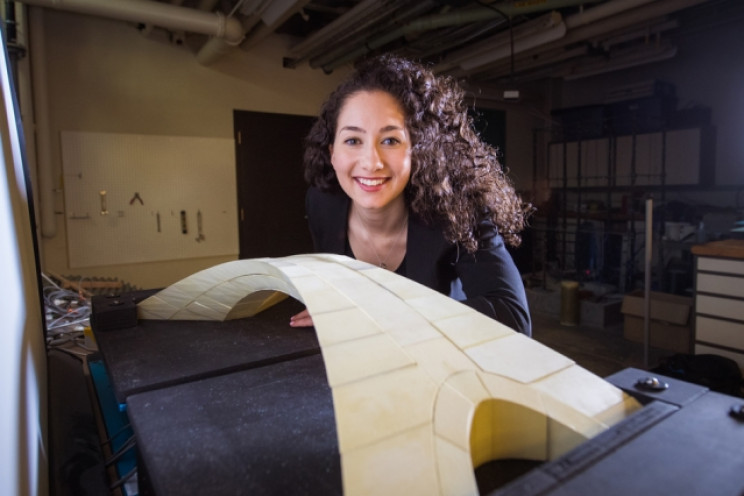
whether his concept would have worked. Recent graduate student
Karly Bast MEng ’19, along with professor of architecture and of
civil and environmental engineering John Ochsendorf and
undergraduate Michelle Xie, analyzed all available information from
the time and built a detailed scale model to test the structure’s
ability to stand and support weight.
The bridge, at the time, would have been about 280
meters long. “It’s incredibly ambitious,” Bast said. “It
was about 10 times longer than typical bridges of that time.”
Since Leonardo provided no details about the materials that
would be used, Bast and the team researched the time’s materials
and concluded that the bridge could only have been made of stone.
They then had to build a model and demonstrate its
stability.
They chose to build it at a scale of 1 to 500 using 126 blocks
for their bridge. The individual blocks were made on a 3D
printer.
“It was time-consuming, but 3D printing allowed us to accurately
recreate this very complex geometry,” Bast said.
Ultimately what the team was trying to test was if the design
would work with the technology from da Vinci’s time.
Held together by compression
“It’s all held together by compression only,” Bast said. “We
wanted to really show that the forces are all being transferred
within the structure,” which is key to ensuring that the bridge
would stand solidly and not topple.
Similar to an actual masonry arch bridge construction, the
pieces of the bridge were supported by a scaffolding structure, and
only after they were all in place could the scaffolding be removed
to allow the structure to support itself. The final test came when
it was time to insert the final piece in the structure: the
keystone at the top of the arch.
“When we put it in, we had to squeeze it in. That was the
critical moment when we first put the bridge together. I had a lot
of doubts” as to whether it would all work, Bast explained. But
“when I put the keystone in, I thought, ‘this is going to work.’
And after that, we took the scaffolding out, and it stood up.”
“It’s the power of geometry” that makes it work, she said. “This
is a strong concept. It was well thought out.”
The design has no practical implications for today’s advanced
bridge designers but it does underscore da Vinci’s brilliance of
the time. It also proves, Bast said, that “you don’t necessarily
need fancy technology to come up with the best ideas.”
References
- ^
RELATED: 10 EXTRAORDINARY
NEOFUTURISTIC BRIDGE DESIGNS
(interestingengineering.com) - ^
decided to test
(news.mit.edu)