When you look at our Earth, it doesn’t present the same
pock-marked surface that our Moon and other planets present, but
that’s not because these impact craters aren’t there. Many of
Earth’s impact craters have been eroded by weathering processes,
while others are either below water or have filled with water.
RELATED: SMALL GERMAN TOWN WAS
UNKNOWINGLY BUILT INSIDE A METEORITE CRATER[1]
Bodies that impact our Earth are categorized as follows:
- Asteroid – a large rocky body in space
- Meteoroid – smaller rocks or particles in
space - Meteor – if a meteoroid enters the Earth’s
atmosphere and vaporizes, it is called a meteor - Meteorite – if either an asteroid or meteroid
survives its journey through the Earth’s atmosphere and lands, it
is called a meteorite - Bolide – is a very bright meteor that often
explodes in the atmosphere.
Scientists identify impact craters by the presence of:
- Shocked quartz – is a form of quartz whose
crystalline structure is deformed along planes within the
crystal - Shatter cones – only form in the bedrock
beneath meteorite impact craters or underground nuclear explosions,
they indicate that the rock has been subjected to pressures of
2 GPa (290,075 psi) to 30
GPa (4,351,132 psi) - Tektites – are small bodies of natural glass
formed from terrestrial debris ejected during meteorite impacts,
they can be black, green brown or gray in color.
To find Earth’s impact craters, you’ve just got to know where to
look, and we’ve provided this list to help you find them.
1. Vredefort Crater – South Africa 27°0′S 27°30′E
This crater is not only the largest but also the oldest impact
crater on Earth. 2.02 billion years ago, a
meteorite or asteroid that was 6.2 to 9.3
miles (10 to 15 km) in diameter crashed
and it blasted out a crater 185 miles (300
km) wide.
Vredefort is one of very few multiple-ringed impact craters on
Earth. The best-known example is the Valhalla Crater on Callisto[2], one of Jupiter’s
moons.
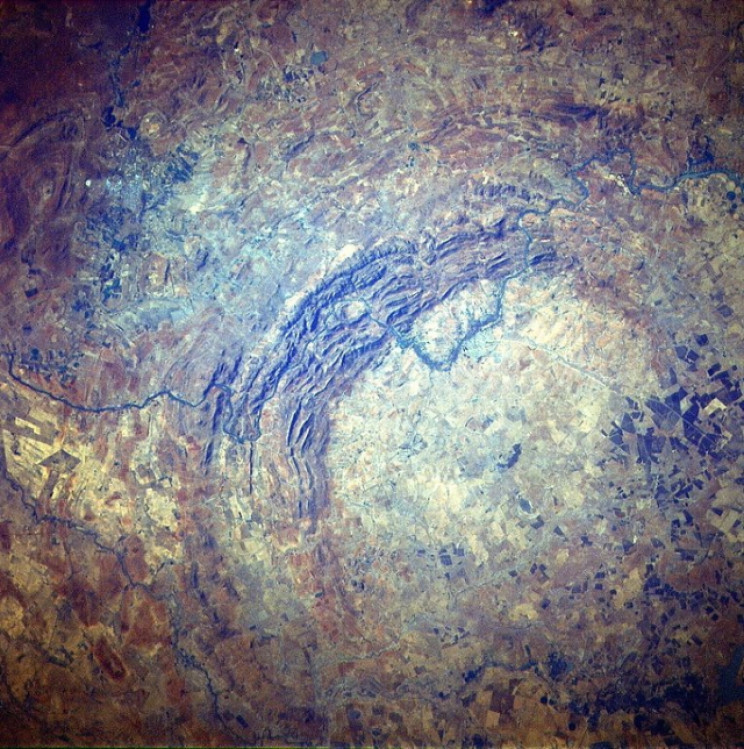 Vredefort
Crater Source: Júlio Reis/Wikimedia Commons[3]
2. Chicxulub Crater – Mexico 21°20′N 89°30′W
In 1978, two geologists working for the Mexican
oil company Pemex were conducting an airborne magnetic survey
flying over the Yucatán Peninsula. In their data, they noticed an
enormous south-facing underwater arc 40 miles
(70 km) across.
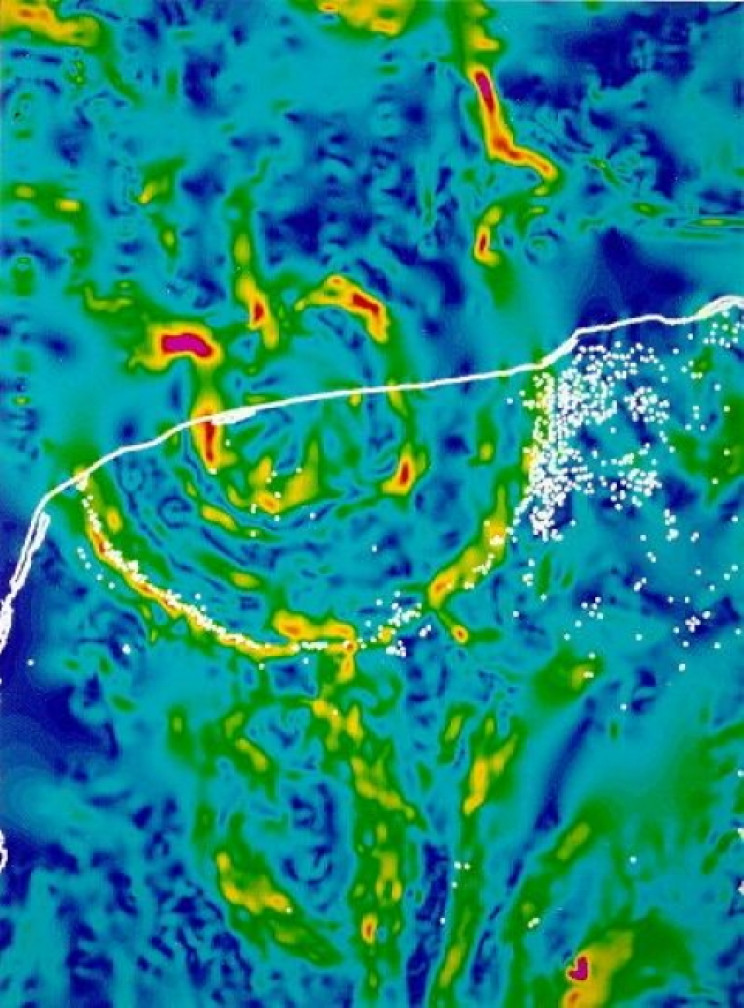 Chicxulub
Crater Source: USGS/Wikimedia Commons[4]
Consulting an earlier map, they found a matching north-facing
arc, and together the two arcs formed a 110 mile
(180 km) wide circle centered near the Mexican
town of Chicxulub.
At the same time, geologists were examining a white, chalky
layer of sediment, called the K-pg boundary[5], that existed worldwide.
Carbon dating showed the layer to be 66 million
years old.
A team consisting of the Nobel Prize-winning physicist Luis
Alvarez[6], his son geologist
Walter Alvarez[7], and chemists Frank
Asaro and Helen Michel determined that this layer contained an
unusual concentration of the element iridium[8].
Iridium is rarely found in the Earth’s crust because it is heavy
and it sank into the Earth’s core when the planet was molten.
Iridium is, however, very plentiful in asteroids, and the Alvarezes
suggested that an asteroid must have struck the Earth, and it must
have been at least 6.2 miles (10
km) in diameter, or about the size of Manhattan.
For comparison, the Martian moon Phobos[9]
is 7 miles (11 km) in diameter,
and Mount Everest is just under 5.6 miles
(9 km).
Based on the presence of shocked quartz granules in both the
K-Pg Layer and around the Caribbean, scientists concluded that the
Chicxulub Crater was formed by an asteroid that crashed into Earth
66,038,000 years ago, plus or minus
11,000 years. And, it was this impact that caused
the extinction of the dinosaurs.
3. Sudbury Crater – Ontario, Canada 46°36′N 81°11′W
At 1.85 billion years old, Sudbury Crater is
exceptionally old. It is currently 81 miles
(130 km) wide, but scientists believe it
originally measured 160 miles (260
km).
 Sudbury
Crater Source: Vesta/Wikimedia Commons[10]
It wasn’t until around 1970 that scientists
determined that the basin was formed by an impact, due to the
presence of shatter cones and shocked quartz. In
2014, scientists
determined[11] that the impactor was a
comet rather than an asteroid.
Debris from the Sudbury impact has been found as far away as
Minnesota, over 500 miles (800
km) away.
4. Popigai Crater – Russia 71°39′N 111°11′E
Around 35 million years ago, a
5-mile-wide (8 km) stony asteroid
crashed into carbon-rich graphite rock in Russia’s Siberia,
creating a 62-mile-wide (100 km)
crater.
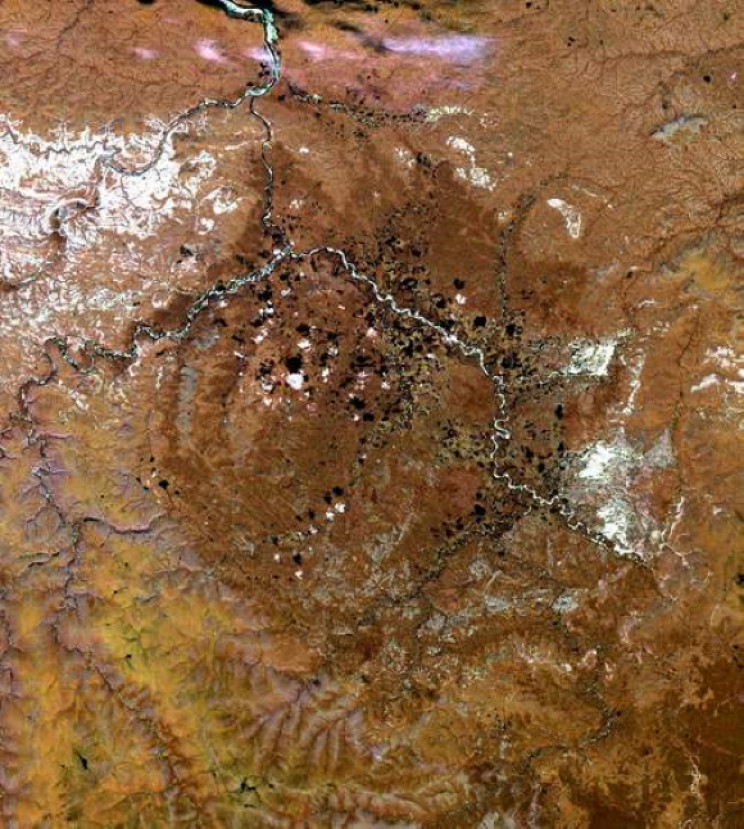 Popigai
Crater Source: Fxer/Wikimedia Commons[12]
The immense temperature and pressure caused the humble graphite
we know from grammar school pencils to become diamonds. Because of
the presence of diamonds, the Popigai Crater was off limits to
geologists until 1997.
The Popigai diamonds are small, about 1 mm in
size, dark colored, and are used in industrial applications.
5. Manicouagan Crater | Quebec, Canada 51°23′N 68°42′W
What is today a stunning swimming and nature spot was created
around 214 million years ago by the impact of a
3-mile-wide (5 km) meteorite
resulting in a 60-mile-wide (100
km) multiple-ring crater.
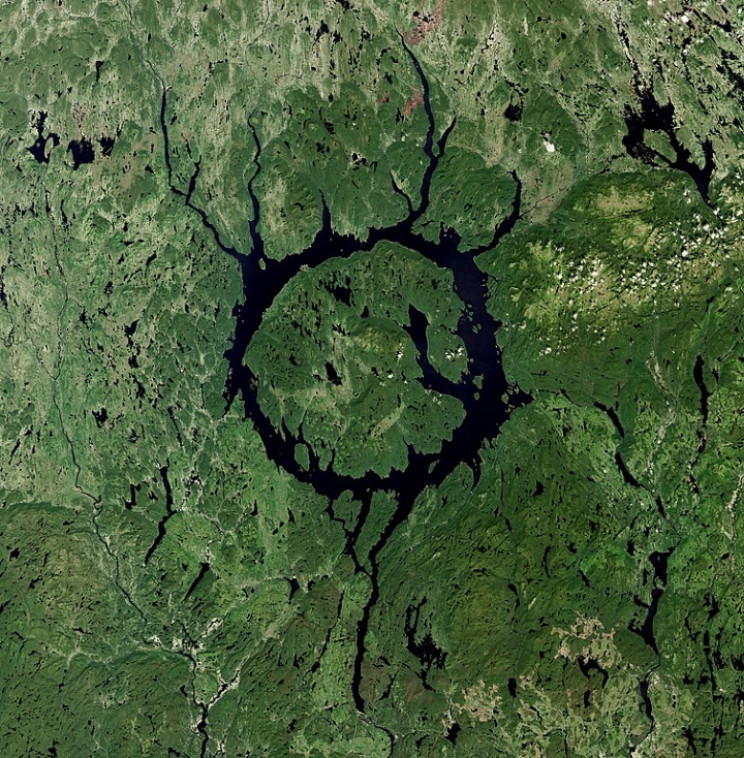
Manicouagan Crater Source: Copernicus Sentinel-2/Wikimedia
Commons[13]
The inner island called René-Levasseur Island, is actually the
central peak of the crater, formed by post-impact uplift. Mount
Babel is 1,936 feet (590 m) above
the reservoir.
Scientists David Rowley of the University of Chicago, John Spray
of the University of New Brunswick and Simon Kelley of the Open
University have posited that Manicouagan is part of a multiple
impact event that also formed the Rochechouart crater in France,
Saint Martin crater in Manitoba, Obolon crater in Ukraine, and Red
Wing crater in North Dakota.
The five craters appear to form a chain, which indicates the
breakup and subsequent impact of an asteroid or comet. This is
similar to the string of impacts made on Jupiter by Comet Shoemaker–Levy 9[14] in
1994.
6. Acraman Crater | Australia 32°1′S 135°27′E
This water-filled crater was created 580 million
years ago and is 56 miles (90
km) in diameter. The crater was only identified in
1986 by the presence of shocked quartz and shatter
cones on islands in the lake.
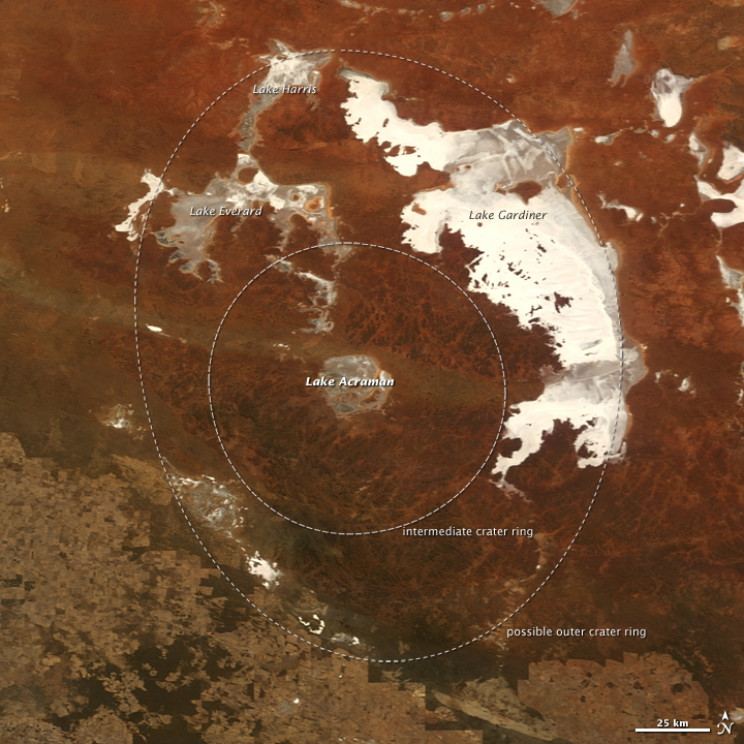 Acraman
Crater Source: NASA Earth Observatory[15]
Impact ejecta from the crater have been found 185
miles (300 km) away in the Flinders
Range, and it contains a high level of iridium, which suggests an
extraterrestrial origin.
7. Morokweng Crater | South Africa 26°28′S 23°32′E
Beneath the Kalahari Desert in South Africa’s North West
province lies the Morokwent Crater. It was formed by an asteroid
145 million years ago and it is approximately
44 miles (70 km) wide.
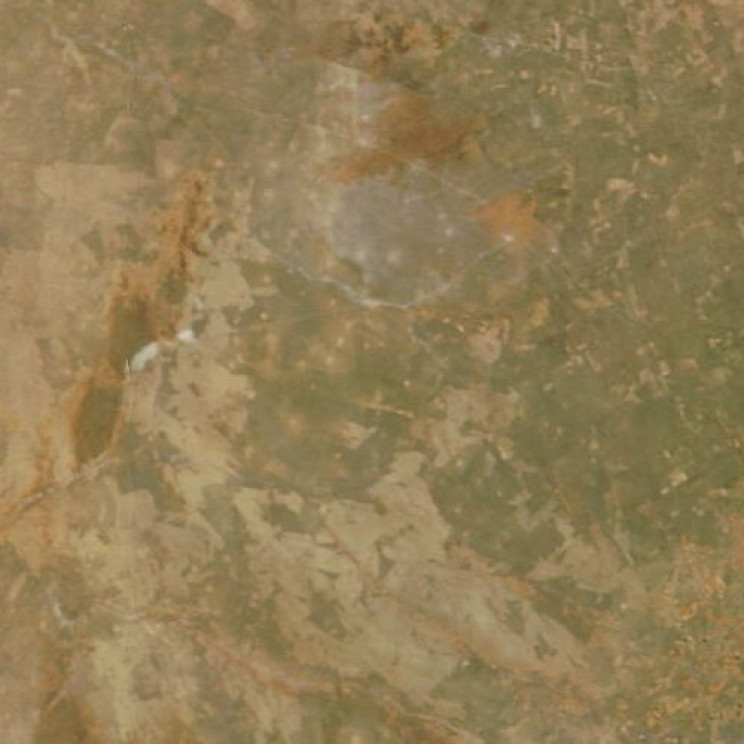 Morokweng
Crater Source: Jacques Descloitres/Wikimedia
Commons[16]
The crater wasn’t discovered until 1994 since
it doesn’t appear on the surface. In May 2006, a
group of scientists discovered fragments of the original asteroid
when they drilled to a depth of 2,530 feet
(770 m). Some of those fragments are displayed in
London’s Science
Museum[17].
8. Kara Crater | Russia 69°6′N 64°9′E
At the southeastern end of the Yugorsky Peninsula lies the Kara
Crater. Today, it is 40 miles (65
km) in diameter, but is thought to have originally been
75 miles (120 km) in size.
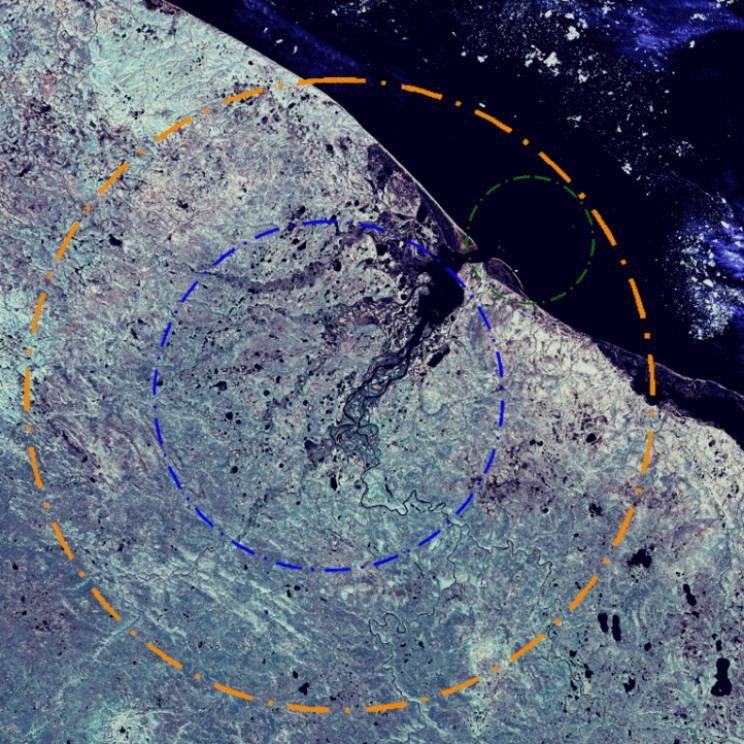 Kara
Kara
Crater Source: NASA/Wikimedia Commons[18]
Whatever created the crater crashed into Earth 70
million years ago.
9. Beaverhead Crater | Idaho/Montana, U.S. 44°15′N 114°0′W
At 37 miles (60 km) in width,
this crater is one of the largest impact craters on Earth. It spans
the border of Idaho and Montana and was created 600 million
years ago.
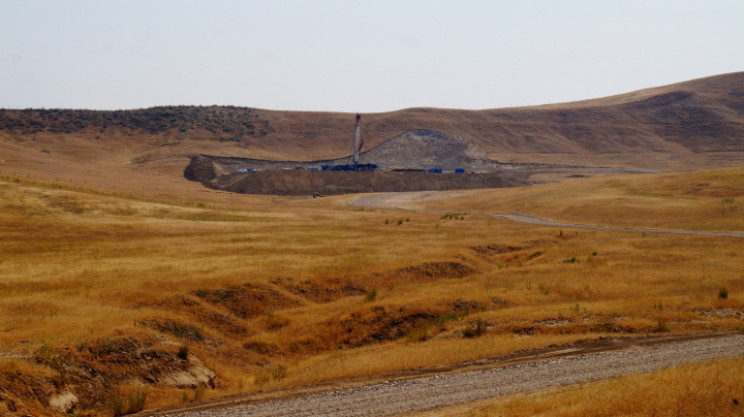 Beaverhead
Crater Source: BLM[19]
The crater wasn’t discovered until the 1990s,
when shocked quartz and shatter cones were identified. The center
of the crater is the city of Challis, Idaho.
10. Meteor Crater | Arizona, U.S. 35°2′N 111°1′W[20]
37 miles (60 km) east of
Flagstaff, Arizona lies Meteor Crater, which is also called
Barringer Crater in honor of geologist Daniel Barringer[21], who first suggested it
was created by a meteorite impact.
 Meteor
Crater Arizona Source: Shane.torgerson/Wikimedia
Commons[22]
The crater is 3,900 feet (1,200
m) in diameter and 560 feet (170
m) deep. The impact created a rim that is 148
feet (45 m) above the surrounding
area.
The meteorite impacted about 50,000 years ago,
during the Pleistocene Epoch[23], and at that time the
area was grassland and wood, and inhabited by mammoths and giant
sloths.
The meteorite was nickel-iron and 160 feet
(50 m) in diameter. It hit with a speed of around
30,000 mph (12.8 km/s), and about
half of the meteorite had been vaporized before impact.
11. Chesapeake Bay Crater | Virginia, U.S. 37°17′N 76°1′W[24]
The Chesapeake Bay off the coasts of Virginia and Delaware is a
busy place. It’s a population center, and a busy shipping and
fishing spot, but look under the mud of the seafloor, and you’ll
find a crater.
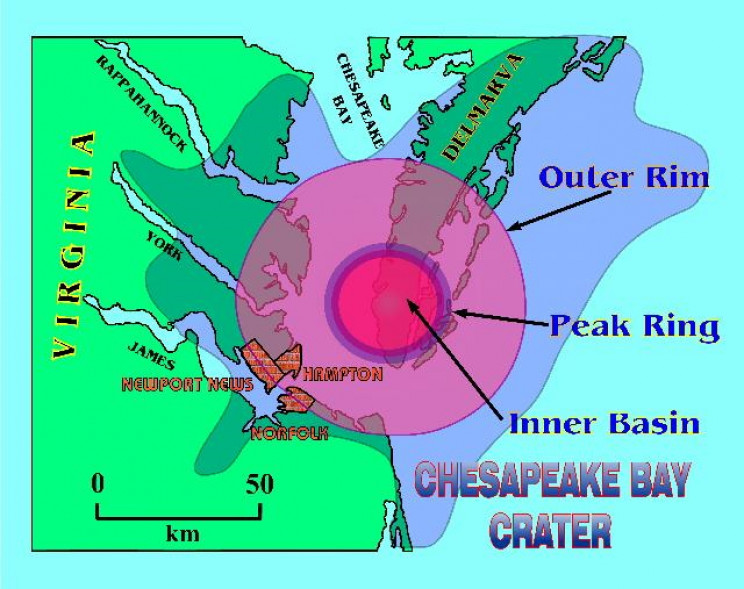
Chesapeake Bay Crater Source: USGS/Wikimedia Commons[25]
The Chesapeake Bay Crater wasn’t discovered until
1983, when a drilling core off Atlantic City, New
Jersey turned up tektites and shocked quartz. Then in
1993, teams searching for oil uncovered the extent
of the crater.
Formed 35 million years ago during the late
Eocene
Epoch[26], the crater is
53-miles-wide (85 km) and
.81 mile (1.3 km) deep, making it
as deep as the Grand Canyon. The shape of Chesapeake Bay takes its
form from the rubble of the crater.
The crater was formed by a bolide, an extremely large impactor
that hit at a speed of 60 kilometers per second.
This punched a deep hole through the sediment and into the granite
forming the continental shelf, fracturing the rock to a depth of
5 miles (8 km).
The impact sent millions of tons of water, sediment and
shattered rock into the atmosphere, and a megatsunami[27] rushed inland, possibly
as far as the Blue Ridge Mountains.
References
- ^
RELATED: SMALL GERMAN TOWN WAS
UNKNOWINGLY BUILT INSIDE A METEORITE CRATER
(interestingengineering.com) - ^
Valhalla Crater on Callisto
(www.jpl.nasa.gov) - ^
Júlio Reis/Wikimedia Commons
(commons.wikimedia.org) - ^
USGS/Wikimedia Commons
(commons.wikimedia.org) - ^
K-pg boundary
(www.geologypage.com) - ^
Luis Alvarez
(www.britannica.com) - ^
Walter Alvarez
(www.britannica.com) - ^
iridium
(www.britannica.com) - ^
Phobos
(www.britannica.com) - ^
Vesta/Wikimedia Commons
(commons.wikimedia.org) - ^
scientists determined
(onlinelibrary.wiley.com) - ^
Fxer/Wikimedia Commons
(commons.wikimedia.org) - ^
Copernicus Sentinel-2/Wikimedia
Commons (commons.wikimedia.org) - ^
Comet Shoemaker–Levy 9
(www.britannica.com) - ^
NASA Earth Observatory
(earthobservatory.nasa.gov) - ^
Jacques Descloitres/Wikimedia
Commons (commons.wikimedia.org) - ^
Science Museum
(www.sciencemuseum.org.uk) - ^
NASA/Wikimedia Commons
(commons.wikimedia.org) - ^
BLM
(www.blm.gov) - ^
35°2′N 111°1′W
(tools.wmflabs.org) - ^
Daniel Barringer
(en.wikipedia.org) - ^
Shane.torgerson/Wikimedia Commons
(commons.wikimedia.org) - ^
Pleistocene Epoch
(www.britannica.com) - ^
37°17′N 76°1′W
(tools.wmflabs.org) - ^
USGS/Wikimedia Commons
(commons.wikimedia.org) - ^
Eocene Epoch
(www.britannica.com) - ^
megatsunami
(en.wikipedia.org)