Nike[1]
is one of the largest and best-known shoes, sports equipment, and
clothing brands in the world. It is estimated that they enjoy
somewhere in the region
of 60%[2] market share and
have become, rightfully, a pop culture icon[3].
But their name, and logo, were almost aborted at a very early
stage. Thankfully for the business, and it’s millions of consumers
around the world today, the company’s founders decided to
‘take a punt[4]‘ with them.
Here we explore some of the major moments in Nike’s history[5]
and explore where it got its name and logo.
RELATED: THE FUTURE IS BACK: CHECK OUT
NIKE’S NEXT SELF-LACING SHOE, THE ADAPT BB[6]
Who invented Nike shoes?
Nike[7], or as they were known
at the time of founding Blue Ribbon Sports[8], was the brainchild of
Bill Bowerman and his former student Phil Knight. Bowerman was, at
the time, a track-and-field coach for the University of
Oregon.
The company that would become Nike was created in 1964 and they
would open their first retail outlet in 1966. The company initially
served as the U.S. distributor for running shoes made by the
Japanese company Onitsuka
Tiger[9] (aka Asics).
After a few successful years, Knight and Bowerman decided to
develop and manufacture their own shoes. To this end, the
now-famous Nike brand shoe hit the shelves in 1971.
In 1978, the company officially changed its name to Nike and later went public in
1980.[10] By the turn of the
Millenium, Nike had grown to be one of the world’s most valuable
brands.
The company’s name, Nike, is derived from the Greek Goddess of
Victory[11]. If you are more
familiar with the Roman Pantheon, Victōria (where we
derive the word victory in
English[12]) is its equivalent.
Today it has retail outlets and distributors in more than
170 countries. Its logo, the now widely recognized
curved checkmark or “swoosh”, it one of the most famous in the
world.
Where was Nike started?
Nike, more specifically Blue Ribbon Sports (BRS) was
founded and initially operated in Eugene, Oregon. It was,
originally set up to be the official U.S. distributor for Japanese
running shoes, and would sell around 1,300 pairs
of shoes in its first year.
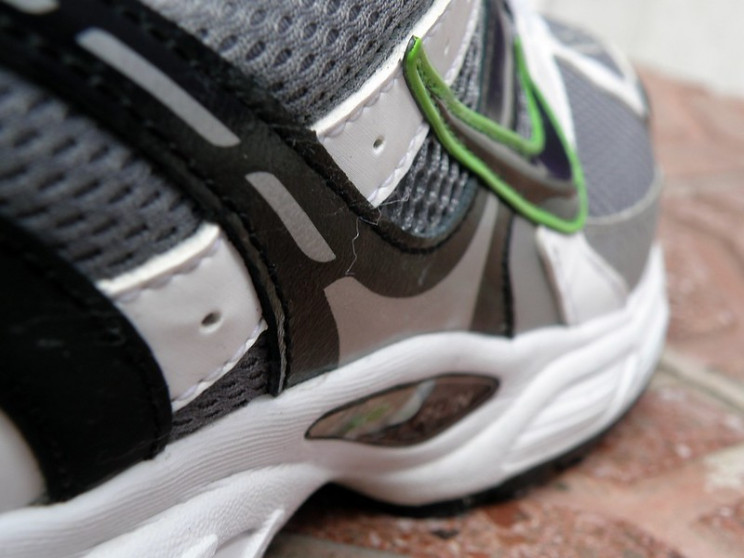 Source: Eduardo Francisco Vazquez
Murillo/Flickr[13]
With no official sales premises, the founding members were
forced to sell their shoes out of the trunks of their
cars.
They could continue to see excellent sales of shoes, and
by 1965 they had enough revenue to hire their first full-time
employee. Nike’s (BRS’s) first retail store was opened on Pico Boulevard in Santa Monica,
California[14] in
1966.
In the late-1960s sales had continued to grow, and they further
expanded operations into the East Coast of America in Wellesley,
Massachusetts.
The rest of the 20th Century would see exponential growth and
expansion of the company all around the world.
Today the company is headquartered in Beaverton,
Oregon. The Nike brand[15] also includes other
famous shoe-brands like Converse, Hurley, and
Jordan.
Why is Nike called Nike?
As we have already seen, the name Nike is derived from the
Ancient Greek Goddess of Victory. But why was the name
chosen?
Originally co-founder Knight wanted to name their brand
“Dimension Six”.
“Knight went for Dimension Six; we thought perhaps for his
love of the pop group The
5th Dimension,” said Geoff
Hollister, the company’s third employee who managed one of their
first stores.
Various other suggestions were bounced around by other early
employees, including Jeff Johnson, BRS’s first-ever employee. In a
famous recollection of the
meeting[16], Hollister believed
they should take a leaf out of Puma’s book.
“I stayed in the zone of Puma,” referring to the
successful German shoe company named after a cougar, suggesting the
name “Peregrine,” a type of falcon.
Perhaps also inspired by Puma, another early BRS employee
suggested “Bengal.” But none of these ideas were popular amongst
the current staff.
According to Business Insider[17], “Johnson, who ran
the company’s East Coast factory in Exeter, NH, would come up with
another idea.” Runners World
contributor Matt McCue documented how Johnson
read an in-flight magazine about great brand names, such as Kleenex
and Xerox.[18]
 Stone carving of Nike in Ephesus,
Turkey. Source: Carole Raddato/Flickr[19]
“They had no more than two syllables and at least one
exotic letter or sound in them with a Z, X or K,” writes McCue,
paraphrasing Johnson.
At 7 a.m. the next morning, Johnson awoke with the name
‘Nike.’ But it was only 4 a.m. in Portland, so Johnson waited three
hours before calling Woodell.
‘I’ve got it!’ Johnson said to Woodell [another early
employee], according to Strasser and Becklund.
‘What?’
‘Nike!’
‘What?’ Woodell asked. ‘What’s a Nike?’
‘It’s the Greek winged goddess of victory,’ Johnson
said.”
But despite reaching a sort of consensus amongst existing staff
members, Knight was not too enamored with the name.
“I guess we’ll go with the Nike thing for a
while… I don’t like any of them, but I
guess that’s the best of the bunch.”, Knight told his staff before
eventually signing off on the new brand name.
The rest, as they say, is history.
Who designed the Nike Logo?
The now world-famous Nike logo was designed by a Portland
State University graphic design student, Carolyn Davidson[20]. She sketched out a few
ideas, but one of the ones she decided to show Nike’s founders was
the now-iconic “Swoosh”.
Despite its destined fame, Knight was not too impressed with it
the time. “Well, I don’t love it,” he said of the design. “But maybe it
will grow on me.”[21]
For her efforts, she was paid $35 and
also worked for Nike for a few years until they needed a full ad
agency.
“Twelve years later, in 1983, Ms. Davidson received a gold
Swoosh ring with an embedded diamond at a luncheon honoring her,
along with a certificate and an undisclosed amount of Nike stock,
in recognition of the Swoosh design logo.” – kicksonfire.com[22].
What was Nike’s first shoe?
According to Sotheby’s one of the first, if not the first,
Nike shoe was the so-called 1972 “Moon Shoes”.
The 1972 Nike Waffle Racing Flat ‘Moon
Shoe,’ the last remaining pair in Sotheby’s Stadium Goods: the
Ultimate Sneaker Collection, achieved $437,500 earlier today,
setting a new world auction record for a pair of sneakers. #SothebysStadiumGoods https://t.co/GGmjh8hSKh[23][24]
— Sotheby’s (@Sothebys) July
23, 2019[25]
This very rare pair of early Nikes were designed and
manufactured for athletes at the 1972 Olympic Trials in Munich.
According to The Vintage News[26], only 12 pairs
were ever made and the pair sold at an auction was never actually
worn.
The shoes were hand-made by Nike’s co-founder Bowerwamn who,
famously, used his wife’s Belgian waffle iron as a mold for the
rubber “waffle” soles of the shoes.
This, he believed, would produce a new sole for athletic
footwear that would have enough grip but, most importantly, be
lightweight.
References
- ^
Nike
(interestingengineering.com) - ^
somewhere in the region of 60%
(www.kicksonfire.com) - ^
a pop
culture icon (interestingengineering.com) - ^
take a punt
(english.stackexchange.com) - ^
Nike’s
history (interestingengineering.com) - ^
RELATED: THE FUTURE IS BACK: CHECK
OUT NIKE’S NEXT SELF-LACING SHOE, THE ADAPT BB
(interestingengineering.com) - ^
Nike
(about.nike.com) - ^
Blue Ribbon Sports
(news.nike.com) - ^
Onitsuka Tiger
(www.onitsukatiger.com) - ^
Nike and later went public in
1980. (www.investopedia.com) - ^
Greek Goddess of Victory
(greekgodsandgoddesses.net) - ^
victory in English
(www.dictionary.com) - ^
Eduardo Francisco Vazquez
Murillo/Flickr (www.flickr.com) - ^
Pico Boulevard in Santa Monica,
California (www.sneakerfreaker.com) - ^
Nike
brand (about.nike.com) - ^
famous recollection of the
meeting (www.amazon.com) - ^
Business Insider
(www.businessinsider.de) - ^
Runners World contributor Matt McCue
documented (www.runnersworld.com) - ^
Raddato/Flickr
(www.flickr.com) - ^
Carolyn Davidson
(awkward-media.com) - ^
he said of the design. “But maybe
it will grow on me.” (www.oregonlive.com) - ^
kicksonfire.com
(www.kicksonfire.com) - ^
#SothebysStadiumGoods
(twitter.com) - ^
https://t.co/GGmjh8hSKh
(t.co) - ^
July 23, 2019
(twitter.com) - ^
The Vintage News
(www.thevintagenews.com)