Cybersecurity researchers have discovered a new malware dropper
contained in as many as 9 Android apps distributed via Google Play
Store that deploys a second stage malware capable of gaining
intrusive access to the financial accounts of victims as well as
full control of their devices.
“This dropper, dubbed Clast82, utilizes a series of techniques
to avoid detection by Google Play Protect detection, completes the
evaluation period successfully, and changes the payload dropped
from a non-malicious payload to the AlienBot Banker and MRAT,”
Check Point researchers Aviran Hazum, Bohdan Melnykov, and Israel
Wernik said in a write-up published[1]
today.
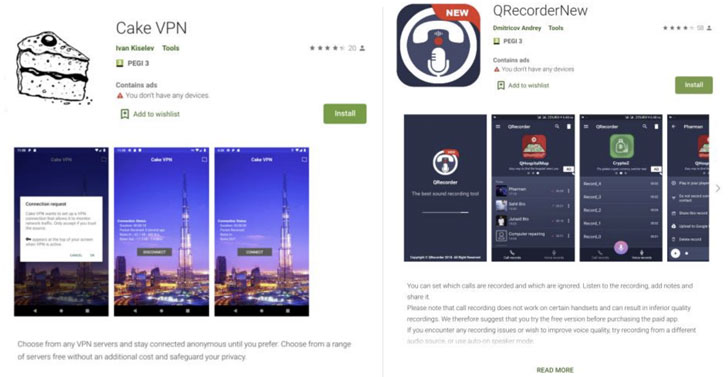
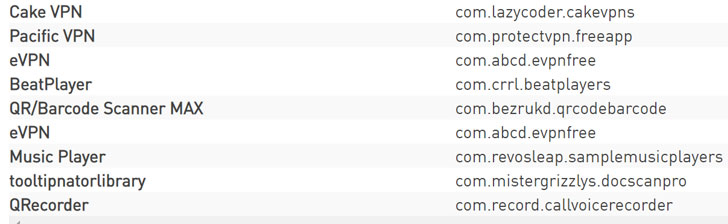
The apps that were used for the campaign include Cake VPN,
Pacific VPN, eVPN, BeatPlayer, QR/Barcode Scanner MAX, Music
Player, tooltipnatorlibrary, and QRecorder. After the findings were
reported to Google on January 28, the rogue apps were removed from
the Play Store on February 9.
Malware authors have resorted to a variety of methods to bypass
app store vetting mechanisms. Whether be it using encryption to
hide strings from analysis engines, creating rogue versions of
legitimate apps, or crafting fake reviews to lure users into
downloading the apps, fraudsters have hit back at Google’s attempts
to secure the platform by constantly developing new techniques to
slip through the net.
Equally popular are other methods like versioning, which refers
to uploading a clean version of the app to the Play Store to build
trust among users and then sneakily adding unwanted code at a later
stage via app updates, and incorporating time-based delays to
trigger the malicious functionality in an attempt to evade
detection by Google.
Clast82 is no different in that it utilizes Firebase as a
platform for command-and-control (C2) communication and makes use
of GitHub to download the malicious payloads, in addition to
leveraging legitimate and known open-source Android applications to
insert the Dropper functionality.
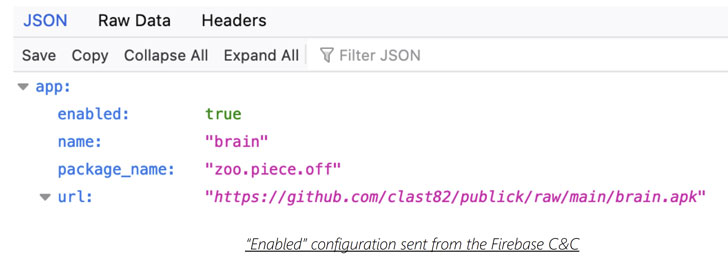
“For each application, the actor created a new developer user
for the Google Play store, along with a repository on the actor’s
GitHub account, thus allowing the actor to distribute different
payloads to devices that were infected by each malicious
application,” the researchers noted.
For instance, the malicious Cake VPN app was found to be based
on an open-sourced version[2]
of its namesake created by a Dhaka-based developer by the name of
Syed Ashraf Ullah. But once the app is launched, it takes advantage
of the Firebase real-time database to retrieve the payload path
from GitHub, which is then installed on the target device.
In the event the option to install apps from unknown sources has
been turned off, Clast82 repeatedly urges the user every five
seconds with a fake “Google Play Services” prompt to enable the
permission, ultimately using it to install AlienBot, an Android
banking MaaS (malware-as-a-service) capable of stealing credentials
and two-factor authentication codes from financial apps.
Last month, a popular barcode scanner[3]
app with over 10 million installations turned rogue with a single
update after its ownership changed hands. In a similar development,
a Chrome extension by the name of The Great Suspender[4]
was deactivated following reports that the add-on stealthily added
features that could be exploited to execute arbitrary code from a
remote server.
“The hacker behind Clast82 was able to bypass Google Play’s
protections using a creative, but concerning, methodology,” Hazum
said. “With a simple manipulation of readily available 3rd party
resources — like a GitHub account, or a FireBase account — the
hacker was able to leverage readily available resources to bypass
Google Play Store’s protections. The victims thought they were
downloading an innocuous utility app from the official Android
market, but what they were really getting was a dangerous trojan
coming straight for their financial accounts.”
References
- ^
published
(blog.checkpoint.com) - ^
open-sourced version
(github.com) - ^
barcode
scanner (blog.malwarebytes.com) - ^
The
Great Suspender (thehackernews.com)