
Researchers have discovered a new side-channel that they say can
be reliably exploited to leak information from web browsers that
could then be leveraged to track users even when JavaScript is
completely disabled.
“This is a side-channel attack which doesn’t require any
JavaScript to run,” the researchers said. “This means script
blockers cannot stop it. The attacks work even if you strip out all
of the fun parts of the web browsing experience. This makes it very
difficult to prevent without modifying deep parts of the operating
system.”
In avoiding JavaScript, the side-channel attacks are also
architecturally agnostic, resulting in microarchitectural website
fingerprinting attacks that work across hardware platforms,
including Intel Core, AMD Ryzen, Samsung Exynos 2100, and Apple M1
CPUs — making it the first known side-channel attack on the iPhone
maker’s new ARM-based chipsets.
The findings[1], which come from a group
of academics from the Ben-Gurion Univ. of the Negev, the University
of Michigan, and the University of Adelaide, will be presented at
the USENIX Security Symposium in August.
Side-channel attacks typically rely on indirect data such as
timing, sound, power consumption, electromagnetic emissions,
vibrations, and cache behavior in an effort to infer secret data on
a system. Specifically, microarchitectural side-channels exploit
the shared use of a processor’s components across code executing in
different protection domains to leak secret information like
cryptographic keys.
Additionally, studies have also previously demonstrated fully
automated attacks such as “Rowhammer.js[2]” that rely on nothing
but a website with malicious JavaScript to trigger faults on remote
hardware, thereby gaining unrestricted access to systems of website
visitors.
While these leaky side-channels can be effectively plugged by
domain isolation techniques, browser vendors have incorporated[3]
defenses[4]
to offer protection against timing attacks and fingerprinting by
reducing the precision of time-measuring functions, aside from
adding support for completely disabling JavaScript using add-ons
like NoScript.

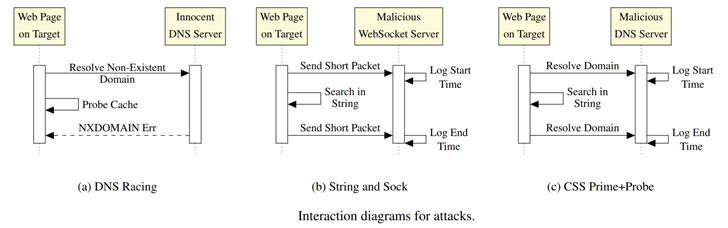
However, the latest research released this week aims to bypass
such browser-based mitigations by implementing a side-channel
attack called “CSS Prime+Probe” constructed solely using HTML and
CSS, allowing the attack to work even in hardened browsers like
Tor, Chrome Zero, and DeterFox that have JavaScript fully disabled
or limit the resolution of the timer API.
“A common trend in these approaches is that they are symptomatic
and fail to address the root cause of the leakage, namely, the
sharing of microarchitectural resources,” the researchers outlined.
“Instead, most approaches attempt to prevent leakage by modifying
browser behavior, striking different balances between security and
usability.”
First, a small primer: Unlike Flush+Reload attacks, wherein a
spy can use a cache flush instruction (e.g., clflush in x86) to
flush specific cache lines, and determine if the victim accessed
this data by re-accessing the same memory line and timing the
access for a hit (data is back in the cache) or miss (not accessed
by the victim), Prime+Probe requires the attacker to populate the
entire shared cache in order to evict victim’s data from the cache,
and then timing its own accesses after it fills the cache — the
presence of a cache miss indicating that the victim accessed the
corresponding cache line causing the spy’s data to be removed.
The CSS Prime+Probe technique, then, hinges on rendering a web
page that includes a long HTML string variable covering the entire
cache (e.g., a <div> element with a class name containing two
million characters), then performing a search for a short,
non-existent substring in the text, in turn forcing the search to
scan the whole string. In the final step, the time to carry out
this probe operation is sent to an attacker-controlled server.
“The attacker first includes in the CSS an element from an
attacker-controlled domain, forcing DNS resolution,” the
researchers explained. “The malicious DNS server logs the time of
the incoming DNS request. The attacker then designs an HTML page
that evokes a string search from CSS, effectively probing the
cache. This string search is followed by a request for a CSS
element that requires DNS resolution from the malicious server.
Finally, the time difference between consecutive DNS requests
corresponds to the time it takes to perform the string search,
which […] is a proxy for cache contention.”
To evaluate the effectiveness of the methods via website
fingerprinting attacks, the researchers used the aforementioned
side-channel, among others, to collect traces of cache use while
loading different websites — including Alexa Top 100 websites —
using the “memorygrams” to train a deep neural network model to
identify a specific set of websites visited by a target.
While JavaScript-based cache occupancy attacks offer higher
accuracy of over 90% across all platforms when compared to CSS
Prime+Probe, the study noted that the accuracy achieved by the
latter is high enough to leak data that could allow malicious
parties to identify and track users.
“So, how can security-conscious users access the web?,” the
researchers concluded. “One complicating factor to this concept is
the fact that the web browser makes use of additional shared
resources beyond the cache, such as the operating system’s DNS
resolver, the GPU, and the network interface. Cache partitioning
seems a promising approach, either using spatial isolation based on
cache coloring, or by OS-based temporal isolation.”
References
- ^
findings
(arxiv.org) - ^
Rowhammer.js
(arxiv.org) - ^
incorporated
(developer.mozilla.org) - ^
defenses
(bugs.chromium.org)
Read more http://feedproxy.google.com/~r/TheHackersNews/~3/ABjGBrLXfHY/new-browser-attack-allows-tracking.html