A hacking group related to a Chinese-speaking threat actor has
been linked to an advanced cyberespionage campaign targeting
government and military organizations in Vietnam.
The attacks have been attributed with low confidence to the
advanced persistent threat (APT) called Cycldek[1]
(or Goblin Panda, Hellsing, APT 27, and Conimes), which is known
for using spear-phishing techniques to compromise diplomatic
targets in Southeast Asia, India, and the U.S. at least since
2013.
According to researchers from Kaspersky, the offensive, which
was observed between June 2020 and January 2021, leverages a method
called DLL side-loading to execute shellcode that decrypts a final
payload dubbed “FoundCore[2].”
DLL side-loading[3]
has been a tried-and-tested technique used by various threat actors
as an obfuscation tactic to bypass antivirus defenses. By loading
malicious DLLs into legitimate executables, the idea is to mask
their malicious activity under a trusted system or software
process.
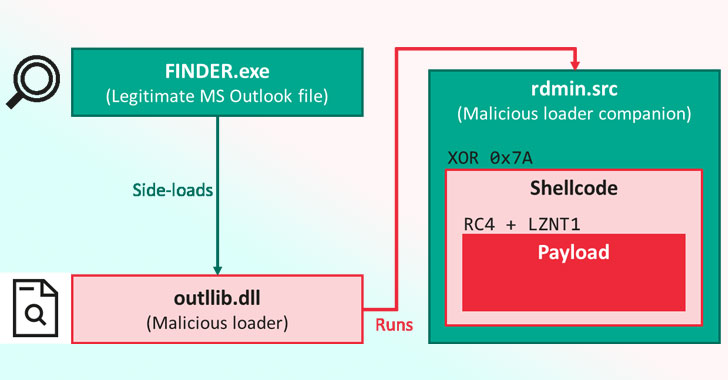
In this infection chain revealed by Kaspersky, a legitimate
component from Microsoft Outlook loads a malicious library called
“outlib.dll,” which “hijacks the intended execution flow of the
program to decode and run a shellcode placed in a binary file,
rdmin.src.”
What’s more, the malware comes with an extra layer designed
explicitly to safeguard the code from security analysis and make it
difficult to reverse-engineer. To achieve this, the threat actor
behind the malware is said to have scrubbed most of the payload’s
header[4], while leaving the rest
with incoherent values.
Kaspersky said the method “signals a major advancement in
sophistication for attackers in this region.”
Besides giving the attackers full control over the compromised
device, FoundCore comes with capabilities to run commands for file
system manipulation, process manipulation, capturing screenshots,
and arbitrary command execution. Infections involving FoundCore
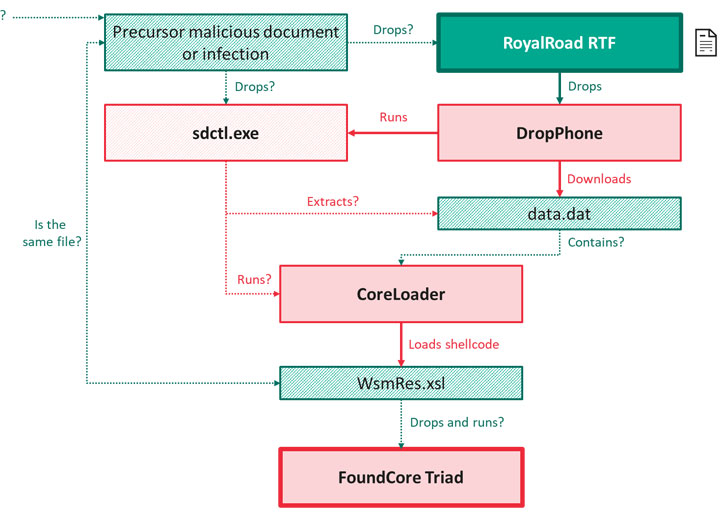
were also found to download two additional malware. The first,
DropPhone, gathers environment-related information from the victim
machine and exfiltrates it to DropBox, while the second,
CoreLoader, runs code that enables the malware to thwart detection
by security products.
The cybersecurity firm theorized the attacks originate with a
spear-phishing campaign or other precursor infections, which
trigger the download of decoy RTF documents from a rogue website,
ultimately leading to the deployment of FoundCore.
Among dozens of affected organizations, 80% of them are based in
Vietnam and belong to the government or military sector, or are
otherwise related to the health, diplomacy, education, or political
verticals, with other victims, occasionally spotted in Central Asia
and Thailand.
“No matter which group orchestrated this campaign, it
constitutes a significant step up in terms of sophistication,” the
researchers concluded. “Here, they’ve added many more layers of
obfuscation and significantly complicated reverse engineering.”
“And this signals that these groups may be looking to expand
their activities. Right now, it may seem as if this campaign is
more of a local threat, but it’s highly likely the FoundCore
backdoor will be found in more countries in different regions in
the future,” said[5]
Kaspersky senior security researcher Mark Lechtik.