
A team of security researchers from Google has demonstrated yet
another variant of the Rowhammer attack that bypasses all current
defenses to tamper with data stored in memory.
Dubbed “Half-Double,” the new hammering technique hinges on the
weak coupling between two memory rows that are not immediately
adjacent to each other but one row removed.
“Unlike TRRespass[1], which exploits the
blind spots of manufacturer-dependent defenses, Half-Double is an
intrinsic property of the underlying silicon substrate,” the
researchers noted[2].
“This is likely an indication that the electrical coupling
responsible for Rowhammer is a property of distance, effectively
becoming stronger and longer-ranged as cell geometries shrink down.
Distances greater than two are conceivable.”
Rowhammer attacks are similar to speculative execution[3]
in that both break the fundamental security guarantees made by the
underlying hardware. Discovered in 2014, Rowhammer refers to a
class of DRAM vulnerabilities whereby repeated accesses to a memory
row (“aggressor”) can induce an electrical disturbance big enough
to flip bits stored in an adjacent row (“victim”), thereby allowing
untrusted code to escape its sandbox and take over control of the
system.
While DRAM manufacturers deployed countermeasures like Target
Row Refresh (TRR) to thwart such attacks, the mitigations have been
limited to two immediate neighbors of an aggressor row, thus
excluding memory cells at a two-row distance. The imperfect
protections meant TRR defenses in DDR4 cards could be circumvented
to stage new variants of Rowhammer attacks such as TRRespass[4]
and SMASH[5].
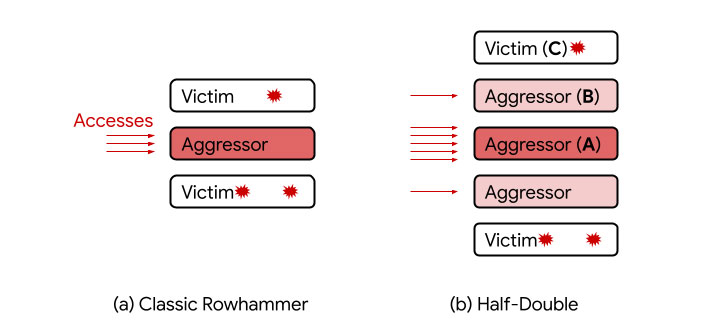
The distance-two assisted Rowhammer — aka Half-Double — now
joins that list. “Given three consecutive rows A, B, and C, we were
able to attack C by directing a very large number of accesses to A,
along with just a handful (~dozens) to B,” the researchers
explained. In this new setup, A is the “far aggressor,” B is the
“near aggressor,” and C is the “victim.”
Google said it’s currently working with the Joint Electron
Device Engineering Council (JEDEC), an independent standardization
body and semiconductor engineering trade organization, along with
other industry partners, to identify possible solutions for
Rowhammer exploits.
“To evaluate the effectiveness of a [SoC-level] mitigation, a
DRAM vendor should test a mix of hammering distances rather than
only testing at individual distances,” the researchers said[6]. “In other words,
hammering a single row or a pair of sandwiching rows on the raw
medium will not show this effect. Instead, pairs of rows on one or
both sides of an intended victim need to be hammered.”