Cybercrime actors part of the Magecart group have latched on to
a new technique of obfuscating the malware code within comment blocks[1]
and encoding stolen credit card data into images and other files
hosted on the server, once again demonstrating how the attackers
are continuously improving[2]
their infection chains to escape detection.
“One tactic that some Magecart actors employ is the dumping of
swiped credit card details into image files on the server [to]
avoid raising suspicion,” Sucuri Security Analyst, Ben Martin,
said[3]
in a write-up. “These can later be downloaded using a simple
GET request[4]
at a later date.”
MageCart is the umbrella term given to multiple groups of
cybercriminals targeting e-commerce websites with the goal of
plundering credit card numbers by injecting malicious JavaScript
skimmers and selling them on the black market.
Sucuri attributed the attack to Magecart Group 7[5]
based on overlaps in the tactics, techniques, and procedures (TTPs)
adopted by the threat actor.
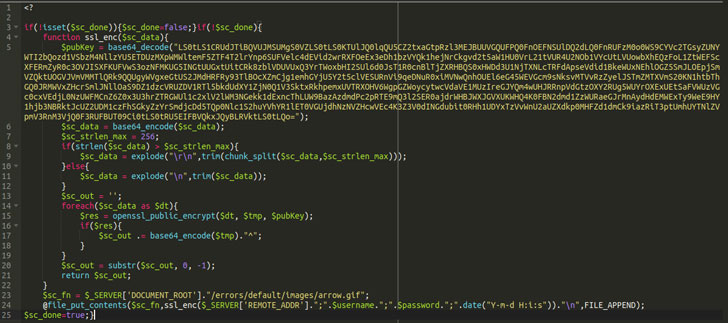
In one instance of a Magento e-commerce website infection
investigated by the GoDaddy-owned security company, it was found
that the skimmer was inserted in one of the PHP files involved in
the checkout process in the form of a Base64-encoded[6]
compressed[7]
string.
What’s more, to further mask the presence of malicious code in
the PHP file, the adversaries are said to have used a technique
called concatenation wherein the code was combined with additional
comment chunks that “does not functionally do anything but it adds
a layer of obfuscation making it somewhat more difficult to
detect.”
Ultimately, the goal of the attacks is to capture customers’
payment card details in real-time on the compromised website, which
are then saved to a bogus style sheet file (.CSS) on the server and
downloaded subsequently at the threat actor’s end by making a GET
request.
“MageCart is an ever growing threat to e-commerce websites,”
Martin said. “From the perspective of the attackers: the rewards
are too large and consequences non-existent, why wouldn’t they?
Literal fortunes are made [by] stealing and selling stolen credit
cards on the black market.”
References
- ^
comment
blocks (en.wikipedia.org) - ^
continuously improving
(thehackernews.com) - ^
said
(blog.sucuri.net) - ^
GET
request (developer.mozilla.org) - ^
Magecart
Group 7 (www.riskiq.com) - ^
Base64-encoded
(en.wikipedia.org) - ^
compressed
(www.php.net)