

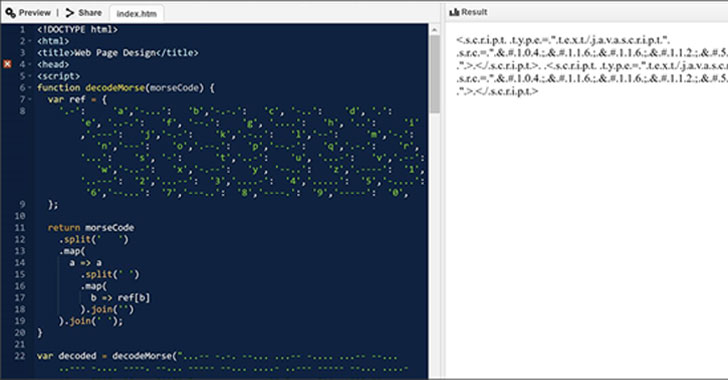
Microsoft has disclosed details of an evasive year-long social
engineering campaign wherein the operators kept changing their
obfuscation and encryption mechanisms every 37 days on average,
including relying on Morse code, in an attempt to cover their
tracks and surreptitiously harvest user credentials.
The phishing attacks take the form of invoice-themed lures
mimicking financial-related business transactions, with the emails
containing an HTML file (“XLS.HTML”). The ultimate objective is to
harvest usernames and passwords, which are subsequently used as an
initial entry point for later infiltration attempts.
Microsoft likened the attachment to a “jigsaw puzzle,” noting
that individual parts of the HTML file are designed to appear
innocuous and slip past endpoint security software, only to reveal
its true colors when these segments are decoded and assembled
together. The company did not identify the hackers behind the
operation.
“This phishing campaign exemplifies the modern email threat:
sophisticated, evasive, and relentlessly evolving,” Microsoft 365
Defender Threat Intelligence Team said[1]
in an analysis. “The HTML attachment is divided into several
segments, including the JavaScript files used to steal passwords,
which are then encoded using various mechanisms. These attackers
moved from using plaintext HTML code to employing multiple encoding
techniques, including old and unusual encryption methods like Morse
code, to hide these attack segments
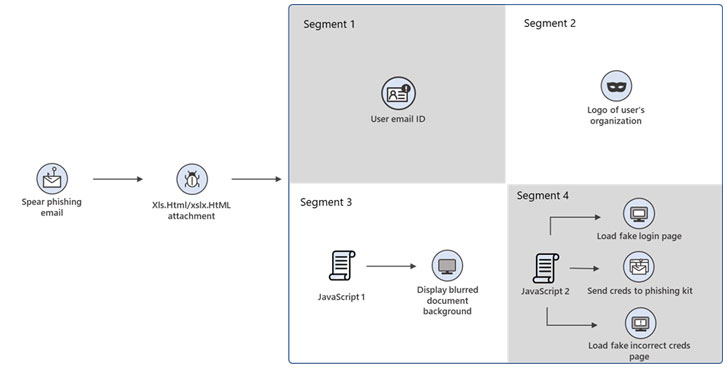
Opening the attachment launches a browser window that displays a
fake Microsoft Office 365 credentials dialog box on top of a
blurred Excel document. The dialog box shows a message urging the
recipients to sign in again due to reasons that their access to the
Excel document has purportedly timed out. In the event the user
enters the password, the individual is alerted that the typed
password is incorrect, while the malware stealthily harvests the
information in the background.
The campaign is said to have undergone 10 iterations since its
discovery in July 2020, with the adversary periodically switching
up its encoding methods to mask the malicious nature of the HTML
attachment and the different attack segments contained within the
file.
Microsoft said it detected the use of Morse code in the attacks’
February and May 2021 waves, while later variants of the phishing
kit were found to direct the victims to a legitimate Office 365
page instead of showing a fake error message once the passwords
were entered.
“Email-based attacks continue to make novel attempts to bypass
email security solutions,” the researchers said. “In the case of
this phishing campaign, these attempts include using multilayer
obfuscation and encryption mechanisms for known existing file
types, such as JavaScript. Multilayer obfuscation in HTML can
likewise evade browser security solutions.