
WhatsApp on Friday announced[1]
it will roll out support for end-to-end encrypted chat backups on
the cloud for Android and iOS users, paving the way for storing
information such as chat messages and photos in Apple iCloud or
Google Drive in a cryptographically secure manner.
The feature, which will go live to all of its two billion users
in the coming weeks, is expected to only work on the primary
devices tied to their accounts, and not companion devices such as
desktops or laptops that simply mirror the content of WhatsApp on
the phones.
While the Facebook-owned messaging platform flipped the switch
on end-to-end encryption (E2EE) for personal messages, calls, video
chats, and media between senders and recipients as far back as April 2016[2], the content — should a
user opt to back up on the cloud to enable the transfer of chat
history to a new device — wasn’t subjected to the same security
protections until now.
“With the introduction of end-to-end encrypted backups, WhatsApp
has created an HSM (Hardware Security Module) based Backup Key
Vault to securely store per-user encryption keys for user backups
in tamper-resistant storage, thus ensuring stronger security of
users’ message history,” the company said in a whitepaper.
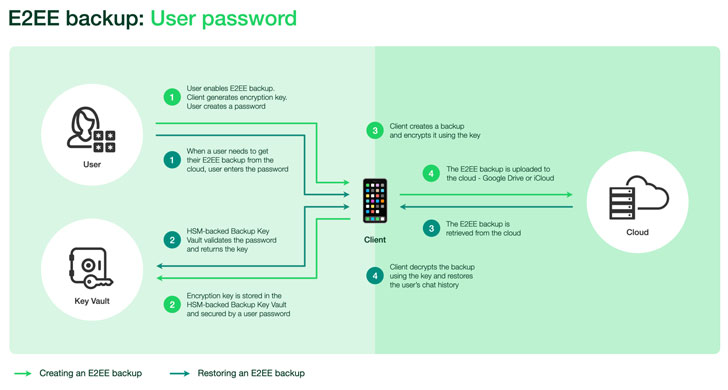
“With end-to-end encrypted backups enabled, before storing
backups in the cloud, the client encrypts the chat messages and all
the messaging data (i e text, photos, videos, etc) that is being
backed up using a random key that’s generated on the user’s
device,” it added.
To that end, the key to encrypt the backup is secured with a
user-furnished password, which is stored in the vault to permit
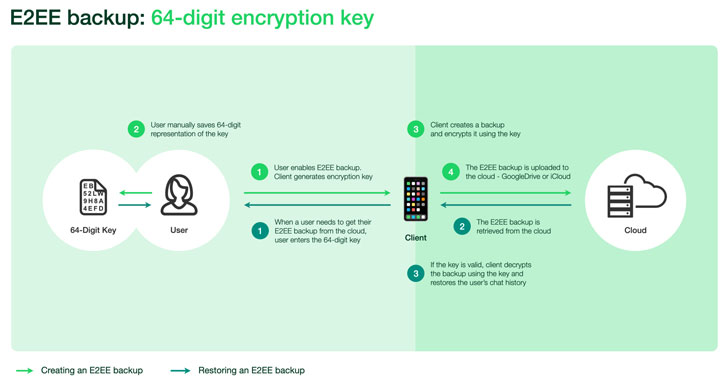
easy recovery in the event the device gets stolen. Alternatively,
users have the option of providing a 64-digit encryption key
instead of a password — but in this scenario, the encryption key
will have to be stored manually given that it will no longer be
sent to the HSM Backup Key Vault.
Thus when an account owner needs access to their backup, it can
be done so with the help of the password or the 64-digit key,
which, subsequently, is employed to retrieve the encryption key
from the backup key vault and decrypt their backups.
The vault, in itself, is geographically distributed across five
data centers and is also responsible for enforcing password
verification as well as rendering the key permanently inaccessible
after a set threshold for the number of unsuccessful attempts is
crossed so as to safeguard against brute-force attacks to retrieve
the key by malicious actors.
Unencrypted cloud backups have been a major security loophole
using which law enforcement agencies have been able to access
WhatsApp chats to gather incriminating evidence pertaining to
criminal investigations. In addressing this escape outlet, the
company is once again setting itself[3]
on the warpath with governments[4]
across the world, who have decried Facebook’s decision to introduce E2EE[5]
across all of its services.
Facebook has since adopted[6]
E2EE for Secret Conversations on Messenger and recently extended the feature[7]
for voice calls and video calls. In addition, the social media
giant is planning a limited test of E2EE for Instagram direct
messages.
“WhatsApp is the first global messaging service at this scale to
offer end-to-end encrypted messaging and backups, and getting there
was a really hard technical challenge that required an entirely new
framework for key storage and cloud storage across operating
systems,” said[8]
Facebook’s chief executive Mark Zuckerberg in a post.
References
- ^
announced
(engineering.fb.com) - ^
as far
back as April 2016 (signal.org) - ^
setting
itself (thehackernews.com) - ^
with
governments (www.fbi.gov) - ^
introduce E2EE
(about.fb.com) - ^
adopted
(signal.org) - ^
extended
the feature (thehackernews.com) - ^
said
(www.facebook.com)