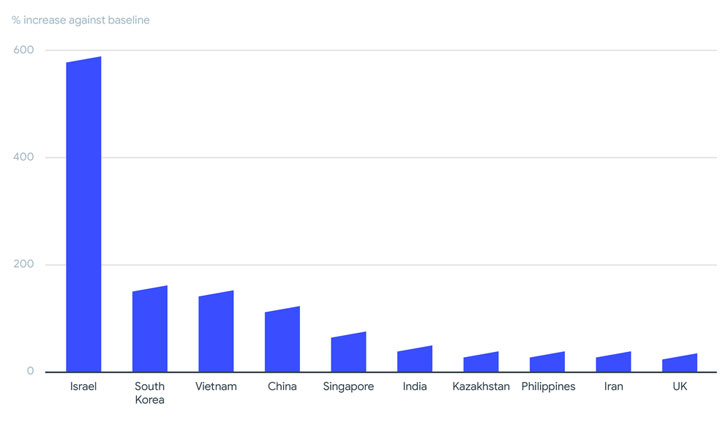
As many as 130 different ransomware families have been found to
be active in 2020 and the first half of 2021, with Israel, South
Korea, Vietnam, China, Singapore, India, Kazakhstan, Philippines,
Iran, and the U.K. emerging as the most affected territories, a
comprehensive analysis of 80 million ransomware-related samples has
revealed.
Google’s cybersecurity arm VirusTotal attributed a significant
chunk of the activity to the GandCrab ransomware-as-a-service
(RaaS) group (78.5%), followed by Babuk (7.61%), Cerber (3.11%),
Matsnu (2.63%), Wannacry (2.41%), Congur (1.52%), Locky (1.29%),
Teslacrypt (1.12%), Rkor (1.11%), and Reveon (0.70%).
“Attackers are using a range of approaches, including well-known
botnet malware and other Remote Access Trojans (RATs) as vehicles
to deliver their ransomware,” VirusTotal Threat Intelligence
Strategist Vicente Diaz said[1]. “In most cases, they
are using fresh or new ransomware samples for their campaigns.”
Some of the other key points uncovered in the study are as
follows —
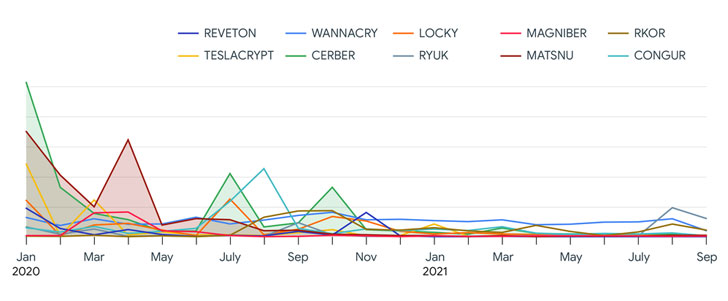
- GandCrab accounted for most of the ransomware activity in the
first two quarters of 2020, with the Babuk ransomware family
driving a surge of infections in July 2021. - 95% of ransomware files detected were Windows-based executables
or dynamic link libraries (DLLs), while 2% were Android-based. - Around 5% of the analyzed samples were associated with exploits
related to Windows elevation of privileges, SMB information
disclosures, and remote execution. - Emotet, Zbot, Dridex, Gozi, and Danabot were the primary
malware artifacts used to distribute ransomware.
The findings come in the wake of a relentless wave of ransomware
attacks aimed at critical infrastructure, with cybercriminal gangs
aggressively pursuing victims in critical sectors, including
pipeline operators and healthcare facilities, even as the landscape
has witnessed a continuous shift wherein ransomware groups evolve,
splinter, and reorganize under new names, or fall off the radar to
evade scrutiny.
If anything, the explosion of new malware families has drawn new
actors into participating in these lucrative schemes, turning
ransomware into a profitable criminal business model.
“While big campaigns come and go, there is a constant baseline
of ransomware activity of approximately 100 ransomware families
that never stops,” the report said. “In terms of ransomware
distribution attackers don’t appear to need exploits other than for
privilege escalation and for malware spreading within internal
networks.”