
Cybersecurity researchers on Tuesday took the wraps off a mass
volume email attack staged by a prolific cybercriminal gang
affecting a wide range of industries, with one of its
region-specific operations notably targeting Germany and
Austria.
Enterprise security firm Proofpoint[1]
tied the malware campaign with high confidence to TA505[2], which is the name
assigned to the financially motivated threat group that’s been
active in the cybercrime business since at least 2014, and is
behind the infamous Dridex banking trojan and other arsenals of
malicious tools such as FlawedAmmyy, FlawedGrace, Neutrino botnet,
and Locky ransomware, among others.
The attacks are said to have started as a series of low-volume
email waves, delivering only several thousand messages in each
phase, before ramping up in late September and as recently as
October 13, resulting in tens to hundreds of thousands of
emails.
“Many of the campaigns, especially the large volume ones,
strongly resemble the historic TA505 activity from 2019 and 2020,”
the researchers said. “The commonalities include similar domain
naming conventions, email lures, Excel file lures, and the delivery
of the FlawedGrace remote access trojan (RAT).”
The group has a track[3]
record[4]
of striking research institutes, banks, retail businesses, energy
companies, healthcare institutions, airlines, and government
agencies for profit-seeking motives, with the malicious activities
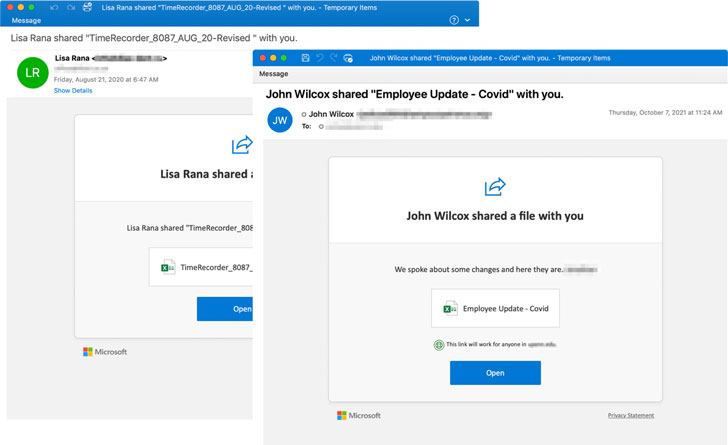
typically commencing upon opening malware-laced attachments in
phishing messages purported to be related to COVID-19 updates,
insurance claims, or notifications about Microsoft OneDrive shared
files.
“Over time, TA505 evolved from a lesser partner to a mature,
self-subsisting and versatile crime operation with a broad spectrum
of targets,” NCC Group said in an analysis[5]
published in November 2020. “Throughout the years the group heavily
relied on third party services and tooling to support its
fraudulent activities, however, the group now mostly operates
independently from initial infection until monetization.”
The success of the latest campaign, however, hinges on users
enabling macros after opening the malicious Excel attachments, post
which an obfuscated MSI file is downloaded to fetch next-stage
loaders before the delivery of an updated version of the
FlawedGrace RAT that incorporates support for encrypted strings and
obfuscated API calls.
FlawedGrace[6]
— first observed in November 2017 — is a fully-featured remote
access trojan (RAT) written in C++ that’s deliberately designed to
thwart reverse-engineering and analysis. It comes with a roster of
capabilities that allow it to establish communications with a
command-and-control server to receive instructions and exfiltrate
the results of those commands back to the server.
The actor’s October attack wave is also significant for its
shift in tactics, which include the use of retooled intermediate
loaders scripted in unusual languages like Rebol[7] and KiXtart[8] in place of Get2[9], a downloader previously
deployed by the group to perform reconnaissance, and download and
install final-stage RAT payloads.
“TA505 is an established threat actor that is financially
motivated and known for conducting malicious email campaigns on a
previously unprecedented scale,” Proofpoint said. “The group
regularly changes their TTPs and are considered trendsetters in the
world of cybercrime. This threat actor does not limit its target
set, and is, in fact, an equal opportunist with the geographies and
verticals it chooses to attack.”
“This combined with TA505’s ability to be flexible, focusing on
what is the most lucrative and shifting its TTPs as necessary, make
the actor a continued threat,” the cybersecurity firm added.